Skip the Resolutions and Pass the Gravy

 “I finally figured out the only reason to be alive is to enjoy it.” 
― Rita Mae Brown

“Enjoy life. There’s plenty of time to be dead.” 
― Hans Christian Andersen

“Do anything, but let it produce joy.” 
― Walt Whitman (Leaves of Grass)

“You’re looking at the waves, but ignoring the sea.”  ― Rumi


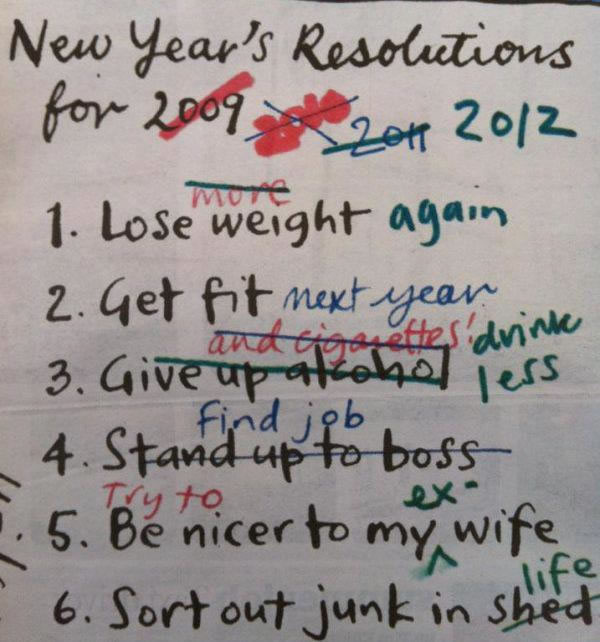
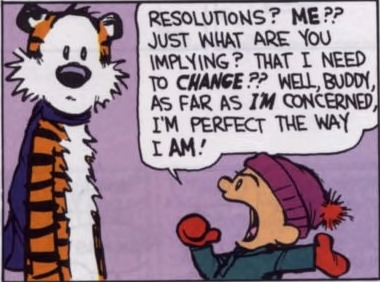
It’s that time of year once again when people are asking, “What’s your plan for 2018? What New Year’s resolutions did you make?”

My inner Sassy Girl is tempted to reply: “I’m giving up pinochle.” Or, “I’m swearing off glyphosate as a salad dressing.” But as most of these folks are friends (let’s face it—who else really cares what’s going on with you?), I give them the straight truth with a solemn face: I didn’t make any resolutions. I don’t have a plan. 

Which is just a tiny bit disingenuous because that is my plan.

Like 320 million other ordinary Americans, I’m always trying to figure out how to do this thing called Life. Lacking a roster of servants to do my bidding, and having never purchased a winning lottery ticket, I’m left to struggle with the eternal question: How the hell do I fit everything into the narrow confines of a 24-hour day?  The stuff I’m passionate about—writing, family, political action. The daily drudgework like dishes and laundry. The unending avalanche of forms/bills/notices that if not filed/paid/answered may result in a stiff penalty. Or a short jail sentence.

And sometimes I just need to sleep.

Resolution Madness

The single uniting force in the human race appears to be our mania for resolutions. If we share nothing else, come January 1, we all want to: 1) get in shape; 2) be more productive, and 3) manage the stress caused by #s 1 and 2.

Googling the subject, I see that 50 is THE number to shoot for this year. Fifty New Year’s resolutions came up more than once on my search. Ay caramba! Well, I suppose it seems less daunting than, say, 100, but it’s still madness. I mean, you’re gonna need a lot more than a Fitbit to keep track of that load. By the time I hit #16 (Get a Side Hustle) on the first 50-List, my head was exploding.

But it’s not just the number of resolutions these lists propose, it’s the scope. A second 50-list suggested the reader:

(#3) stop procrastinating—LOL, if we could do that, we wouldn’t need resolutions;

(#17) have better sex (Is there a meter for this? A checklist?);

(#22) get out of debt—has someone volunteered to pick up my tab?

(#33) re-invent yourself. This last strikes me as redundant. If I took up resolutions #1-49, there’d be no need to re-invent myself. I would be unrecognizable. 

For some reason, “drink more water” was a featured item on every list. Turn on the tap already.

Not every catalog of resolutions was so Herculean. Number one on Alexia Dellner’s list “Start your day with a really good stretch” felt both attainable and non-invasive.

Scroll down to #14: “Stop doing one thing.”

Ah, now we’re getting somewhere!

Andrea, dear soul, like a mom holding out dessert for last, dishes up major relief with #50: Cut yourself some slack.

Amen. That’s my kind of list. Stop doing. Lie down. Let sanity find you.

Sisyphus 0; Rock 100  

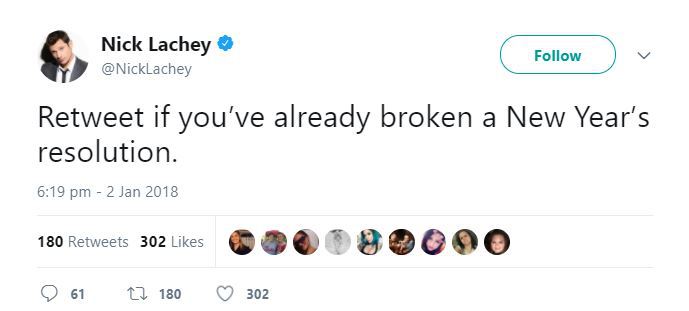
The thing, as it turns out, is that though we’re resolution junkies on the front end, we suck at keeping them. It’s a true Sisyphean situation. The rock doesn’t just roll back down that hill. It flattens us. According to usnews.com, 80% of resolutions fail by the second week of February. All that remains is the $1,995 you still owe on that Peloton Indoor Exercise Bike.

Researchers at the University of Scranton don’t even give us that much staying power. They claim that the resolution success rate is in the single digits. Eight percent to be exact. People, I don’t have to tell you this is not a flattering portrait.

Or—and this is the explanation I favor—perhaps we were never meant to be like that Timex watch in the old ads. The one that takes a lickin’ (by an 18-wheeler!) and keeps on tickin’. We are human beings. We have needs: Food, water, sex, online solitaire.

According to the Huff Po, there are numerous reasons why we fail the resolutions test in such astounding numbers, but they basically boil down to the same thing: A serious lack of realism in the expectations department. Vowing “I’ll never eat sugar again when a) you love sweets, and b) you love sweets, is like swearing you’ll never take another breath until we have someone sane in the White House. However noble your intention, it’s a doomed mission from the start. 

Case in point—one familiar to all writers—the ambitious plan to work on your novel 10 hours a day and/or resolving to pen 5,000 new words before each sunset. If you live in a monastery, where all you have to do is pray and someone prepares your meals, you might make it, but if you have a family, a job, a house, I can tell you from experience: It’s not happening. As Forbes noted: The average person has so many competing priorities that extreme life makeovers sink faster than the Titanic.

Enough Already with the Straitjackets

This post actually started with me considering a “plan” proposed by another self-employed blogger: Do one thing each day. Just that. This resolution grabbed my attention because it sounded so sane. Blog on Monday. Write on Tuesday, Thursday, and Friday.  Do household stuff and errands on Wednesday. Rest on the weekend. I could feel my anxiety level plummeting in the clarity and simplicity of the idea. Like the sound of those miniature desk fountains people buy to soothe themselves in the midst of utter chaos.

But then I realized that’s just trading one kind of to-do list for another, and to paraphrase Jackie DeShannon’s 1965 hit (“What the World Needs Now”): Lord, we don’t need another to-do list. Which is what resolutions really boil down to.

I’m a putterer. The thing I treasure most—what truly floats my boat—is to look at a day on the calendar and see nothing penciled in. This is a day to do with as I please, and I can make it all about one big project or several smaller projects. I can go to the gym or grab my honey and head out for a day of adventure. I can paint the kitchen or write a short story. Nothing kills a day for me more than getting up and realizing I’m straitjacketed into must-do tasks from dawn until lights out.

My plan—the one that isn’t a plan—is to minimize those strait-jacket days.

Carpe Diem

Last summer, I started cataloguing my books—all my books—a massive project that evolved out of a deep desire to stop purchasing copies of books I already own (I’m aware this makes sense only to my fellow book junkies). Whenever I got the chance, I would enter a shelf of titles/authors on my laptop. For someone who lives in a smallish house, I have an astounding number of books. Anyway, the project proceeded slowly. I was always promising myself I’d “reward” myself with cataloging a shelf after I wrote the next chapter of the novel or the next short story. After I’d penned the next blog post or researched a few more lit-mags and agents. After I finished weeding the garden or …

Surprise! The moment I could get to my cataloging project almost never happened. Ditto for playing my guitar or trawling for creative recipes. I was like the kid who dutifully eats her dinner day after day but never gets dessert. Feeling I had to cross off everything on a to-do list the length of War and Peace made me resentful. I felt like one of the Morlocks in The Time Machine, slaving away in the dark underground, the surface world something I glimpsed the light of only rarely.

So, I switched things up. In the week between Christmas and New Year’s this year, I gave myself a rare treat: I left my days completely open. This doesn’t mean I did nothing. I actually accomplished quite a few things, but I chose each activity in the moment, and only worked at a task until I felt my energy for it fading. The sense of possibility in each day energized me. Not having a to-do list calmed me. Gone was the stress of cramming, cramming, cramming. As my resentment faded, my focus sharpened. I finished the cataloging project (yay!). I also wrote this post, penned several new chapters of my novel and revised others, cleaned out dresser drawers, read one book and started another, watched several movies, cleared the mess on my desk, caught up with all my correspondence. All without forcing or fretting or rush.

A Different Kind of List

As someone who has earned a living writing and editing for much of my adult life, I’m no stranger to deadlines, and I’ve never missed one. But I don’t use a list to whip me to the finish line. Instead, I look at the scope of a project, estimate the total number of half-day units it will take to complete, add 2-4 more units because you never know what surprises lurk, in the project itself or in life, and count backward from the due date. I like the flexibility of this system. It leaves me time to write fiction. It allows me to work all day one day and skip the next if circumstances demand it or I’m just chomping at the bit for some free rein.

But we’re all individuals, so if you feel naked without a list (or a resolution), resolve to try this one: The Got-Done List. Got-done lists are not about the non-stop push to cross off task after task. They’re not about the relentless spur in the side that keeps you running until you drop, always short of some hoped-for finish line.

In her book Overwhelmed: Work, Love and Play When No One Has the Time, Brigid Schulte talks about the weight many of us suffer from overloaded to-do lists, how it steals our happiness, slows our productivity, and damages our health. Schulte calls this state “The Overwhelm.” Got-done lists are about throwing off that weight and celebrating what we did achieve rather than ruing what we haven’t (yet) accomplished.

Research supports Schulte’s claims. Studies find that focusing on what we have achieved motivates us, makes us more creative, enhances problem-solving, and just plain adds to our happiness.

“I spend a few minutes at the end of the day writing down what I accomplished successfully,” says Nada Arnot, chief marketing officer of Qubed Education. “It’s rewarding and empowering to focus on what I did, rather than on what I didn’t do, which can be both stressful and demoralizing.”

I hear you, Nada!

So I’m sticking to my plan that isn’t a plan. Following my heart and letting the dust bunnies blow where they may. I’ve got living to do.

(Crank this one to the rafters and never forget what it is to hold the possibilities of your life in your hands.)

I Still Holler

“It always seems impossible until it’s done.”   Nelson Mandela


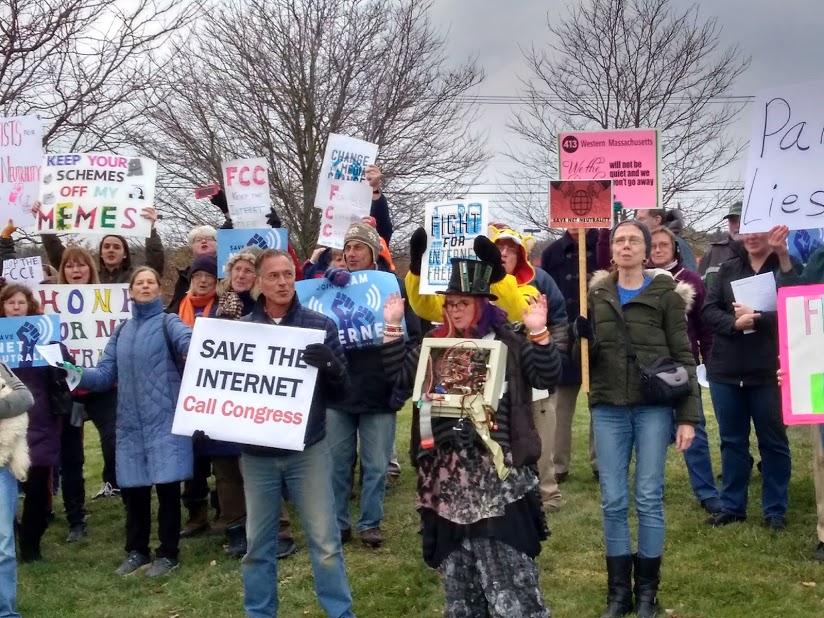
It’s two-and-a half weeks before Christmas. I’m standing in the parking lot of my local Verizon store. To be precise, I’m standing on the soggy, grassy strip that separates the paved lot from the onrushing traffic of Route 9. It’s a good place to be if you’re wielding, as I am, a sign that says “Save Net Neutrality.”

Earlier today, the sun was out, sort of, but now it’s 4:00 p.m. Darkness is descending and the temperature’s in free fall. I’m a veteran of these things. I should have remembered to wear two pairs of socks. But despite the teeth-chattering cold and the marshy ground, I’m good because I’m not alone. There’s a hundred or so of us out here, waving our signs at the passing cars, and there are lots of cars. The Verizon store is situated between two malls and just down the road from the University of Massachusetts, Amherst. People honk and wave wildly, opening their car windows in the freezing air to give us a thumbs-up in solidarity.

“Net Neutrality is Free Speech!” we shout. “Hey, hey. Ho, ho. Ajit Pai has got to go!”

This is what democracy looks like.

The Crazy That Was 2017

2017 has been a tumultuous year. To quote Dickens, It was the best of times; it was the worst of times.

The awfulness is easy to identify:

The Muslim travel ban.

The elevation of pro-Nazi groups and their rhetoric of hate.

The silencing of scientists and the dismantling of EPA regulations. 

The deportation of Dreamers.

The repeated threats to our healthcare. (Trump’s monkeying with payments to states has resulted in higher premiums for everyone.)

Attacks on our first amendment rights.

Attacks on women, LGBTQ folks, and all people of color.

The proposed drilling of the Arctic, and the doling out of national monuments/public lands like candy to fossil fuel magnates.

The baiting of North Korea’s volatile, psychopathic leader by our own volatile, psychopathic leader.

A slew of appointments for far-right racist, sexist, homophobic, anti-environment federal judges—a legacy which we’ll suffer for the next four decades.

And that’s the short list.

What can you say about a country where an accused child-molester was in serious contention for a seat in the Senate?

A country where the Speaker of the House wets his pants at the prospect of dismantling Social Security and Medicare, reducing millions of Americans to starvation, homelessness, and premature death.

A country where thousands of disabled Americans fill the halls of Congress, pleading “Kill the [tax reform] bill! Don’t kill us!”, only to be ousted from their wheelchairs and dragged out by cops.

During the Geo W. Bush years, it often felt like we were fighting some Medusa. For every threat we battled, two more appeared with lightning speed. I remember thinking, “Crikey, does this guy ever take a rest?” Little did we know Bush was just the warm-up act.

David S. Graham nailed it in The Atlantic : “[The Trump] administration has set a new standard for chaos and dysfunction.”

A word to the wise: Never ask what else can go wrong.

The Best of Times

So, what’s the upside to this mayhem you might well ask. As Francoise Stovall, Digital Director for Every Voice, noted: “I’ve protested, I’ve called, I’ve signed, I’ve knocked, I’ve rallied, I’ve organized – but it can still be hard not to get discouraged or feel hopeless that our democracy is under attack or that one person can’t make a difference.”

The upside is that it’s not just you or me battling the behemoth. It’s millions of us. The continual onslaught of threats to our civil rights, first amendment protections, and democracy itself has gotten us out of our armchairs and into the streets. We are organizing and mobilizing and raising our voices from Maine to California. From the Women’s March, which drew an estimated 4,000,000 people, to protests against the Muslim travel ban at airports across the country. From noisy denunciations of Republican fake healthcare bills at Town Halls to packing the halls of Congress in outrage against the current tax-bill scam.

Driving home from the Net Neutrality action, I felt energized and hopeful and, yes, happy. Standing with a hundred other people—shouting If they take away net neutrality, Corporations will control what you see!, and getting lots of positive feedback from passersby—gives you strength. Makes you part of something positive and powerful. Reminds you that you don’t have to fight this alone. We’ve got each others’ backs.

The Proof is in Your Inbox

 For proof that our collective fight for our democracy is working, you need only to consult your Inbox. Two notes I received today:

Thank you, thank you, thank you! Because of you, two of Trump’s radically extreme judicial nominees, Jeff Mateer and Brett Talley, had their nominations withdrawn today. This victory would not have been possible without supporters and activists like you who signed petitions, bombarded senators with calls, donated, and shared information about why these nominees were completely unfit for lifetime seats.

                                                           : People For the American Way (PFAW)

I’m excited to share that the outpouring of public pressure from UCS supporters like you has worked. Together, we successfully defeated Michael Dourson, President Trump’s dangerous pick to lead the Environmental Protection Agency’s (EPA) Office of Chemical Safety and Pollution Prevention. This is a victory for science and the safety of families throughout the country—and it wouldn’t have been possible if thousands of people like you didn’t speak out.

: Union of Concerned Scientists

We must be the change we wish to see, and we are being it.

The Long Arm of the Law
Stephen Carr / Daily Breeze / SCNG )

When I was a young punk, I associated “lawyer” with other evils like “Nixon” and “Agent Orange.” But life has shown me that “lawyer,” like “satisfaction guaranteed,” is a relative term. Which lawyers are we talking? The ACLU? Lambda Legal? The SPLC (Southern Poverty Law Center)? These are the heroes out there, protecting in court the democratic values we fight for in the streets. “We’ve got lawyers on the ground” has become a balm to my jangled nerves.

The Boston Globe reported that Trump has been sued 134 times in federal court since he took office—lawsuits that erupted over the Muslim travel ban, violations of the Emoluments Clause (Trump’s private profiteering from the presidency), and the attempted ban on transgender people serving in the military.

But that tally only takes us up to last May. Add to it the subsequent litigation concerning the rights of Dreamers (DACA), proposed drilling in the Arctic, sexual harassment, Trump’s (unconstitutional) plot to reduce and sell off national monuments/public lands, and you’ve got quite the list. The Center for Biological Diversity, alone, has filed 40 lawsuits. And just yesterday, New York Attorney General, Eric Schneiderman, tossed his hat in the ring when he announced a multi-state lawsuit against the FCC, challenging their December 14 repeal of net neutrality.

Conservative lawyer Jonathan Turley fumed, “Every group, every aggrieved person, is filing lawsuits.”

“If every aggrieved person is indeed filing suit, then the president can expect a good deal more,” Caroline Hallemann wryly observed in her article for Town & Country.

Out of the Darkness, Into the Light

In the past year, the volume of e-mails I get has almost doubled. It’s running around 600 a day. And then there’s the text alerts. All of it begging me to please stop whatever I’m doing now and save this, sign that, call my senators, my rep, write a letter, submit a public comment. Top that off with the many calls to action: Be here to fight this/that in the rain, the snow, the cold, the heat, weekends, holidays.

I do my best to keep up with it all, but I must confess there are moments I resent the time these unending requests take from my writing, from relaxing with friends and family, from reading and gardening, from dreaming. I’ve been marching and protesting and fighting the good fight since I was a student in the 1970s. When do I get the time to live my life, pursue my goals? And then I realize, this is my life—this is what matters—and I am living it. So, I must keep hollering for what I value. For justice. For democracy. For the preservation of the planet.

Two years ago, my stepdaughter gave me an orchid plant. It cycled through a series of blooms until this past July when the petals fell away and then …nothing. A friend advised me to cut back the old stem and continue regular watering. A new stem, she assured me, would appear in time. Last week, it finally sprouted. I know it will be some weeks though before buds appear and more time still before they blossom. I just have to keep watering.

Fighting the good fight is like that. It’s not enough to sit in a corner and hope. Like my orchid, hope needs active tending. And sometimes it’s a long wait. Last week, though, Doug Jones defeated accused child molester Roy Moore for the Alabama senate seat vacated by now Attorney General Jeff Sessions. Jones, as the U.S. Attorney for the Northern District of Alabama, brought to justice the two remaining Klansmen responsible for the 1963 bombing of an Alabama church that killed four young black girls. In his victory speech, Jones quoted Martin Luther King, Jr.: The arc of the moral universe is long but it bends toward justice.

The arc doesn’t bend toward justice by some magic, but from our collective actions. And that’s possible because, as Anne Frank so poignantly noted in her diary, there truly are more good people than soulless scoundrels in this world.

Tomorrow is the winter solstice, the turn of the earth from darkness toward the light. People in every culture celebrate this as a moment of renewal, of hope. In a blog post written right after the 2016 elections, I quoted D.D. Guttenplan: If we withdraw into our grief and abandon those most threatened by Trump’s win, history will never forgive us.

So, as we head into 2018, I’m still here. I still holler. Let’s get together and make some noise.

Peace on Earth. Happy Holidays.

  (And now a little “Holiday Cheer” guaranteed to put a smile on your face.)


Sometimes a Cigar Is (Should Be) Just a Cigar

“Simplicity, simplicity, simplicity! We are happy in proportion to the things we can do without.” (Henry David Thoreau)


I’m about to say something so heretical, I can already hear the gasps of disbelief and nervous laughter all the way from the West Coast:

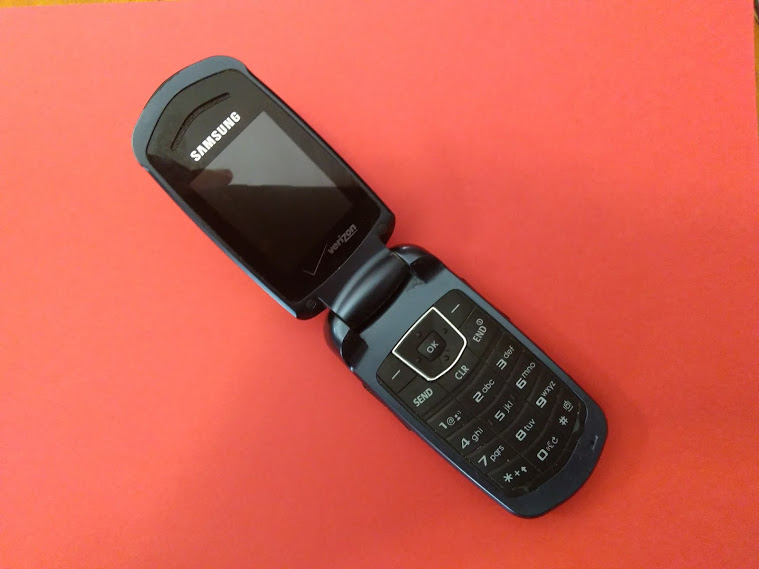
I miss my old flip phone.

That’s right. I miss my Verizon Samsung flip phone with its archaic texting set-up (no separate keyboard) and its crap camera that was really only good for taking close-ups of your jean-clad arse if you left the phone in your back pocket when you sat down. This last is more of a guy thing. Somewhere, I feel certain, there are men with online photo albums composed entirely of their denim-covered derrières.

Before you do an eye roll and dismiss my flip-phone fetish as “one of those old people things,” I would like to direct your attention to a story on Time.com about millennials who still use and prefer flip phones. According to a survey cited in the article, 13% of 25-34 year olds like their flip phones, and—this will really blow your mind—an even greater number (15%) of 18-24 year olds are flip-phone users.

Does this mean the phone-that-is-just-a-phone is poised to make a comeback? Can it be that people are searching for something more meaningful to do with their lives than snapping selfies? If only.

Okay, confession: The Time story is from 2014, but that’s not so ancient. Everyone reading this post was already alive in that year. In a different sense, though, 2014 does seem like another lifetime, an existence I dimly recall when people still went out to the movies and someone sensible was at the helm of the government. Sigh.

But Ame, I hear you saying, why do you yearn for that crappy little flip phone? Don’t you love that you can drain your bank account in an afternoon of frenzied shopping simply by tapping your sexy new Smartphone on that little white cube? Hasn’t it qualitatively enriched your existence now that you have a keyboard that anticipates—rightly or wrongly—every next word you wish to text? That you have a world of .gifs at your fingertips? Or apps like Android’s Flush Toilet Finder, and Is It Dark Outside which, I kid you not, tells you whether … it’s dark outside.

Okay, I know smartphones make it easy to bank online from anywhere, check the weather in Dubai, or pinpoint a leaky window.  And yet … I long for a phone that does only one thing: Be a phone. And here is why.

Multitasking is the fast track to insanity.     

Psychologists have pretty well debunked the efficacy of that 1980s’ Type-A wet dream, multitasking. Turns out that though you may be able to do two things at once, say, walk and chew gum, you cannot concentrate on two things at the same time. 

Even those who haven’t entirely forsaken multitasking acknowledge that it’s both a time and energy drain. It takes us about 15 minutes to mentally switch tasks, and there’s a certain amount of cerebral friction that comes from dealing with multiple distractions. The day flies by without much to show for it. To boot, your brain may become addicted to this state of distraction. Bye-bye focus.

My old flip phone never invited me to watch an episode of Stranger Things while tweeting to friends and playing Super Mario Run. It was just there when I needed to tell someone my car had broken down at a major intersection during rush hour.

I am not a Finger Monkey. 

Critic Anne Billson, recently declared: “People who watch movies on phones (especially if they think they can leave valid critical comments on imdb) should be shot.”

While I do find this a tad harsh, it should be noted that Anne made her comment on Twitter, a medium known for encouraging impassioned, if not always well-considered, reactions. But beneath the emo, she makes a good point: No one is going to watch Magnolia or Schindler’s List—both clocking in at 3+ hours—on a screen measuring 2¼ x 4 ¼ inches, a size suited to Finger Monkeys and  Pygmy Rabbits, but not people.

Nor are readers likely to scroll through War and Peace (1,296 pp.) or Infinite Jest (1,079 pp.). I could barely get through the Wiki article on kangaroos I used as a test case for the “ease” of reading on a Smartphone.

Reading is made for curling up in a large, comfy chair, or nestling among piles of pillows, snug beneath the blankets in bed. It’s about the feel of paper beneath your fingers as you turn the pages, and reveling in a wealth of words you don’t have to squint to decipher.

Brevity may be the soul of wit but it’s murdering journalism.

“Old person! Old person!” I hear you shouting.

Not so fast. While it’s true I won’t see 20 again in this lifetime, a wealth of decades provides (along with wrinkles) a useful yardstick to measure change. I used to freelance as a magazine writer, and I watched the average length of articles shrink from pages to paragraphs to 500-word blurbs as increasing numbers of publications went online. It became impossible to make a decent living writing pay-per-word. I continue to subscribe to The Atlantic because it still publishes articles worthy of the name, with stuff like well-researched content and in-depth analysis.   

In a Slate.com article, Jack Shafer cites a revealing study which found that people who get their news from print sources “remember significantly more news stories than online news readers.” Print readers also recall significantly more topics and remember more main points. Only when it comes to recalling headlines does the online crowd match print readers.

Shafer, who cancelled his own print subscription to the New York Times, lured by the sexy design of the online version, was back to home delivery within a year. “What I really found myself missing was the news,” he explains. “Even though I spent ample time clicking through the Times website… I quickly determined that I wasn’t recalling as much of the newspaper as I should be. Going electronic had punished my powers of retention.”

A paragraph here, a page there—what is this thing I’m reading?

A reviewer on Goodreads lamented that more and more books are making less and less sense. Half-baked plots. Twists that don’t stand up to scrutiny. Cardboard characters with incomprehensible motivations. She wondered how so many of these spotty reads were selling.

I wonder how many readers even notice.

I think “gaps” in a novel’s plot, structure, and characters reveal themselves readily when we read a printed book, but maybe not so much when we’re scrolling through a page or two while waiting on the subway platform, then scanning another half dozen paragraphs while standing in the checkout line at CVS. With the noise and movement of the world all around, who’s to really remember if Mrs. McGillicuddy was at the manor on the night of Lord Dudley’s murder, or if her name is actually Ms. McQuade and she dresses as Lord Dudley on her nights off from the massage parlor? Details—and sometimes entire plotlines—are easily lost in the flitter flutter of smartphone reading on the run.

I want a life apart from my phone.

In a 2014 Pew Research poll, 46% of smartphone owners reported “they couldn’t live without” their phone. Among millennials, 87% said their smartphones never leave their side.

Well, I can, and do, live without my phone much of the day, often leaving it in the jumble of notes and manuscripts on my desk, ignoring it until it rings.

I know it seems like the ultimate definition of personal freedom to head out into the world each day with nothing more than the clothes on your back and a phone that offers every app modern life requires, but I don’t want to reach for my smartphone each morning (as one user reported) to shut off the alarm and find myself automatically scrolling through my Twitter timeline.

In an age where nearly 40% of people under 35 interact more with their smartphones than they do with friends, family, or co-workers, I still enjoy going for a beer with friends or having dinner out with my husband—and talking to each other, nary a smartphone in sight.

I also like to take a walk or go for a bike ride without wires coming out of my head, my texting fingers idle by my side.

I like a thing to be just what it is.

Irony of ironies, a UK survey reports that making phone calls is not among the Top 10 uses we make of our smartphones. We are more likely to check email, trawl Facebook, shop online, watch YouTube videos, even check the weather than phone someone.

“I honestly can’t remember the last time I used my phone to call someone,” one user admitted. “I get incoming calls, but I usually just ignore them.”

As someone who has worked phone banks for political campaigns, I can attest to the truth of this statement. Almost no one picks up.

I like a thing to be what it is. Just that. I don’t want a stove that doubles as a dishwasher, or a microwave that also serves as a TV and hair dryer.

When I go to the gym, I take my iPod, not my phone. That’s because my iPod contains my workout  music. That’s all it does—play music—and I don’t want a perfectly good gym tune like “Build Me up Buttercup” to be interrupted by a text, or a notification that I’ve got 200 new messages in my Inbox. I go to the gym to get away from that.

On road trips (where I do carry a phone in case of breakdown), I use my portable Garmin GPS that sits on the dashboard. It does one thing: provides directions. Why do I prefer this geriatric invention to the Google Maps app? In a complex situation, like driving into New York City, I like to see the entire grid of streets and on-off ramps without having to take my eyes from the road or juggle my phone between my knees. Do I have to navigate five lanes or three? Will I need to bear left on the off ramp? That’s the beauty of something with only one purpose: All its components are geared toward doing that one thing well.

In a world of 2.2 million apps, where the number of smartphone users is expected to top 5 billion in 2019, I am certainly Don Quixote here, tilting at windmills. But there are worse characters to be, and I still think nothing is lovelier than a summer day on my deck, a warm breeze riffling the pages of the book I’m reading, a gin-and-tonic at my elbow. And if you should stop by, I’ll snap a photo of you. With my Nikon camera. That’s all it does—take pictures. I love it.

Keep Walking

The only journey is the one within.  (Rainer Maria Rilke)

ADD PARA HERE   December, the holidays—whatever one celebrates: Hanukkah, Christmas, Kwanzaa, Bodhi Day, the Solstice—are traditionally a time of peace, family, friends, joy, generosity, and hope. We count on this. We expect it to be so. Which makes the tremendous uncertainty of the present—the fears for the future of our democracy, our freedoms, our planet—all the more stressful. We humans struggle with uncertainty and yet, in truth, that’s all we ever have. So, how do we stay strong and be joyful in the face of the unknown?

In the interest of full disclosure, I’ll state upfront that I have often—half jokingly, half seriously—referred to life as a minefield. Running, running down the days, the years, in pursuit of life, liberty, and happiness. All the while, one eye out for those pesky tripwires, ducking, dodging the myriad hazards until I land on the one that blows me sky high, game over. An event, hopefully, far off in the misty future.

This is not as dark a characterization as it may sound. I would describe myself as a happy person. I have a major sense of whimsy. Love to laugh, love to joke. The minefield thing is more of a heads-up approach to the great unknown that greets us each morning. And the near-miss can be quite exhilarating, just as I imagine it is on a real battlefield.  Ha-ha, dodged that one! There’s a sense of inner strength. The ability to endure.

But what happens when we encounter one landmine after another—family illness, natural disasters, a precipitous drop in circumstances, a nutso president and his arsenal of threats? The constant state of high alert wears us out. When will there be good news? Can we make it to a place where we can draw a free breath?

Wisdom Through the Ages

As any trawl through Twitter will attest, most of us seem to have a need for guideposts. A map through the minefield, or at least a large supply of encouraging words.

Sometimes this encouragement wears a stiff upper lip:

F.E.A.R. has two meanings:

Forget Everything And Run

OR

Face Everything And Rise

The choice is yours.

(Andrea Shea/WBUR)

Sometimes, it appears as a balm to a wounded heart:

One small crack doesn’t mean that you are broken;

it means that you were put to the test and you didn’t fall apart. (Linda Poindexter)

Thomas Jefferson, in his famous “10 Rules of Life” suggested (Rule #9) that we Take things always by their smooth handle,

while Winston Churchill cut straight to the chase: If you’re going through hell, keep going.

Perhaps the most famous example of such words of wisdom—WOWs, we’ll call them—is the “Serenity Prayer,” written by theologian Reinhold Niebuhr, and made famous by Alcoholics Anonymous:

God, grant me the serenity to accept the things I cannot change,

Courage to change the things I can,

And wisdom to know the difference.

Sufi Poets, Hedgehogs, and Anxiety

My personal WOW comes from Jalal ad-Din Muhammad Rumi, the 13th-century Persian Muslim poet, scholar, and Sufi master. Rumi’s writing are beloved the world over. A 2014 BBC story hailed Rumi as America’s bestselling poet. That’s a longer run than Shakespeare can boast.

So what does some Sufi dude born in 1207 know about life in the 21st century? How does a poet who lived before the invention of the printing press speak to us who navigate the digital age?

Up top, I spoke of life as a trip through a minefield, always ducking and dodging as we race toward the hazy future. But, it’s more often a confused slog of uncertainty (as opposed to outright catastrophe), and uncertainty makes us anxious. Faced with a disaster, we tend to deliver: roll up our sleeves and get to work. Uncertainty, on the other hand, can paralyze. Like a hedgehog, we curl up in a ball and wait for clarity to strike. Or we stumble about, unfocused, grasping wildly at every straw.

And Rumi absolutely got this. You don’t need to be born in the age of the iPhone X to recognize our need to believe we run the show. Our craving to have control over our lives. It’s the most basic of all human tendencies. And yet, of course, we don’t. The folks in Puerto Rico couldn’t turn Hurricane Maria away from their shores. The concert-goers at the Route 91 Harvest Festival in Las Vegas couldn’t vanquish the bullets of a madman’s bump-stocked semi-automatic rifle.

Something Approaching Grace

So somewhere in my wanderings, I came across this verse from Rumi, typed it up in 24-point bold, and taped it to the bookcase by my desk:

Keep walking, though there’s no place to get to.

Don’t try to see through the distances,

That’s not for human beings. Move within,

But don’t move the way fear makes you move.

When the weight of uncertainty threatens to sink me, these lines tease my brain to look beyond the moment, to consider something outside my flailing angst. For almost two decades, I have sifted Rumi’s words for a way I can live with “what is” with something approaching grace. I’m still pondering, still learning. This is merely my interim report. What I’ve gleaned so far.

Keep walking, though there’s no place to get to.

We are creatures of ambition. We love to make plans, set goals, imagine ourselves moving smoothly from success to success. We crave “places to get to.” It is hard, hard, hard for us to move forward without these destinations to propel us. Like a person wandering the desert, plans and goals are the oasis we thirst for, a mirage always on the horizon, just over the next hill. We may get there, but rarely the way we imagine. And if we do, the reality of the mirage may be quite different to what we fantasized. As John Lennon said, Life is what happens to you while you’re busy making other plans. 

It’s not that plans and goals are bad or futile, but we need to recognize two things: 1) We create them. Our pictures of dazzling accomplishments and ideal lifestyles are self-imposed, the children of our own brain—they have no mandate in the natural world; 2) They can go south at any moment and often do.

If our happiness, our very ability to function, depends on getting into an Ivy League school, making partner at the law firm, or having our novel published by one of the “Big Five,” we make ourselves vulnerable to the vagaries of life. Ask anyone in Puerto Rico or the Virgin Islands. One day, you’re making breakfast, going to work, dreaming of the new motor scooter business you’re going to start this winter, just in time for tourist season, and the next day you’re homeless, stumbling about your hurricane-wrecked island, searching for drinkable water.

Rumi says keep walking. Walking is life.

Don’t try to see through the distances,

That’s not for human beings.

But we do try, over and over. We want to know what lies ahead. We want to shore up against any and all disappointments, disasters. We have no say about the circumstances of our birth, nor (discounting suicide) the hour of our death, so we scramble like hell between these endpoints to foresee the future, and prepare.

I don’t read this as we should do nothing with the knowledge we have at hand. Rather we do today what we can do, and let neither our hopes blind us to reality nor our fears cripple us. We join a campaign to get our town to commit to renewable energy. We donate to a legal fund to defend Dreamers. We write the next chapter of our novel. We study for the exam. The outcomes are unknowable. We can only act in the moment.

If you read this blog regularly, you know I’m a big fan of history, partly because I simply love stories, and partly because I want to understand the patterns of human behavior. Over the years, two key things have emerged for me:

1) Everything you have, including your life, can be taken from you at any moment. Think Nazis. Think ICE. Boko Haram or Czar Nicholas II. There are no guarantees, no talismans. The trick is to somehow acknowledge this truth while living each day with joy and generosity and hope. That is grace.

2) We tend to focus on the threats all around us. Survival instinct, no doubt. What we fail to see, cannot see in fact, is the thing that may happen to throw a monkey wrench into what looks like doom. The discovery of a vaccine for polio. The tiny island of Britain shutting down Hitler’s voracious advance, alone, for two years until America joined the fight. And there are people out there right now inventing plant-based plastics that won’t damage the environment, and high-tech sieves to render ocean water drinkable.

There is as much hope as threat in what we cannot yet see.

Move within,

But don’t move the way fear makes you move.

 Ah, this is the one I puzzle over most. I get the “don’t move the way fear makes you move.” Don’t delete your manuscript because 20 agents turned down your novel. Wake up tomorrow and query Agent #21, and if no one bites, ever, keep writing because it’s what you love. Don’t abandon fighting for a more humane and cooperative world because white nationalism is showing its ugly face across the planet and Trump is in the White House. Make phone calls to defend Dreamers. Raise your voice in Town Halls for diplomacy, not war. Bring a sick neighbor a meal. Give a stranger a genuine smile.

Okay, I get that. But what does it mean to “move within?” Within the limits of the day at hand?

Gandhi  said: “I do not want to foresee the future. I am concerned with taking care of the present. God has given me no control over the moment following.” Taking care of the present is good. It’s all we ever live, really.

Move within the confines of our own head? Change the perceptions that color how we view the world. The assumptions that drive our actions.

How would the quality of our life be different if we saw our mistakes not as failures but as practical wisdom gained? If we viewed setbacks not as insurmountable roadblocks but as opportunities to explore new and different paths?

What if we were to relish the journey of this day rather than tizzy over some imagined endgame?

To Look On Tempests

Searching these deceptively scant lines for Rumi’s meaning, meditating on his many subtle layers, has been comforting, energizing, life-affirming. Heeding it has been much harder. I still exist on the far side of grace, that state in which I can face the truth of each moment without panic, without despair. To look on tempests, as Will Shakespeare said, and remain unshaken.

To keep walking. Whatever.

(Still) Out of Control

The sword of murder is not the balance of justice.  (Julia Ward Howe)


In my salad days, I wrote news stories and theater reviews for The Lansing Star, an alternative indie rag. Eventually, I had a weekly column. A little soapbox all mine own of social/political commentary. From all that ink, I clipped and saved a few of the pieces that meant the most to me. After the recent carnage on the Vegas Strip, I took down my dusty box of tear sheets, and pulled this one, penned in January 1983. I believe you will recognize much from it.

Following the piece is a brief but telling update.

Out of Control (1983)

Two years ago, on December 8, 1980, John Lennon was murdered in front of his apartment house in Manhattan—shot five times in the chest and shoulder. He lost over 80% of his blood volume within seven minutes and was pronounced dead on arrival at St. Luke’s Roosevelt Hospital, just one mile away from his home.

John Lennon was killed by a .38 Charter Arms revolver, a fairly common type of handgun, especially favored for its rapid-fire capability. He never had a chance—before he could even turn to face the man who had called his name, all five bullets had been fired.

The media reacted to his murder as if on cue, pointing to all the assassinations over the last two decades. Camera operators zoomed in on tearful faces in the crowd outside the Dakota Apartments where Lennon had lived with his wife and son. Famous personalities were rounded up to explain, conjecture, expound upon the moment.

Time and Newsweek ran special sections on Lennon’s life and death, alongside articles calling for tougher gun laws.

“This will be the turning point,” prophesized singer-songwriter Harry Nilsson, a close friend of Lennon. “I think John’s death will do more for the cause of gun control than all the combined efforts of the past decade.”

The media had its week—tributes, memorials, rhetoric—and then we woke up one morning to find the newspapers had returned to Iran, the network news teams were once again consumed  with the economy. All the fiery speeches and inspired visions of a better world had been clipped, taped, and safely stored away by the historians.

Two years have passed and we are still on the dark side of that turning point Harry Nilsson and so many others spoke of. Around 20,000 more people have died since that night in December 1980—murdered by handguns on the streets of Detroit, New York, Chicago, and Lansing. The National Rifle Association (NRA) still runs one of the most powerful lobbies in Washington, DC. Nothing has changed.

We’ve been busy with other things since that time—tightening up on welfare, trying to stop Japanese imports, deregulating business, and building nuclear weapons. The seeming urgency for stricter gun control which inflamed the passions of so many in recent times is almost passé. Last month, the gun control proposal in California went down to a quiet defeat. Yet the long list of handgun victims continues to grow, untouched by a generation of assassinations and murders.

In Michigan, a state in which the NRA has seldom been pressed into any serious action to defend the faith, gun control and the prevailing attitude toward tougher legislation is summed up on the bumper stickers of many pickup trucks: You’ll take away my gun when you pry it from my cold, dead hands.

There is no notable movement dedicated to gun control in Michigan. The NRA and the Michigan United Conservation Club have succeeded with steamroller precision in flattening the few attempts Michigan legislators have proposed: a requirement that all gun owners pass a competency test, a call for a mandatory two-year minimum sentence for anyone having a handgun in their possession while committing a crime. Both proposals were conservative in scope—benign in terms of gun control legislation that would prohibit the manufacture, sales, and possession of all handguns.

Current handgun registration practices and requirements vary from state to state. “Registration” may mean nothing more than being able to sign your name in one state, while another state demands that you have a record clear of felonies for x-number of years. But variations aside, it is still frighteningly easy to purchase a handgun almost anywhere in this country. America is the land of cowboys, gunslingers, and the Marlboro Man.

The NRA expends great energy (and dollars) to convince people that the constitutional right to bear arms means private citizens have a right to carry handguns. They prey on the uneasy paranoia of people frightened by the rising rate of violent crime (paradoxically, of course, handguns are the major factor in these crimes)—people who feel unsafe and uncertain. Just a “small” gun in the house for protection—just in case. There are now over 50 million “small” handguns in circulation.

As for protection, the number of incidents in which Mr. Upstanding Citizen has successfully fended off the “bad guy” by wielding his .38 are so rare as to not be worthy of statistical count. The “little gun in the nightstand drawer” or “the little surprise under the cash register counter,” however, kills thousands of people each year, either through accidents or during heated family quarrels. These homeowners and shopkeepers whose thinking has been paralyzed by anxiety for their safety and the protection of their property, wittingly or unwittingly aid and abet the rampant violence in America. Violence begets violence. Fear and paranoia breed violence.   

There is only one solution that will stop the killing: A total ban on the manufacture, sale, and possession of handguns in the United States. Anything less is empty rhetoric. New Yorkers pointed out, after John Lennon’s death, that Mark Chapman could never have purchased his Charter Arms .38 in their state. The fact remains, however, that a gifted composer, poet, father, and husband died because Chapman could purchase a gun in Hawaii and bring it into New York.

The NRA is fond of saying that if guns are outlawed, only outlaws will have guns, but who are these outlaws? Chapman was not a criminal until he pulled the trigger. By the time the smoke has cleared, and a person has legitimately been branded an “outlaw,” there is another body in the morgue.

Murder may be in the heart but opportunity is in the weapon—the gun is the great equalizer. It cannot be turned away by physical strength or ingenuity as can a knife or lead pipe. The gun makes no distinction, shows no deference, nor does it need to. Anyone can shoot anybody at any time and, with the advent of exploding bullets, be fairly certain of firing a fatal shot.

In the week following Lennon’s death, there were pages upon pages written in favor of stricter gun control legislation in moving, eloquent, thoughtful prose. But I am reminded of Dallas, November 1963, of Bobby Kennedy and Martin Luther King, Jr.—and how we’re still eclipsed in darkness waiting for the turning point.

The View From 2017

1) In the almost 35 years since I wrote “Out of Control,” around 450,000 more Americans have been murdered by guns. This number does not include suicides involving firearms, which is closer to a million for the same time period.

2) Not only has the frequency of mass shootings taken an uptick in the last 10 years, four of the six deadliest shootings (as measured by number of fatalities) since 1983 have occurred in that same decade:

Virginia Tech 2007 (32 dead)

Sandy Hook victims

Sandy Hook 2012 (27 dead)

Orlando 2016 (49 dead)

Las Vegas 2017 (58+ dead)

Nine months into 2017, we have already tied the record—seven—for highest number of mass shootings in any given year. There were 51 mass shootings for 2007 to 2017, a 60% increase over the total number from the 25 years prior to that.

3) The gun that killed John Lennon was a five-round, rapid firing handgun. Five rounds. Today’s semi-automatic weapons put that number in the shade. One gun aficionado estimated the possible firepower of a semi-automatic weapon (where the shooter has to actually squeeze the trigger for each shot) as 120 bullets a minute including the five-second pause to reload every 30 rounds.

Twelve of the semiautomatic rifles, including an AR-15, the Las Vegas gunman had in his hotel room were outfitted with “bump stocks,” an accessory that gives a semi-automatic gun the firepower of an automatic weapon—400 to 800 rounds per minute.

4) The NRA is one of the most powerful lobbies in Washington, DC. In 2015, alone, it took in $336.7 million. The following year, it spent almost $32 million to elect Trump through its Institute for Legislative Action, a lobbying arm that spends BIG on political campaigns.

The NRA is currently pushing two bills in Congress. The first would make it easier to purchase silencers. The NRA argues that silencers cut down on hearing damage in hunters, but opponents point out that silencers make the location of a gunman difficult to detect by both those in the vicinity of the shooter, and police officers attempting to isolate and stop the perpetrator.

The second bill on the NRA wishlist would override state laws that forbid concealed carry, allowing gun owners in concealed carry states to bring their guns (concealed, of course) anywhere in the country.

5) Who’s got the guns? According to a recent survey, half of America’s firearms are owned by just 3% of its citizens (an average of 17 guns per person). Who are these people, and why do they feel the need for so much firepower?

6)  Forty-two states require a state-issued permit to carry concealed weapons in public. Eight states, however, require no such permit. In Alaska, Arizona, Idaho, Kansas, Maine, Vermont, West Virginia, and Wyoming, anyone you meet may be carrying a concealed weapon and no one needs a permit to do so. All but five states allow open carry of firearms, and 31 of those states do not require a license or permit to do so.

7)  Florida was the first state to enact a Stand Your Ground law in 2005—the law that allowed George Zimmerman to fatally shoot Trayvon Martin, a black 17-year-old student, and walk away free. Florida’s Stand Your Ground law says homicide is justifiable if the shooter feels “threatened” in some way.

Since 2005, 33 more states have adopted some version of Stand Your Ground.  A study found that homicides have risen by an average of 8% in these states.

The Trajectory of Violence

It’s late November, 1963. The week before Thanksgiving, and the onset of holiday hoopla. I’m in elementary school and I come home for lunch to find my mother kneeling on the family room rug, the local daily paper spread out around her. She’s clipping articles about the assassination of President Kennedy in Dallas, an event that happened just yesterday. She looks up at me. “You’ll want these,” she says. “To remember this moment.” My mother, a lifelong Republican, voted for Nixon, not Kennedy. She can’t stand JFK and his wife Jackie, but she understands: This is a historic tragedy. Nothing like this has happened in my lifetime, or hers.

What we both fail to grasp on that day, is that this is just the beginning. In less than five years, Malcolm X, Martin Luther King, Jr., and Bobby Kennedy will be dead, felled by gunmen. Kent State will see four college students shot dead by their own state’s National Guard for protesting the Vietnam War.

On that day in 1963, there are roughly 84 million guns in America. Fifty years later, there will be four times that number of firearms.

We are still eclipsed in darkness. Still waiting for the turning point.