The Human Condition (BLOG)

The Persistence of History: Talking to Writer/Educator Toni Rhodes

Something a little different in this space today. I have a guest: Author and educator Toni Rhodes. Recently, Toni interviewed me on her website The Writing on the Wall, a wonderful compendium of ideas and resources for teaching history (read the interview here ). Today, it’s her turn to sit in the hot seat while I ask the questions. Thanks for being such a good sport, Toni. (And for giving us such a terrific reading list!)

Amy: We share an intense interest in World War II, an event and time that continues to be the setting for much that is popular in both fiction and non-fiction. What do you feel is the great importance of this war? Why do you think it still speaks to us so strongly 75 years later?

Toni: In WW2 there was a powerful and clear evil that we were fighting. There was a sense that if we didn’t win, the world would become controlled and oppressed by Hitler and the Nazis, who were intent on killing or enslaving whole populations of people. To this day we are still trying to figure out how Hitler came to power and how so many seemingly ordinary Germans carried out his heinous plans. Perhaps that’s why there are so many Hitler-related shows still on TV.

Cascade, Idaho. July 1941.

Amy: One of the things we first bonded over on FB was that we were both writing novels set in World War II. You have written a number of nonfiction books (which we’ll get to in a minute), but I recall you saying that you found writing a novel a different kind of challenge. Can you talk about that in more detail?

Toni: I love reading historical fiction, and I’m trying to write historical fiction. I think what trips me up is the whole process of creating a true-to-life time and place. All the research involved is daunting, to say the least. Right now, I’m writing a MG (middle-grade) novel set in the small town of Clarkston, near Atlanta, during the early 1940s. Briefly, the story is about a boy in his early teens who is too young to enlist in the Army but wants to do his part, especially because his beloved older brother has gone off to war. The boy thinks he has discovered a local plot to aid the enemy, and enlists his friends to help. Anyway, the plot is evolving.

Amy: What inspired this particular story and its main character?

Toni: First, I was thinking about writing a story set in the late ’30s – early ’40s about a fatherless boy who is darker than his classmates. An older kid bullies him and claims to know that the deceased father was “a colored man.” I actually wrote a first draft of this story, but the project stalled because I’ve been having health problems and couldn’t devote the energy necessary to do the rewrite.
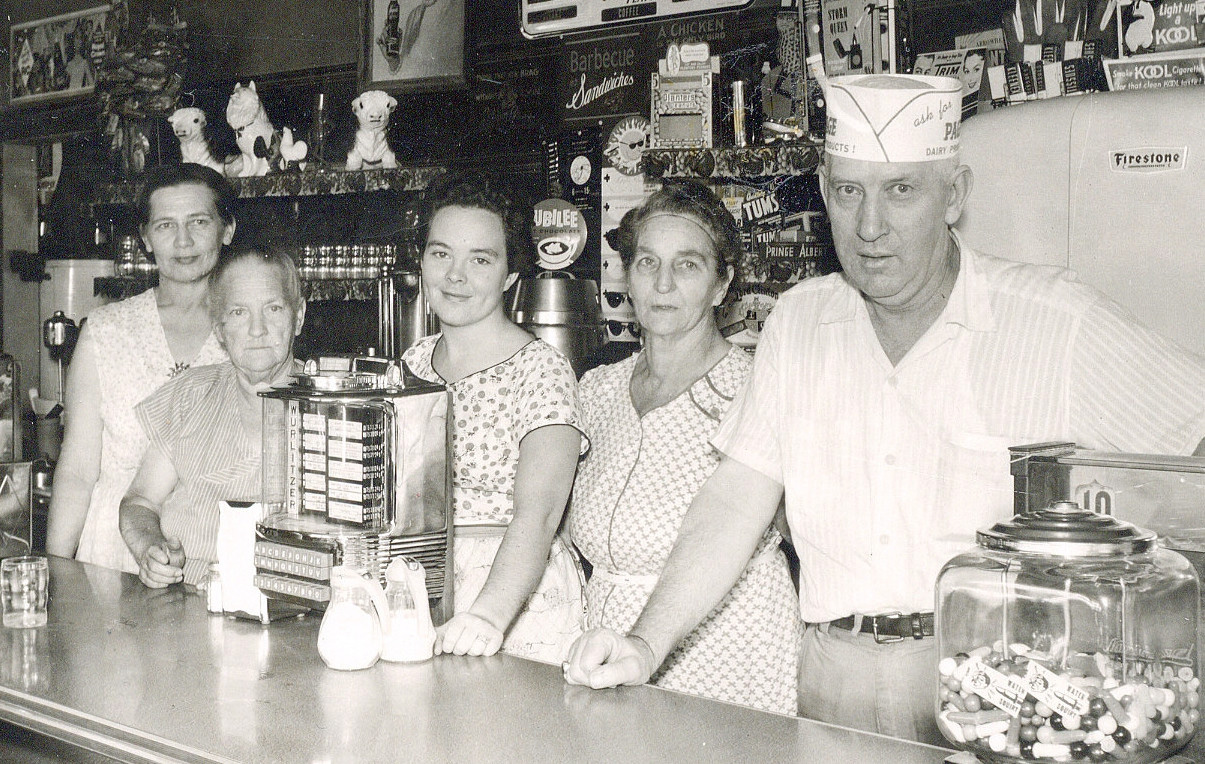
Coney Island Cafe
Coney Island Cafe

Lately, I’ve been thinking I would incorporate elements of this story into a more upbeat tale about the boy confronting his fears and the bully by hunting Nazi spies in his own little hometown. Oh, and there’s also a dog who rides the streetcar by herself, and a sidekick named Jerry, and a Jewish girl who wants to be a friend, too, and help the boys find the Nazi traitors. How in the world I’ll fit all these pieces into the puzzle is beyond explaining at this point!

Amy: You taught elementary school in the Atlanta area for 10 years, and you’ve written a number of books and articles for the educational market about various world cultures and their histories. Every writer brings a point of view to their work. What did you feel was important for students to understand about other people’s cultures and histories?

Toni: I know that history is usually the least-liked subject for most students. This is really unfortunate because so many decisions people make throughout their lives, including political decisions, should be informed by what happened in the past. Otherwise, they become susceptible to propaganda. My main goal in my writing has been to get children interested in history from an early age. Instead of only writing about dates, kings, and queens, I’ve tried to introduce unusual topics. For instance, in my Wonders of World Culture series for Walch Education (see here), I introduce ‘treasure’ and ‘wonders’ of various cultures, like the Rosetta Stone of Egypt, the Taj Mahal of India, and the Rock Art of the African Bushmen. My latest book is The Writing on the Walls: Discovering Medieval and Ancient Graffiti for Middle School Social Studies, published by Prufrock Press (here).

Gigantic termite mound in Australia (copyright 2016 T.B. Rhodes and A.B. Kautz)

Amy: Writers are often teachers, or were teachers at one time. Why do you think these two professions so frequently go hand in hand? How do they complement each other?

Toni: I guess it’s just natural for some teachers to want to continue teaching even after they’ve left the profession. Teaching sort of gets into your blood, so to speak. I know in my case the activity I enjoyed most was sharing children’s literature with my students. How they loved to act out the picture book Caps for Sale!

Amy: Your father, Verlin C. Blackwell, was an artist who made a series of drawings and paintings while he was serving in northern Australia during World War II. They’re quite good, evocative of ordinary people in that time and place. Did your father ever talk to you about this work? What have these drawings come to mean to you?

Toni: Yes, my father talked somewhat about his war experience, but his drawings, paintings, and photographs speak for themselves. He served in northern Australia where, apparently, he had plenty of time to draw and paint what was going on around him, including a Japanese air attack, which he painted after climbing to the top of the city water tower! One of my projects is to write a memoir of my father’s experiences in the Army. In this way I hope to understand him better and somehow get closer to him. (He was a bit of an enigma.) I’ve been in touch with a person who is a military historian and works in a museum in Darwin [Australia]. I’m hoping he can help me interpret the material my father left behind.

Verlin C. Blackwell and pet wallaby (copyright 2016 T.B. Rhodes and A.B. Kautz)

Amy: What works of historical fiction or non-fiction have you most enjoyed?

Toni: I read so much historical fiction that it’s hard to pick out favorites, but here goes (in no particular order):

All the Light We Cannot See by Anthony Doerr (I hate to rank books, but this is one of my favorites.)

All the Richard Peck books

City of Thieves by David Benioff (This is a favorite, too, and not many people have heard of it.)

Symphony for the City of the Dead by M.T. Anderson

The Astonishing Life of Octavian Nothing books by M.T. Anderson

All of the historical fiction by Laurie Halse Anderson

All of the historical fiction by Karen Cushman

All of the historical fiction by Avi

The Devil in the White City by Erik Larsen

The Watsons Go to Birmingham by Christopher Paul Curtis

Rose by Martin Cruz Smith

A Tree Grows in Brooklyn by Betty Smith

The Plot Against America by Philip Roth

The Baker’s Daughter by Sarah McCoy

The Good Lord Bird by James McBride

The Orphan Train by Cristina Baker Kline

Unbroken by Laura Hillenbrand

Well, that’s probably enough for now. Happy reading!

Amy: Thanks, Toni! 

(NOTE: Featured photo is “Spotlight.” Watercolor of Japanese night raid by Verlin C. Blackwell. Copyright 2016 Toni Blackwell Rhodes and Andrea Blackwell Kautz.)
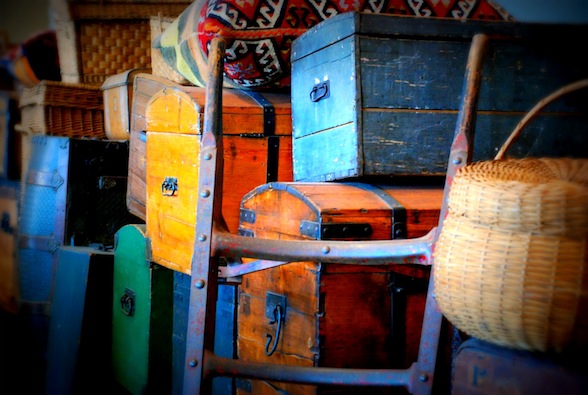

Men Are From Mars, But This Woman Is Packing For Greece And London

“In a minute there is time for decisions and revisions which a minute will reverse.”     T. S. Eliot

I stand here befuddled by indecision. I love my jeans jacket, but it’s too laid-back for the Little Black Dress I need for the theatre, so … maybe I should go with the trendy green coat?

I could take both, but that won’t leave room for the navy cable knit sweater I must wear under either to keep from freezing at night in London. Besides, I can’t layer a chunky sweater over a cocktail dress.

And where on earth am I going to find room for the sundresses and tank tops I’ll need for Greece? LOL stuff them in my laptop case?

Down parka with sandals, anyone?

Welcome to my nightmare. I love to travel but I dread packing.

graylinealaska.com
graylinealaska.com

In my life, I have moved cross country in a VW Bug, raised two kids, taught first-grade children to read and write, dug by hand and terraced a quarter-acre lot, and penned a half dozen novels.  So, why am I traumatized by the very thought of luggage?

The Goal

My goal here is to somehow assemble a suitcase-size wardrobe (leaving room for books! And maybe a little souvenir I Love Athens shot glass) that will take me through the next five weeks, from chilly London to sweltering Greece and back to a (somewhat) still chilly London.

I dump half the contents of my closet across the bed, searching for the magic outfit that can go from the Waterlily House in Kew Gardens to an evening of Puccini at the London Coliseum, from the mountain trails of Crete to the beaches of Santorini. Something like a NASA temperature-controlled flightsuit. But with more panache.

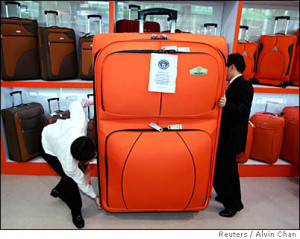
REUTERS/Alvin Chan
REUTERS/Alvin Chan

It doesn’t help that my husband, Ed, has assembled a neat stack—two pairs of pants, four shirts, one sweater, a jacket, the shoes he stands up in—and announced he’s ready to go.

Men.

Packing should be considered an Olympic sport, with gold medals for bags that don’t exceed the limit at check-in, and event categories like “Weekend Getaway: Three items + a toothbrush.” Or “Two weeks with only one pair of shoes.”

Last year, I packed a suitcase full of slinky little summer dresses and jaunty capris for a May/June trip to Paris, only to wind up wearing the same jeans/sweater/wool jacket combo every day because the thermometer never topped 55. The Parisians could spot this “femme Américaine” a kilometer away.

At least, I was able to swap out the accessories.

Accessories and Other Junk

And that’s another area where men and women are on completely different planets. My husband wears his wedding ring. End of accessorizing for him. But I’m staring at 27 potential outfits and trying to figure out what is the fewest number of earrings, bracelets, and necklaces I can make it out of the country with. I want to believe that this year I will be strong and take only the silver hoop earrings. But I know I will probably cave at the last minute, and throw a bunch of unrelated earrings, bangles, and necklaces into my little travel jewelry thingie where they will fuse during the flight into a tangled ball of tarnished junk.

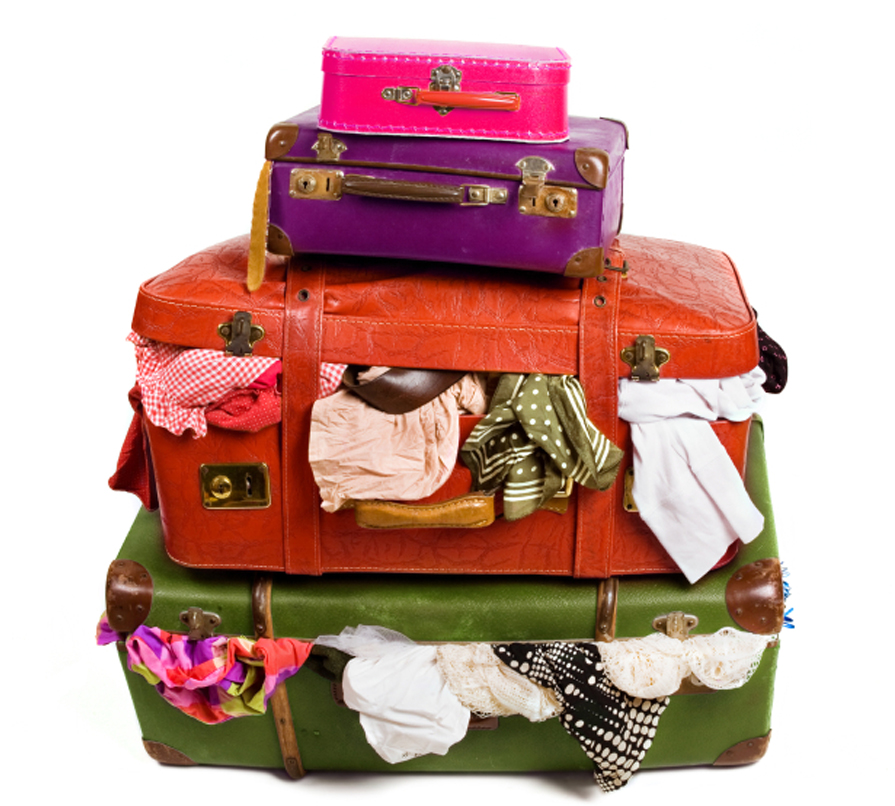
Vagabomb.com
Vagabomb.com

Several years ago, Ed purchased two sets of compression packing cubes to maximize and organize the space in our luggage (why he needs them, I have no idea). You really can pack A LOT in these cubes. Like bombs, they weigh a ton and explode on opening. But their true perk is they allow—almost—adequate space for THE BATH BAG, my name for the heavy-duty plastic drawstring bag (stamped with the name of a local clothing emporium) that houses the contents of what would be my bathroom cabinets. If I were so fortunate as to have actual bathroom cabinets.

NOTE: It is beyond the scope of current human capability to reduce THE BATH BAG to anything less than half the suitcase. And weirdly, the size of the suitcase doesn’t matter. THE BATH BAG, like some immutable law of physics, always takes ½ the available space.

Once again, where are the men on this issue? Ed dumps soap, razor, deodorant, toothbrush, and a mini-shampoo into his wee dopp kit, zips it up, and voila! off he goes to watch a Red Sox game on TV.

Leaving me to transfer economy size bottles of shampoo, conditioner, and make-up remover into tiny plastic vials, like Viktor Frankenstein at the cosmetics bar in Bloomingdale’s. Now I can squeeze in the jumbo canister of curling mousse needed to prevent massive frizz-outs, as well as a stash of hair ties (for days when the mousse fails), perfume, make-up (without mascara and brow pencil, you wouldn’t even notice a redhead has eyes), my Invisalign retainer (w/its own accessories and cleaners). And Q-tips. I don’t know how men travel without these, they are such a staple of life.

So, the eleventh hour’s upon me and I still haven’t winnowed down the mess on the bed. What’s a woman to do?  Limit her travel wardrobe to black? Vacation in a nudist colony? Or maybe just pick up a massive armful of the cotton, denim, silk, and knitwear strewn before me and dump it into my bag. Sort it out at the other end. Who knows? I might go to the opera in cropped jeans and sneakers. Or walk the beach in my little black cocktail dress (how Breakfast at Tiffanys!).

I only know there will never be true equality between the sexes until men have to tone in their eyeshadow with their outfit.

Barci CROP 0902 Barcelona Park Guell Amy & Ed (3)

Love’s Labour’s Saved

“We know what we are, but know not what we may be.”  (Hamlet)

April 23 marks the 400th anniversary of Will Shakespeare’s death. Celebrations of the Bard, his life and work, are scheduled throughout the world, including the first-ever (!) opportunity to see his school room at the King Edward VI School in Stratford-on-Avon (I would probably walk in, drop to my knees, and kiss the floor).

londontheatredirect.com

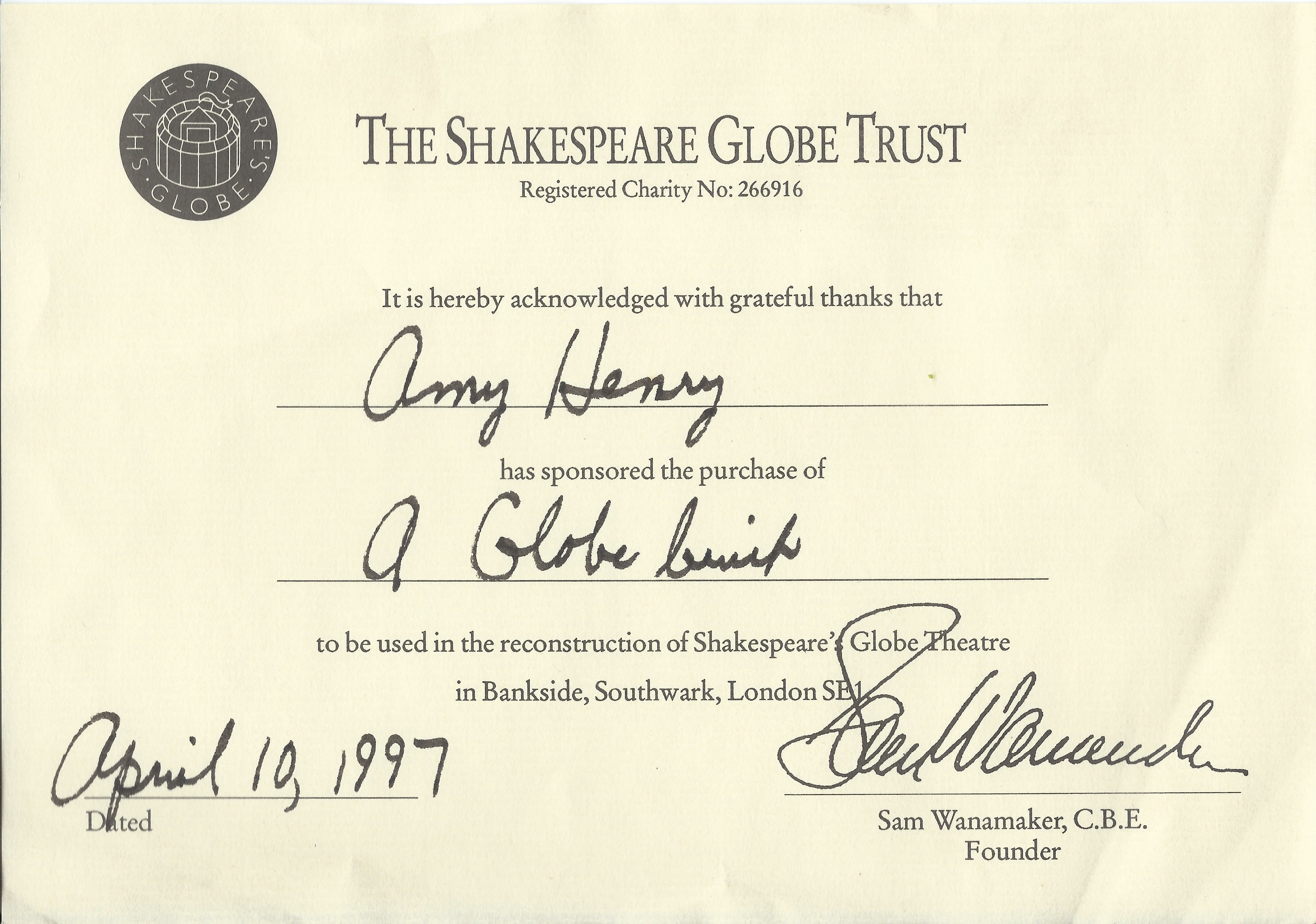
Shakespeare was and is a BIG DEAL. He almost single-handedly put British theatre on the world map. Four centuries later, people still valued his work enough to rebuild the Globe Theatre near its original site in Southwark. Some 400 television and feature-length films have been made from the Bard’s work, according to the Guinness Book of Records (including Kurzel’s excellent Macbeth, 2015), making Shakespeare the most filmed author. In any language. Ever. Hey, I invested £2 to buy a “brick” for the reconstruction of Shakespeare’s Globe Theatre in London back when £2 was a lot (to me, anyway).

 His wizardry with words is legendary. Without Shakespeare, those opposed to borrowing and lending money would have no recourse to the pithy line “Neither a borrower, nor a lender be.” Magicians could not announce that the rabbit “vanished into thin air.” Nor lawyers claim that their client’s innocence is “a foregone conclusion.” We could never grouse that we areShakespeare GLOBE BRICK CROP “more sinned against than sinning.” And none of us would be able to say “good riddance” to Donald Trump.

As I considered how I would like to honor Will’s life in this space, it occurred to me to shine a light on two players in the shadows: John Heminge and Henry Condell. Together, they compiled and edited one of the greatest literary treasures in all history, the First Folio. Or, as it was titled in their time: Mr. William Shakespeares Comedies, Histories, & Tragedies.

The First Folio: What Its Editors Had to Say

The First Folio appeared in 1623, seven years after Shakespeare’s death. That the 36 plays it contains represented a monumental undertaking for Heminge and Condell is proved by their own words in the Preface:

“It had bene a thing, we confesse, worthie to haue bene wished, that the Author himselfe had liu’d to haue set forth, and ouerseen his owne writings; But since it hath bin ordain’d otherwise, and he by death departed from that right, we pray you do not envie his Friends, the office of their care, and paine, to haue collected &publish’d them… ”

So, it was something of a royal pain to collect and get Will’s work into shape for publication, and the two editors got cranky on occasion, suspecting the Bard of taking the easy way out by dying and leaving the task to them. And yet, they did it. (Read the entire Preface here.)

So who were these guys?

Heminge and Condell

John Heminge came to London at age 12, where he spent most of a decade apprenticed to the City Grocer. He eventually became a freeman of the Grocer’s Company, and a year later he married the widow DSCN5946 WILL on LAPTOPof an actor. Perhaps she exerted some strange influence or maybe it was the company she kept, but Heminge soon ditched produce for a life on the stage.

Less is known about Henry Condell’s early life, but by the early 1590s both men were actors in the theatrical company Lord Strange’s Men. There, they trod the boards alongside Augustine Phillips, Richard Burbage, and an aspiring young playwright, Will Shakespeare. These five men would continue to work together—first, with Lord Strange’s Men, and then The Lord Chamberlain’s Men  (which became The King’s Men after Elizabeth I’s death)—until Phillips died in 1605 and Shakespeare retired to Stratford in 1610.

Like Shakespeare, both Heminge and Condell had shares in The King’s Men, and Heminge was the company’s financial manager. Heminge also owned a share in the Globe Theatre where, in true entrepreneurial fashion, he operated a taphouse. When Shakespeare purchased the Blackfriar’s Gatehouse in 1613, Heminge was one of the trustees. He and Condell were bequeathed 26 shillings and eightpence in Shakepeare’s will to purchase mourning rings in his memory.

John Heminge and Henry Condell were much more than Shakespeare’s fellow actors and business associates. They had his trust. They had his back. They were two of his dearest friends.

Something of a Miracle  

To appreciate what a truly remarkable gift the First Folio is, you need to realize how easily it might never have happened.

Elizabethan theater was fast-paced and demanding. When not shut down for plague or political squabbles, eight or nine companies played to audiences six days a week. And they weren’t doing three-month runs of Hamlet or Dr. Faustus. The actors in these companies never performed the same play two days in a row, and rarely twice within the same week. In 1592, for example, Lord Strange’s Men performed 23 different plays in a four-month stretch

Conjectural reconstruction of the Globe Theatre: C. Walter Hodges (Folger Shakespeare Library)

The leading actors, on average, memorized 800 lines of verse for each play. At six plays a week, that’s almost 5,000 lines they had to keep in their noggins.

Bottom line: They needed plays. LOTS of plays. Playwrights had to write, rewrite, and collaborate at high speed. Yet, of the thousands of plays estimated to have been written in the 80 years from 1562 until Parliament banned all theatrical performances in 1642, only a small fraction have come down to us. That no other English playwright from that era has a surviving canon of works to rival Shakespeare, we owe to the diligence and love of Heminge and Condell.

Plagiarism and Bad Memories

The dearth of plays that have come down to us from the Bard’s time has much to do with Elizabethan publishing practices and the nature of the theatre business. Only half of the First Folio’s 36 plays appeared in print during Shakespeare’s life. And, as Heminge and Condell lamented, these publications were often “stol’n and surreptitious copies, maimed, and deformed by the frauds and stealthes of injurious impostors.”

Copyright laws didn’t exist yet, so printers interested in making a few bob were not above pirating a company’s prompt book (the single transcript of a play used during performances, cluttered with stage directions, instructions for sound effects, and the names of the actors).

Worse yet, in terms of posterity, were the quarto editions reconstructed from the memory of someone who had seen the play. What could possibly go wrong there?

To answer that question, compare the opening lines of Hamlet’s famous soliloquy in these two examples:

The Real Shakespeare (from the First Folio):

To be, or not to be–that is the question:
Whether ’tis nobler in the mind to suffer
The slings and arrows of outrageous fortune
Or to take arms against a sea of troubles
And by opposing end them. To die, to sleep–
No more–and by a sleep to say we end
The heartache, and the thousand natural shocks
That flesh is heir to. ‘Tis a consummation
Devoutly to be wished. To die, to sleep–
To sleep–perchance to dream: ay, there’s the rub,
For in that sleep of death what dreams may come
When we have shuffled off this mortal coil,
Must give us pause. There’s the respect
That makes calamity of so long life.

The “remembered” Shakespeare from a quarto of Hamlet, published 1603:

To be, or not to be, aye there’s the point
To Die, to sleep, is that all? Aye all:
No, to sleep, to dream, Aye mary there it goes,
For in that dream of death, when we awake
And borne before an everlasting Judge,
From whence no passenger ever returned

I’d continue, but I think you see what Heminge and Condell were up against and why they felt it so important to publish the original works.

Without copyright protection, playwrights had nothing to gain from publication, and the theatrical companies who purchased their scripts had everything to lose. A published play gave other companies access to their property. Rival companies might beat you to the punch, and suddenly there’d be four productions of Hamlet going.

The Real Gift

Memorial to John Heminge and Henry Condell. Sculptor: Charles John Allen. Designer: Charles Clement Walker.

The First Folio was the first publication to group Will’s plays into comedies, histories, and tragedies. It gave us the Droeshout portrait of Shakespeare, considered a true likeness by scholars because it was chosen by two men who knew him well.

But the real gift of Heminge and Condell’s work is that the First Folio preserved 18 of Shakespeare’s plays that had never been printed before. If you think the work of a few people can never make much difference to the world, consider this: Without their efforts, the following plays would have vanished with Will’s death.

Macbeth  *  The Tempest  *  Twelfth Night  *  All’s Well That Ends Well

As You Like It  *  Antony and Cleopatra  *  Julius Caesar  *  Henry VI (1)

The Taming of the Shrew  *  The Winter’s Tale  * Measure for Measure

Two Gentleman of Verona  *  Comedy of Errors  *  Coriolanus

King John  *  Henry VIII  *  Timon of Athens  *  Cymbeline

And most of the others would be known to us only through cheap bootleg editions.

To say Will Shakespeare rocked his world and ours is an understatement. He defined romantic love with Romeo and Juliet. Weighed justice in Measure for Measure. Stared into the dark abyss of ambition in Macbeth. He explored our most base and best selves. Took mercy on our human failings. Celebrated our triumphs of spirit. He is funny, irreverent, honest, brilliant. I would give anything to buy him a beer at the Mermaid Tavern. If he were still here and it was still standing.

 What links a writer to posterity is no more and no less than his or her words on the printed page. And for that, in Shakespeare’s case, we owe everything to Heminge and Condell.

Memorial to John Heminge and Henry Condell. Sculptor: Charles John Allen. Designer: Charles Clement Walker.

You Who Are On The Road


Keep walking though there’s no place to get to.                                     Don’t try to see through the distances,                                                     That’s not for human beings. Move within,                                               But don’t move the way fear makes you move.

                                                            :Rumi    

When I was in my twenties, I imagined that by 40 or so (when I imagined such an advanced age at all), I would have acquired a certain grace at living. Grace implied to me a kind of sanguine wisdom, the possession of which would enable me to transcend all things petty, leaving me unshakably calm.

Ha-ha.

More recently, combing through birthday cards for a friend, I came across this gem: “With age comes wisdom.” (Inside) “But sometimes age comes alone.”

We’re getting closer to the truth here.

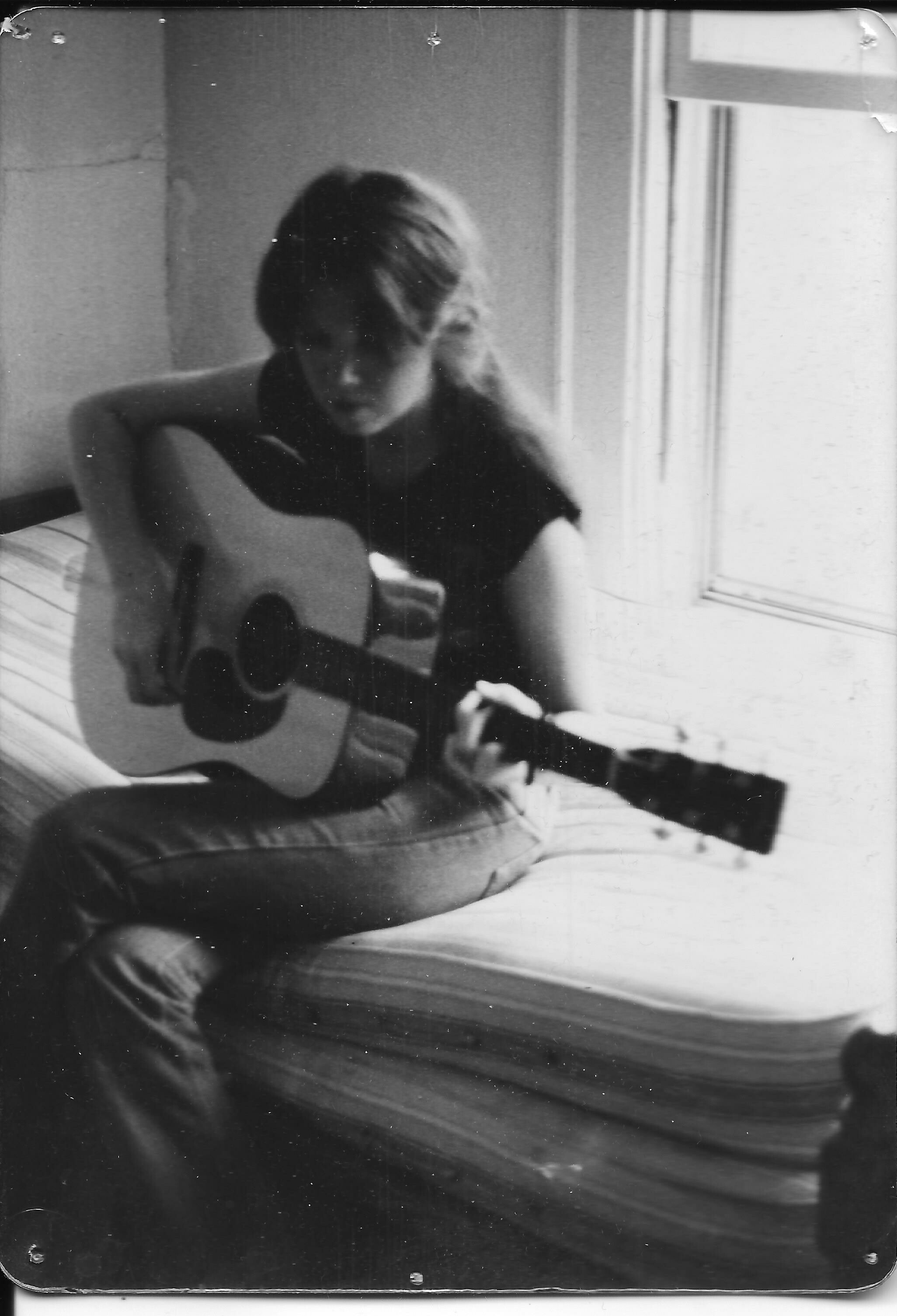
Amy 25 guitar CROPIt’s something of a universal practice to pause on our birthday and consider what (if anything) the years have taught us. To reflect on the hand dealt us, how we’ve played it, and what we might do with the cards we still hold.

 So, with another anniversary of my arrival on the planet just past, I thought I’d share some of the things I’ve learned—and some of the things I still hope to learn but haven’t quite yet got the hang of. It’s not Rumi. It may not even be Kung Fu Panda, but it’s mine own.

What I’ve Learned

  1. When riled to record heights of anger by the insensitive, the stupid, and the just plain nasty, do NOT under any circumstances tell the annoying person what you REALLY think of them.  However eloquent anger may make you, however deeply satisfying it is to take down the offender with your verbal arrows, beware: The gods enjoy messing with us. At some unforeseeable moment in the future, in a setting you cannot now imagine, this person is bound to reappear in your life—as the interviewer for a job you really want, as a member of the critique group you just joined, as your child’s teacher. On that day you will be extremely happy that you kept your mouth shut.

2. When you are the dufus in the room, own it straight out and laugh at yourself. The reality of life is this: People spill drinks. They trip on stairs. Call someone by the wrong name. Trail toilet paper on their shoe. A few even fart.  Look at it this way: Everyone else gets a kick out of your embarrassing moments, so why shouldn’t you?

3. Trust your intuition. That still, small voice you hear at critical junctures in your life? It’s not just some telemarketer from deep space. It’s the real you telling yourself what you already know at gut level. PeopleAMY with kids CROP put their faith in the stock market, in lottery tickets, in Vegas. How much crazier is it to trust your gut? On the brink of college graduation, utterly broke and armed with only a degree in English, my intuition spoke up one night as I sat listening to a musician friend in a local pizza pub. Right in the middle of “City of New Orleans,” it said: “You’ve got a vagabond heart. Do what you’ve always loved doing. Go be a writer.” I’m grateful everyday that I listened.

 4. Ignorance is not bliss; it is a false bliss and a temporary one at best. There are big examples of this: Climate-change deniers. Everyone who looked the other way as Hitler rose to power and built the death camps. And small examples: Ignoring the symptoms of cancer, or the signs that a relationship is becoming abusive. Things ignored do not disappear. More often, they incubate until you have a really nasty mess to deal with. In my experience, it’s best to travel with your eyes wide open.

5. Never sell your soul for money. My dad spent his life accruing money, thinking about money, worrying about money. In exchange, he got the dream house, the country club membership, two luxury cars in the garage. But it never seemed to make him particularly happy. We all need food, shelter, a little fun, but I think the luckiest people are those who grasp the concept of “enough.” They enjoy a freedom that all the money in the world can’t buy. I’ll bet my dodgy 2001 Ford Focus on that.

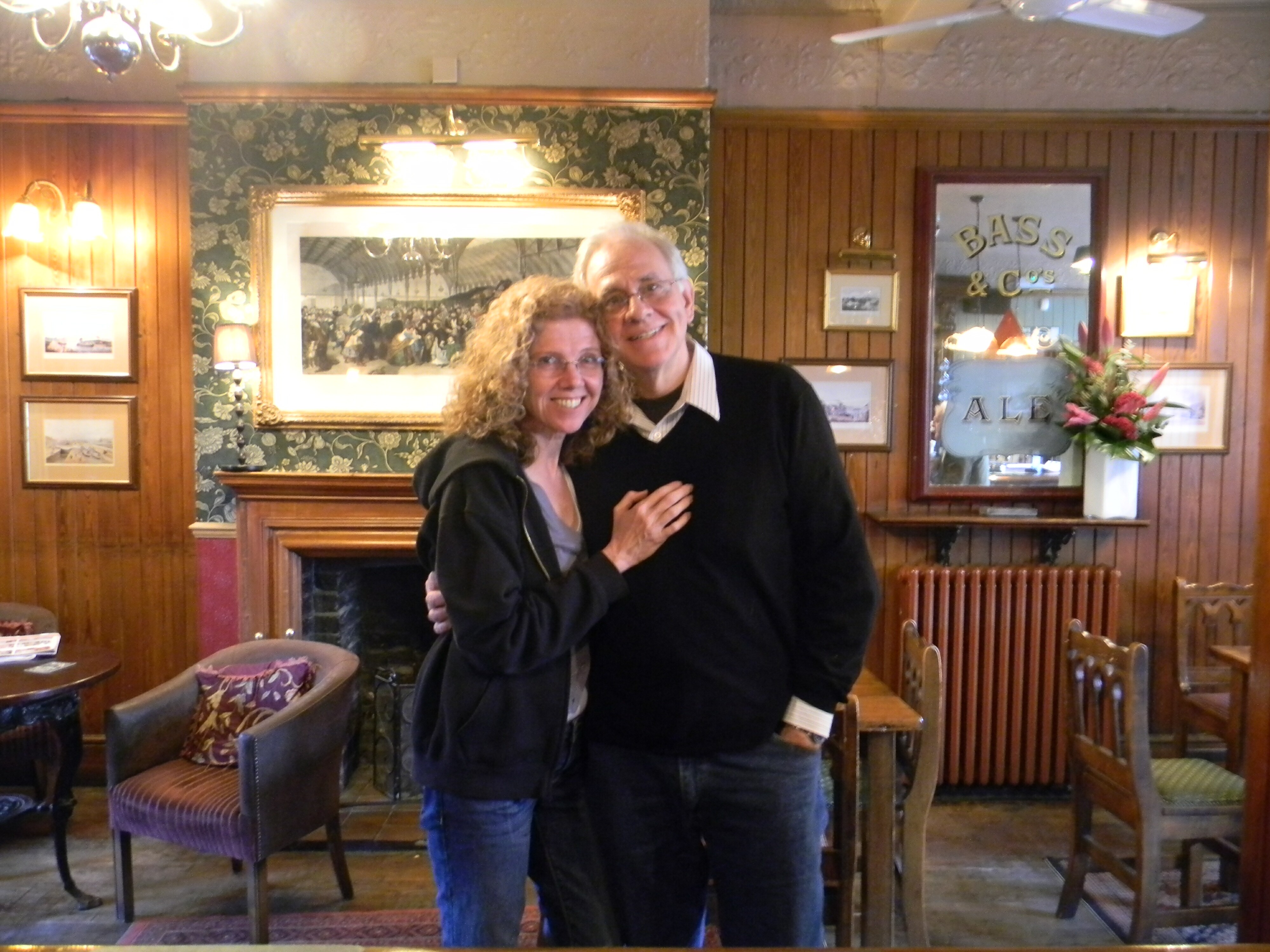
BIRTHDAY USE THIS 0528 Amy & Ed at Warnick Castle Pub in Camden 6. If you possess the true, abiding love of at least one other person in this world, you can survive anything.

What I’ve Yet to Learn But Hope To

  1. Don’t put your life on post-its, at least not the dinky 2” x 2” ones. At any one time, I have 100 or so of these colorful little squares floating over the surface of my desk. A random sampling of their deathless reminders to myself include:

The human capacity for deception

A spy? See Condell perfs in Jonson’s play

Givens QED

The really important ones are actually taped to the front of my desk where they eventually fade to absolute incomprehensibility.

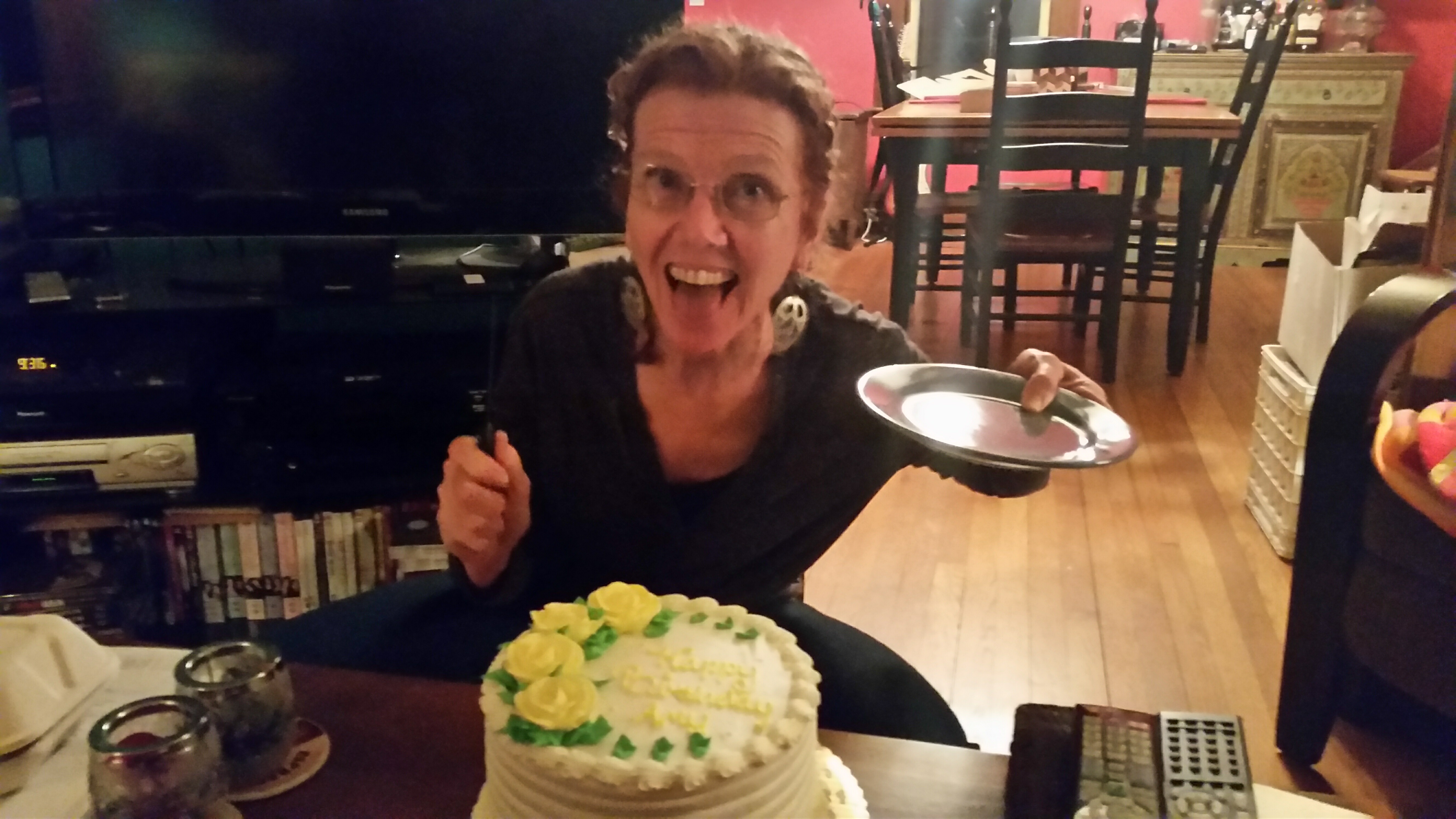
2. When settling in to watch a movie at home, resist the urge to grab a bag of M&Ms, Reese’s Peanut Butter Cups, Cheetohs (or anything else packing a month’s worth of calories) with the promise that you’llBIRTHDAY FUNNY 03 Apr Amy & her Cake stop after “a few.” You won’t.

3. Never shop for clothing when you are at the bottom of your weight range. For the record, I’m not much of a shopper, but the one thing that will propel me to the nearest mall is losing 4-5 pounds. Giddy (from lack of food), I plop down my Visa card and before you know it, I have a couple new pairs of jeans and two or three sleek little tops that look great . . . until I eat my next slice of pizza.

4. Stop counting the minutes, hours, days. I keep Rumi’s quote above my desk, but I’m still learning it. Perhaps, by 80, I’ll achieve that grace I mentioned earlier and learn to let everything arrive in its own time.

We Have Always Depended On The Kindness of Strangers

“Kindness, I’ve discovered, is everything in life.”       Isaac Bashevis Singer

Recently, I was standing at a coffee bar in New Hampshire, waiting for the woman next to me to finish adding cream and sugar to her java. The plastic lid I needed for my cup was in a bin just beyond her. I said nothing. She’d be done shortly. It was no big deal. But as she reached for another sugar, she also grabbed a lid and handed it to me. I thanked her. We smiled at each other. I returned to my table feeling good about the world.

That small act of kindness, unsought, unexpected, started me thinking about other kindnesses I’ve experienced over the years. The pub owner in Dublin who, when asked if he knew a good breakfast place, left his morning preparations to escort my husband and me to a sunny café three blocks away. The KINDness HANDS-1137978__180woman in Ramsgate who my friend and I asked for directions to the ferry to Paris. She was on her way home from work, but she walked us the mile or so down to the harbor terminal. I was a student then, yet the memory of her kindness has lasted these decades. We are more powerful than we think.

In the midst of our current public turbulence—the anger, the hateful talk, the violence—it’s easy to forget this most basic of truths: At every moment, we are ALL depending on the kindness of strangers.

In our lifetime, we each encounter a vast number of strangers. We pass them on the street, ride with them on the subway, sit next to them in cafes, work out beside them at the gym. We don’t know their names, but we are relying on them not to cheat us or assault us, not to steal our wallets or break into our homes, not to detonate a car bomb as we pass by or shoot up our children’s school. We are depending on them as they are depending on us.

KIND abstract blue group diff faces-413973__180There is something so basic in this, that we must all trust it or go mad. It is the most fundamental of all social contracts. It is what makes events like the November 2015 Paris bombings so shockingly frightening—the betrayal of that elemental trust.

The tensions of our time make us wary. We live in the maelstrom of a 24-hour news cycle for which spectacle of the most sensational and violent kinds boosts ratings, hence advertising dollars. Even if we turn off our TVs and silence our radios, we cannot escape the suspicions and doubts aroused by the media. We begin to size up people we don’t know—their accent, the clothing they wear, the vehicle they drive, their occupation or lack of same, their race or nationality—and apply a kind of “media profiling” to make hasty judgments about the person’s values, the way they think. Uncertain, perhaps, we avoid eye contact, eschew the friendly nod, waiting to see what the other person is going to do. And so our common humanity often goes unacknowledged

We cannot live this way and stay sane. We cannot live this way and be happy. To paraphrase CBS chairman Les Moonves’ recent cynical comment: It may be damn good for CBS, but it’s not good for America. Or the world.

Fortunately, there are other ways to live, other choices. Seneca said                                                   “Wherever there is a human being,KIND  silhou people with tree embracing globe tree-569503__180 there is an opportunity for a kindness.” It was good advice circa 40 CE, and it continues to speak to our deepest needs. Kindness is a stone that cast out upon a seemingly indifferent surface, ripples far beyond its original point of contact.

I was reminded of this recently when, stuck in local traffic, waiting in a long line for a short light, I became conscious of a woman in a car looking for a chance to turn left into my lane. I had a lot of work on my desk at home, groceries to pick up for dinner. I wanted to get to the gym. Letting this stranger into my lane almost certainly meant missing the light, losing more precious minutes. But then I remembered all the times I’d sat waiting for a break in traffic, how grateful I was to the person who finally let me in. So when the cars ahead of me began moving, I waved the woman in. A moment later, in my rearview mirror, I saw the driver behind me doing the same for another car. My heart lifted. We are more powerful than we know.

KIND scrapbook of faces photo-montage-556806__180The world has always been a good place. The world has always been a hard place. But, at every moment, we have the choice to be kind or not, and so tip the world on its axis one way or the other. Like the woman in the coffee shop. Like the woman in Ramsgate, surely tired from a day at work. They stopped for me, a stranger. And in doing so, made the world a better place.


[Note: I penned this post before the violent events in Brussels today.  The deaths of more than 30 people in that city and the wounding of several hundred others make remembering our common humanity feel more essential than ever.]