The Human Condition (BLOG)

The Bard Speaks Out On Immigration

We do pray for mercy, and that same prayer doth teach us all to render the deeds of mercy.    (William Shakespeare)

With all this frenzied chatter about a monolithic wall to keep “bad hombres” out, and religious tests to ban Muslims from entering the United States, one might get the impression that hostility toward immigrants is a new phenomenon in America, reflective of  a contemporary global threat in its urgency to keep us “safe.” Nothing could be further from the truth. (Have patience, we’ll get to Shakespeare before the final curtain.)

When the Religious Society of Friends, who became known as Quakers, formed in mid-17th century England, they were persecuted by the established church and its leaders. Some Quakers took refuge in the Netherlands. Others came to the New World where, quelle surprise!, their books were burned, their
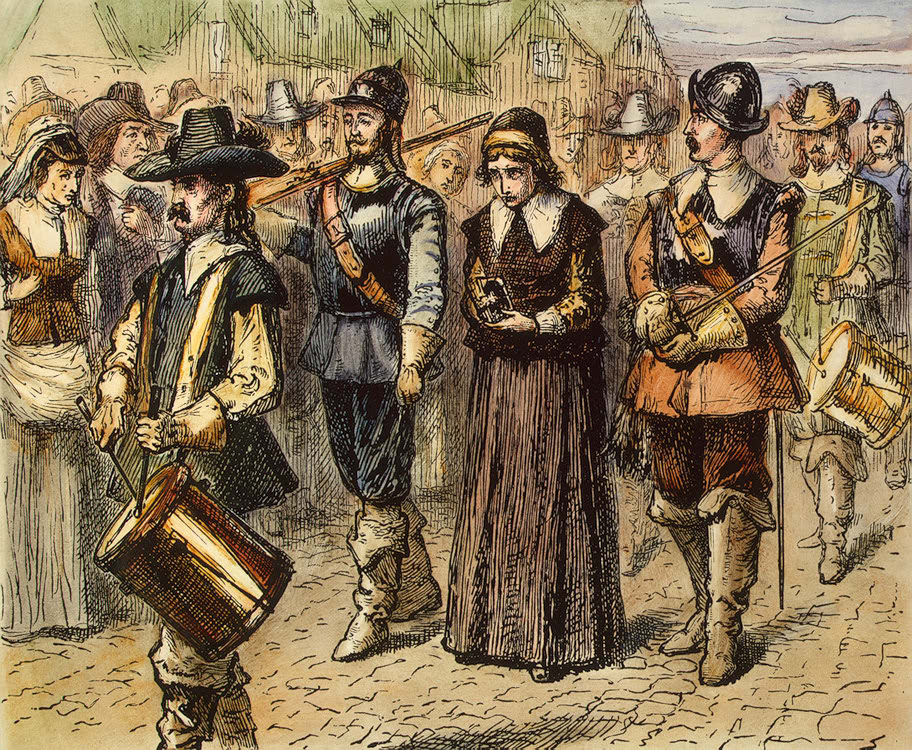
Mary Dyer led to execution on Boston Common, 1 June 1660. Color engraving. Copyprint Nineteenth Century. Library of Congress. Courtesy of The Granger Collection, New York

property confiscated, and their “heretic” selves thrown into prisons or banished by Massachusetts Puritans. Several were executed.

Under the leadership of Roger Williams, a community of Quakers established a safe haven at Providence Plantations (now, Rhode Island) in 1657, but that same year saw Quakers being flogged, fined, and imprisoned in New Amsterdam (the southern tip of Manhattan). When Edward Hart, the town clerk of Flushing, reminded Governor Stuyvesant that the town charter promised citizens liberty of conscience, Hart was arrested along with two other magistrates who had signed his petition.

What Would Emma Lazarus Say?

Okay, it can be argued that this was well before we declared our independence and became this grand experiment called the United States of America. Before we proclaimed ourselves a melting pot. Before the Statue of Liberty lifted her torch, a beacon of light to welcome the world’s “huddled masses yearning to breathe free,” as poet Emma Lazarus put it. And yet, in the several decades both before and after Lady Liberty was erected (1886), hostility to immigrants was vocal and widespread.immigrant-chinese-americans-build-pacific-railroad2010-08-30_railroadsf9b0

What were these “dirty, lazy, untrustworthy” Irish, Italians, and Chinese wannabe citizens doing to earn such public disapprobation?

Well, many of them were building the railroads that would span the country, connecting the East Coast to the West, and increasing the wealth of a newly-industrialized America by millions.

One of the charges made against immigrants then and now is that they “steal” jobs from “real” Americans. But I’m guessing the wealth did not trickle down to those who actually built the railroads. And the work was brutal. Tunneling through the Sierra Mountains at eight inches a day with hammers and chisels, always under threat from the black powder used to blast through the rock. Laying down mile after mile of track by hand in the rain, wind, and snow. Today, immigrants harvest our food and slaughter livestock on industrial and factory farms. Grueling work that leaves many workers sick and broken. Let’s be honest: Immigrants have always done the jobs no one else wants to do. And their employers have always profited handsomely. Sub-minimum wages. No benefits.

The (Reluctant) Melting Pot

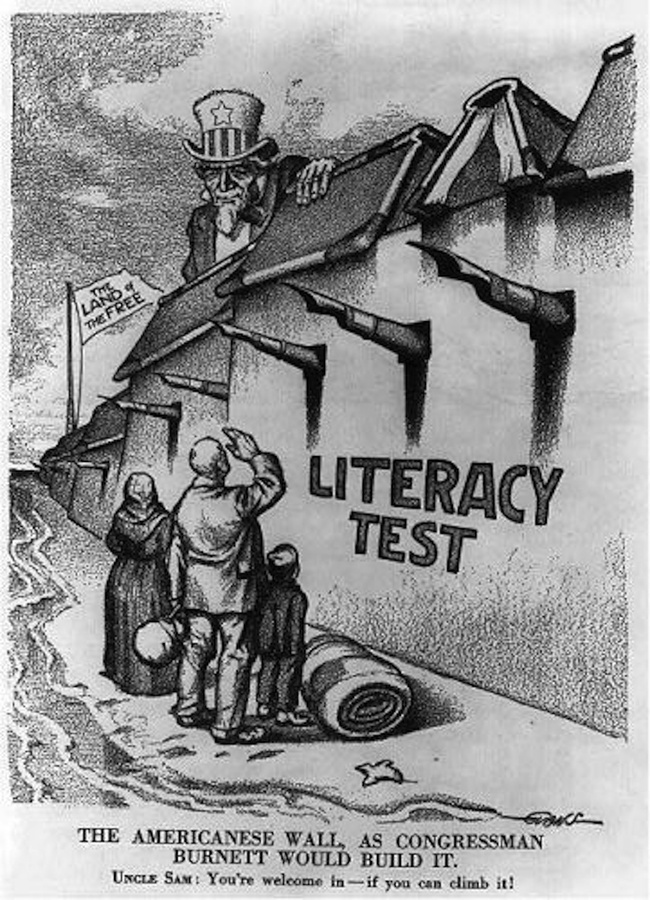
Discrimination against immigrants based on religion, and the resulting clamor to implement discriminatory immigration laws is not new either. The influx of Irish immigrants throughout the 1800s met with violent riots and demands for limits on their rights. The Order of the Star-Spangled Banner, a kind of KKK against Catholic immigrants, supported a 21-year waiting period for naturalization and a ban blocking anyone but native-born Protestants from holding public office.  The OSSB later reformed as the American Party under the motto “Americans Shall Rule America.” In the decade before the Civil War, they won a number of local and state elections.

http://www.victoriana.com/history/irish-political-cartoons.html

Americans were so disgruntled by the influx of Italian immigrants in the 1920s, President Woodrow Wilson felt empowered to enact a raft of anti-immigration legislation. Italians were thought to be low-class, ignorant, and prone to criminal activity. And like the Irish, they were Catholics.

Most shameful of all is the hard line taken by the U.S. against Jews fleeing certain death at the hands of Hitler and his Nazis. In a November 2015 Smithsonian article, Daniel A. Gross writes: In a long tradition of “persecuting the refugee,” the State Department and FDR claimed that Jewish immigrants could threaten national security.

In 1942, a ship transporting hundreds of Jewish refugees seeking asylum from Nazi persecution left Sweden for New York City. On board was a German man, Herbert K.F. Bahr, who the FBI later accused of being a Nazi spy, paid by the Gestapo to steal American industrial secrets. His case got a speedy trial where the prosecution asked for the death penalty. But the real crime was that Bahr’s alleged treachery was used as an excuse to prevent thousands of Jews from entering the country. Even President Roosevelt argued the threat to national security posed by a spy in refugee clothing.

Bahr, however, was more of a lightning rod for prevailing anti-immigrant attitudes than a cause for same. As far back as the late 1930s, the U.S. was denying visas to European Jews. In 1939, the German liner St. Louis with its hundreds of Jewish passengers was turned away at the port of Miami and forced to return to Europe, where many of those aboard died in the Holocaust.immigrant-jewish-girls-looking-out-through-port-holeestate_of_ruth_orkin_jewish_refugees_at_lydda_airport_tel_aviv_1951c_20_2089_41

Although most historians, Gross says, believe Bahr to have been the exception rather than the rule, government agencies such as the State Department were happy to use him to promote their case against refugees. It wasn’t until 1944 that a whistleblower from the Treasury Department issued a report stating:

“I am convinced on the basis of the information which is available to me that certain officials in our State Department, which is charged with carrying out this policy, have been guilty not only of gross procrastination and wilful failure to act, but even of wilful attempts to prevent action from being taken to rescue Jews from Hitler.”

As a result of this report, Roosevelt created the War Refugee Board, an organization that made it possible for tens of thousands of Jewish refugees to gain entrance to America. But what of the hundreds of thousands, even millions, of Jews who might have been saved in the years before?

Present Echoes of the Past
https://cdn.theatlantic.com

Today’s refugee crisis is as great as that of World War II. The total number of displaced people at the end of 2015 was 65.3 million (United Nations High Commissioner for Refugees), or one out of every 113 people on Earth, and the number keeps rising.

Again, we hear protests over religion. They’re Muslims! (Echo: Jews! Catholics!) Again, we hear how refugees will take Americans’ jobs (would these be the jobs already farmed out to countries where U.S. corporations pay $1.00 or less an hour?). Perhaps they have the “wrong” skin color, speak the “wrong” language, play the “wrong” games or laugh at the “wrong” things.

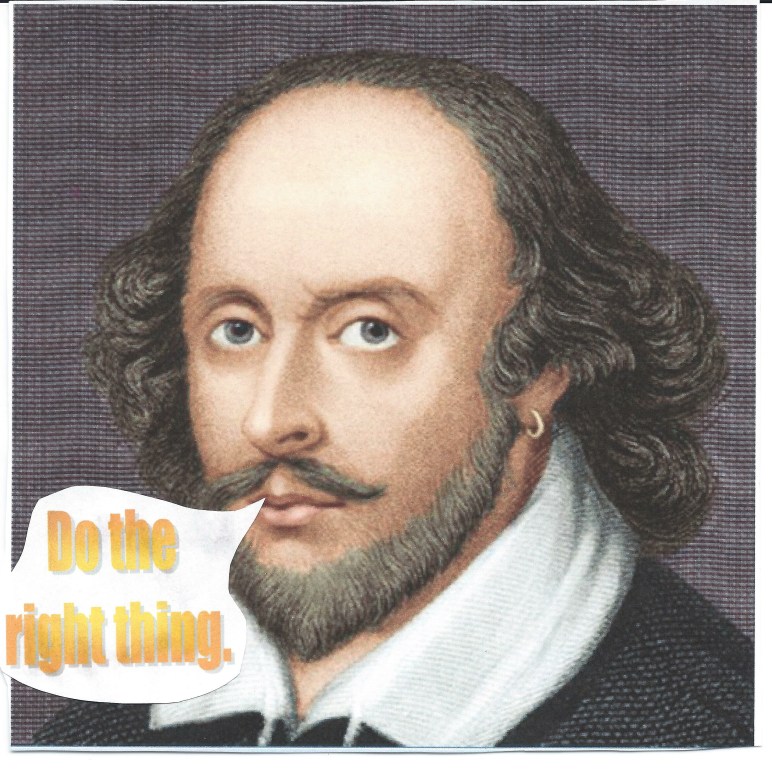
Let me repeat: The fight against immigrants is nothing new. Will Shakespeare understood this. He made an eloquent case for mercy toward refugees in his 147-line contribution to the revised drama Sir Thomas More (originally written by Anthony Munday).

In Shakespeare’s day, upheavals over religion and the flexing of muscle by new nation states (remember, this is the dawn of capitalism) brought many refugees/immigrants to England’s shores. The English people, feeling the strain of several bad harvests and the continual feeding of Elizabeth I’s war chest, resented the  newcomers and feared these “foreigners” would (all together now) TAKE THEIR JOBS! Riots were common. Sir Thomas More was felt to be so incendiary in its portrayal of such riots that the Master of the Revels would not allow the play to be performed during Elizabeth’s lifetime.

In his contribution to the revised play, Shakespeare has Thomas More deliver a moving address to the anti-immigrant rioters. Through More, Shakespeare pleads for compassion and tolerance. What if it were you? he asks.

Petros Giannakouris AP http://www.sacbee.com/

You’ll put down strangers, 
Kill them, cut their throats, possess their houses, 
And lead the majesty of law in lyam 
To slip him like a hound; alas, alas, say now the King, 
As he is clement if th’offender mourn, 
Should so much come too short of your great trespass 
As but to banish you: whither would you go? 
What country, by the nature of your error, 
Should give you harbour? Go you to France or Flanders, 
To any German province, Spain or Portugal, 
Nay, anywhere that not adheres to England, 
Why, you must needs be strangers, would you be pleas’d 
To find a nation of such barbarous temper 
That breaking out in hideous violence 
Would not afford you an abode on earth. 
Whet their detested knives against your throats, 
Spurn you like dogs, and like as if that God 
Owed not nor made not you, not that the elements 
Were not all appropriate to your comforts, 
But charter’d unto them? What would you think 
To be us’d thus? This is the strangers’ case
And this your mountainish inhumanity.
 

[my italics]

Shakespeare understood: It’s not easy to leave your homeland. Your extended family. All your connections and familiar places. People who do so risk everything they have. They are strong, resourceful, determined, hopeful. Not bad qualities for a prospective citizen. I like to think we are big enough, strong enough, kind enough to take them in. It’s who we profess to be after all. A nation of immigrants. And how terrible it would be to realize, as Oskar Schindler does (at the close of Schindler’s List), “I could have got more out. I could have got more. I didn’t do enough.”


Last One In

“The decision to have a child … is to decide forever to have your heart go walking around outside your body.”  (Elizabeth Stone)

 I was at the gym, doing my usual workout on the elliptical machine, when I saw the story. A commuter train bound for Manhattan had crashed through a barrier at the Hoboken station. At least one person was known to be dead. More than a hundred were injured.

My daughter commutes daily from New Jersey to her job in midtown Manhattan, so I was pretty sure she went through Hoboken. Most trains do. As I checked the crawl on the TV screen, searching for the name of the line that had crashed, I reminded myself not to get crazy. Some fifty thousand people ride the commuter trains daily from New Jersey to NYC.  What were the odds that the one fatality was my daughter? They hadn’t even announced the gender of the victim yet.

That occurred while I was riding the stationary bike. The one fatality was a woman. The fear started simmering again. The train involved was part of the Pascack Valley line. That didn’t sound quite right.   I felt the-last-one-woman-pulling-window-blinds-300x300 hopeful. Less reassuring was the news that the crash had occurred just before 9 a.m., in the heart of the rush hour. Right about the time my daughter would be crossing the Hudson to get to her office.

But in that same moment, I knew: Whoever she was, she was someone. Someone’s daughter. Possibly someone’s sister, spouse, mother. Somewhere out there on this beautiful early autumn day were people about to get the worst shock life can deliver. I cut my workout short and skipped a stop-off at the grocery. I needed to figure out which line my daughter traveled, and try to contact her.

Still Here. Still Safe.

When my kids were growing up, we discussed the usual safety issues: crossing busy streets, riding bicycles in traffic, not taking rides from strangers. As they approached the teen years, our conversations turned to safe sexual practices, drug and alcohol use. “If you’re at a party and your ride gets drunk, don’t get in the car,” we told them. “Call us. We’ll come and get you. We won’t be mad. We just want you safe.”

And then they were teenagers. My son, an avid Magic card player, started going to tournaments on the weekends, many of which were two to three hours away. He didn’t have a driver’s license, so he carpooled with local college kids. “Leave us the driver’s name,” we said, “and your destination.” The tournaments usually wrapped up around 10 p.m., and the kids went out for a bite to eat before the drive last-one-clock-midnight-no-shows-clock1back. I remember those weekend nights well. My daughter  would get home from a movie with friends in the late evening. That’s one in, I’d think. Midnight came and went as I puttered around, working on projects, reading. He’ll be home soon and then we’ll all be here, safe, and I can rest.

He always did arrive, and I sank into blissful relief as I turned out the light. The last one in. All safe.

After high school, when my son was working in China, then trekking through Thailand and the Philippines, and my daughter was traveling through Europe, northern Africa, and South America, I looked for the little pop-ups on Google that said one or the other of them was online. Reassured that wherever they were that night, they were alive and well, my heart rested. We were all still here. All still safe.

We Are Resilient. We are Fragile.
Facebook
Facebook

But on September 29, someone didn’t make it home. Fabiola Bittar de Kroon, 34, was standing on the platform at the Hoboken station during the morning rush hour when the Pascack Valley train crashed through a barrier at high speed. She was instantly killed by the debris from the accident. Her one-year-old daughter was in daycare at the time. Her husband was out of town. Her mother was in Brazil, where Fabiola grew up and had lived with her family until recently.

At de Kroon’s memorial service, a friend said Fabiola was standing in the wrong place at the wrong time, but who among us knows the right place from the wrong place before it’s too late?

I was reminded of this again in the recent devastation of Haiti and the southern U.S. coast by Hurricane Matthew. The United Nations described the hurricane as Haiti’s worst humanitarian crisis since the 2010 earthquake. Haiti officials report more than 1,000 deaths, and as I write this, Matthew has killed 28 Americans.

cnn.com
cnn.com

So many families for whom the last one didn’t make it home.

My daughter once suggested the Elizabeth Stone quote was true for children, too. To have a mother was to forever have your heart go walking around outside your body.  I was touched by her words and recognized the simple truth in them, so I am widening Stone’s wisdom here to encompass everyone we hold dear: sons, daughters, mothers, fathers, spouses, partners, sisters, brothers, grandparents. We are so resilient. We are so fragile.

Tonight, when the last one is in, whoever that is for you, let your heart be grateful. No matter what difficulties the day has brought, you have been spared the most painful loss. Once again, you have been incredibly lucky.

last-one-child-sleeping


When I Assume I Make an ASS of U and ME

Prejudice is a chain, it can hold you. If you prejudice, you can’t move, you keep prejudice for years. Never get nowhere with that.                  (Bob Marley)

In the wake of the first presidential debate, a lot of commentary has predictably gone down about the big moments. Trump responding “That’s business” to Hillary’s description of the devastating losses suffered by poor and middle-class Americans in the wake of the 2008 financial meltdown.  Trump crowing “That makes me smart” to Hillary’s assertion that he paid no income taxes for some number of years. These were moments that deserved media attention. They reveal character, attitude, values or lack of. But for me, the most amazing point in the debate occurred here:

Lester Holt: Do you believe that police are implicitly biased against black people?

Joe Raedle AP
Joe Raedle AP

Hillary Clinton: Lester, I think implicit bias is a problem for everyone, not just police. I think, unfortunately, too many of us in our great country jump to conclusions about each other. And therefore, I think we need all of us to be asking hard questions about, you know, why am I feeling this way?  [my italics]

What makes this a standout is its rarity and authenticity. We expect political debates to paint policy with a broad brush: I’m for this. I’m against that.  But here is Hillary suddenly departing from that script and speaking as a human being about the (our) human condition. With these words, she set every American a true challenge.

Assumptions

Assumptions—we all make them. We see someone on the street, in the gym, at the supermarket. Without any attempt to engage the person, we take a slapdash mental survey and rush to judgment. In nanoseconds, we register race, ethnicity, gender/transgender, age, any obvious physical or cognitive disabilities.

arguing-finger-pointing-judgment-imageRequiring closer scrutiny, but equally in the assessment mix, is class. Class gets tricky because it runs along two separate axes that may or may not intersect: education and income. But our eye is not fooled for long. An educated person would never speak in that manner, hang out at that bar, make that mistake. A person of means would never drive that car, live in that neighborhood, frequent that diner. Nothing is off the table: weight, clothing, hair style, accent. We note them all.

As I mentioned in my last post, sizing up people and situations is developmental and has its evolutionary purpose: to distinguish a threatening situation from a non-threatening one. Every seven-year-old does it. It’s the rush to judgment in non-threatening situations that’s the problem. And no, someone being of a race or sexual orientation or class different to our own does not constitute a threat.

Not My Kind

My parents lived for some years in a gated community. The houses, with minor variations in floor plan, were indistinguishable. The community covenant permitted owners to “individualize” their home by choosing one of three colors for their front door. The options? White, off-white, and ivory. (God forbid you should have one beer too many. You’d never find your own house.) There were other rules—many—including no clotheslines, no leaving your garage door open (!), and no pick-up trucks. arguing-suburban-identical-houses-133aaa92f6d038d3ff600ae5ad6d3109

So, did all this homogeneity produce a sense of well-being and harmony? Did these cloistered homeowners feel secure in the knowledge they need never encounter people different from themselves in their immediate environment? No, instead they looked for ever smaller differences, magnifying them until they assumed enough significance to point a finger: Not our kind.

It would be easy to feel superior to this example. Most of us don’t live in gated communities, and many of us wouldn’t wish to. But we do live in divisive times. The Us vs. Them mentality permeates every aspect of our polarized culture.

Us vs. Them

Trump calls a Latina “Miss Housekeeping,” and we all recognize this as a racial/ethnic/gender slur. In this instance, Us vs. Them is those who are biased against Latinos and/or women, and those who aren’t. But there’s a second part to this: Why do we all understand this is a slur—what implicit bias do we hold that equates a “housekeeper” with someone of lesser worth?

Us vs. Them is frequently a triumph of fear over fact. Since 9/11, a growing number of non-Muslim Americans have trouble seeing a Muslim American without thinking “potential terrorist.” In their fear, people buy into propaganda that Muslims are overrunning the country. Fact: Muslim Americans represent only 1% of the total U.S. population. Fact: Muslim Americans have been crucial to helping law enforcement unearth terror suspects. Fact: Hate crimes against Muslim Americans are at their highest levels since 9/11.

arguing-ignoring-eachother-310x295Stereotyping is not the sole property of any particular party affiliation, socio-economic, religious, or cultural group.

Mindful of the history/origins of the Ku Klux Klan, angered and upset by the 2015 racist murders of nine black members of Charleston’s Emanuel AME  Church, how many of us hear a white person with a southern accent, and bristle: Racist, Confederate flag-flying, cracker thug!

And that was exactly Hillary’s point: No one is immune. At some level, whether deep-rooted and multi-generational or free-floating and vague, we all have a personal acquaintance with implicit bias.

Breaking The Silence

I had an encounter in the supermarket this summer that opened my own eyes. I was standing in a long line at checkout. Directly behind me were two men. One middle-aged, one older. Both white. Both dressed in short-sleeve plaid shirts. Work pants. They looked like Joe-the-Plumber’s (political/media stereotype) cousins. High school education. Maybe a year of community college. All this went through my brain in three, four seconds. And my brain fired back a rapid conclusion: Conservative. Probably longing for the “good old days” when white heterosexual men ruled and everyone “else” knew their place. Want to silence “the liberal media.” Would find me in my Neil deGrasse Tyson tee shirt a threat to everything they believe in.

Then I stopped and took stock of this reaction. I asked myself some version of Hillary’s Why am I feeling this way? Because I don’t think I’m like that, and I certainly don’t want to be like that, but there I was, being just like that.

So I took a deep breath, smiled at the men, and nodding at the (still) long line, said, “You think it would break the bank if they hired a few more cashiers?”arguing-two_young_people_demonstrating_a_lively_conversation

And that was all it took. We started talking about how so many big companies have made severe cutbacks in staff, and what this was doing to people’s lives.

“It’s the guys at the top, gettin’ greedy, grabbing all the money,” the younger man asserted.

“It’s the attitude everywhere now,” his uncle agreed. “I like this Bernie guy. If decent jobs and healthcare for everyone makes me a socialist, count me in.”

I wanted to hug him.

Okay, for me, that was a lucky hit. What if they had said something truly repugnant to me? Well then I would have had the option of expressing my views or walking away. But at least my response would be based on reality rather than a preconceived notion.

I know that approaching and talking to strangers is not always easy or pleasant. (I staffed a table at a farmer’s market for Elizabeth Warren during her Senate run. Trust me, I know.)  But, really, how many times do we encounter someone so obnoxious that the finding of any common ground is impossible? More often, people express a mix of things—some which we connect with, others not so much. It can be uncomfortable to hear opinions and ideas different to our own, but the real world isn’t limited to three identical door colors or a single design. There are blue doors and red doors, barns door and metal doors, arguing-mixed-race-joyous-pic-cazeepvjFrench doors and glass bead curtains. And the weird, sometimes scary, sometimes wonderful, true thing is: They’re all our kind.

Humans have a long history of tribalism and clannishness, but we also have a brain structure which gives us the power to evaluate our behavior and to choose to behave differently. In a world full of nuclear weapons and environmental hazards, a world facing the challenges of climate change, a refugee crisis, and cyber attacks, we can’t afford to be feuding like the Hatfields and McCoys. Each of us is depending on all of us recognizing that the sum of what we have in common is far greater than our differences.

Like the woman in the red pantsuit at the debate said: We are stronger together.


You Are Better Than You Know

 “Be careful how you are talking to yourself because you are listening.”  (Lisa M. Hayes)

When I first encountered George Eliot’s Middlemarch in my undergraduate days—a book that among much else explores the ideal we aspire to versus the real we attain—it was Dorothea Brooke who intrigued me. A young woman all fired up to reform the world and save humanity, Dorothea (after an unfortunate marriage choice and other muddles) must ultimately settle for doing good in a hundred smaller ways. Eliot doesn’t disparage Dorothea for what she fails to accomplish, but pays homage in the closing lines to her unwavering resolve to help people:

But the effect of her being on those around her was incalculably diffusive: for the growing good of the world is partly dependent on unhistoric acts; and that things are not so ill with you and me as they might have been, is half owing to the number who lived faithfully a hidden life, and rest in unvisited tombs. 

Tertius Lydgate (BBC 1994 series) imdb.com

Recently, revisiting Middlemarch via the excellent 1994 BBC miniseries, I found myself drawn to Tertius Lydgate, the doctor determined to reform the haphazard (and hazardous) medical practices of his day. He, too, suffers an unhappy marriage, and his bent to self-righteousness doesn’t endear him to the local medical establishment who are jealous of his intelligence and ambitions. In summary, he fares less well than Dorothea:

Lydgate’s hair never became white. He died when he was only fifty …  He had gained an excellent practice …  His skill was relied on by many paying patients, but he always regarded himself as a failure: he had not done what he once meant to do.

I had forgotten this part of the book, or it had slipped off my Teflon-coated twenty-something self. Lydgate’s harsh appraisal of his life surprised me. He endures much, accomplishes much, and is generally a very admirable character. That he regarded himself as a failure saddened me. Where did such a negative self-assessment come from?

The Beginnings of Negative Self-Chatter

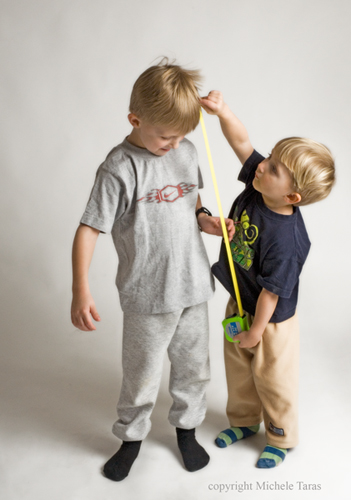
When I was a first grade teacher, I learned a number of things:

Copyright Michele Teras

1) You cannot possibly repeat yourself enough;

2) You must always be in two, preferably three, places at once;

3) Take note of who the miscreants are on Day 1, then win them over.

But the most profound thing I learned was that somewhere between the end of kindergarten and the middle of first grade, we begin to measure ourselves against others, and to form a picture of where we fall on the human continuum. We start to judge our abilities, and those judgments are not often kind.

This ability to assess situations and people, to form judgments is developmental and necessary. If we couldn’t distinguish between the trustworthy and the unreliable, between a safe course of action and a dangerous one, we would not survive long. But its corollary is that we

history.com
history.com

often rank ourselves and our efforts against heroes past and present—Alan Turing, Eleanor Roosevelt, Nelson Mandela, Malala Yousafzai—and conclude we are inferior. I saw brilliant kids falter as they began to realize other kids were brilliant, too, and I understood the question they silently asked: Just how much more brilliant, and what does this say about me?

Reconciling Our Ideal and Real Selves

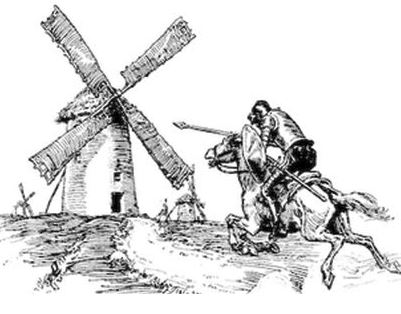
Like Dorothea Brooke or Tertius Lydgate, we each harbor an ideal self. Someone who makes their mark on the world in some profound, indelible way. The scientist who discovers a cure for cancer. The lawyer who takes on the big corporate interests and scores a game-changing win for environmental legislation. The writer whose novel brilliantly reveals the truth of our times. The teacher whose passion for learning changes the lives of her students forever. Our ideal self embraces the challenge, works tirelessly, brusheslove-self-don-quixote-tilting-at-windmills-capture off setbacks, laughs in the face of adversity, and is beloved by all who champion the good.

If this seems an exaggeration, consider the thousands of films and books that feature a protagonist who against all odds takes on the impossible challenge and succeeds. We are drawn to these stories because in their characters’ indefatigable courage and devotion, we glimpse our best true self.

But the movie/book invariably ends and we’re back to real life in real time. A world where meals need fixing and kids need caring. Where cars break down and furnaces die. Where our control is limited and our efforts often go unremarked. Where the best-laid plans fly right out the door.  And rejection truly hurts.

In this world, the rose-tinted glasses are off and we bump up against our very human limits not infrequently. In this world, we are not always so kind to ourselves. How could I be so stupid as to miss that opportunity? Only an idiot would have done that. Everyone else knows how this works except me. We threaten to kick ourselves for being too slow, too timid, too naïve, too lazy. Like my first graders, self-accusation follows self-assessment, and doubt follows both. But does all the negative self-chatter actually bring us closer to who we hope to be, or does it just bring us down?

Try A Little Tenderness

Writers, let me assure you, have ample opportunities for negative self-talk. We must constantly convince strangers who never asked us to write anything to look at what we’ve written. To read our short story, our novel, our screenplay. Most of them don’t, and many won’t even respond. We work in solitude, producing a product that is always subject to subjectivity itself. Your book is brilliant on Tuesday, godawful on Wednesday. Thursday, you salvage what you can, dump the rest, and continue. Any serious writer will vouch for the fact that the writing life is a constant zipline between ecstasy and despair. They will also tell you that they never quite “get it” the way they envisioned it. The ideal remains in the mind. The real is love-self-2nd-anne-color-saying-a622e70b25c04c3989562d851625641awhat tumbles out on the page. Yet somehow, out of this maelstrom  good books are born. Sometimes, even great books.

Like the lives of children teachers do change. Like the lives of people biologists and doctors do save. Like the social injustices lawyers and activists do right. Maybe we don’t always stop the bad guy, win the girl/boy, and save civilization, but we are better than we know.

Last week, I found this card in a store: Talk to yourself like you would to someone you love (Brene Brown).  The words surprised me in their resonance. As if their author understood my struggles, knew my vulnerabilities, and was kindly urging me to give my heart a rest.

Talk to yourself like you would to someone you love. Maybe we just need to cut ourselves some slack. Stop lambasting ourselves for all the ways (we think) we fall short, and begin counting all the ways we succeed. Offer ourselves the kind words we would offer a colleague, our children, a friend.

Eliot tells us the world regarded Tertius Lydgate as a man who “had gained an excellent practice,” a man whose “skill was relied on by many paying patients.”

But Lydgate only saw that “he had not done what he once meant to do.” Pity.


Never Cease Being Amused

“As long as you can laugh at yourself, you will never cease to be amused.”  (Anonymous)

Some months ago, a friend shared a story at a party. The NGO she works for is part of a global project involving a half dozen other NGOs. Right in the middle of a networking weekend, no one could get access to the project’s shared online folder. People from Amsterdam to San Francisco were frantically e-mailing each other: Where’s our data?! When the dust settled, it transpired that one of the participants had moved on to another job and wiped the old files from his computer to gain usable space. Unfortunately, he was listed with Google as the administrator on the folder. When he erased his copy, he unwittingly erased all the members’ copies.

comedy-oops-button-5-ways-to-avoid-embarrassing-moments-on-social-mediaEveryone at the party had a good laugh over this little tale of digital mayhem. Probably because: 1) we could all imagine ourselves doing something equally stupid, and 2) we were relieved we hadn’t been the one to do so in this instance.

Since then, I’ve often found myself chuckling over this incident and wondering if its innocent perpetrator saw its humorous side—after all, no one was hurt and though it was a nuisance, the remaining NGO members were able to reconstruct the folder from their individual notes. I hope he can laugh as we at the party laughed, but I’m doubtful. We tend to suffer the embarrassment of our mistakes for a long time. Sometimes to the grave.

There’s a lot of pressure to perform to perfection out there. Mistakes are anathema—heads will roll, et cetera—yet who among us doesn’t make them?

To compound the problem, we are vulnerable to something psychologists call the “Spotlight Effect.” When we think we’ve screwed up—called a prospective employer by the wrong name, tripped over a cord as we made our way to the podium to give a speech, sent the wrong manuscript to an editor—we tendcomedy-credit-writingpad-com-embarrassing-moment-615x461 to freak out, imagining that everyone saw, that everyone now thinks we’re awkward, stupid, incapable. This magnification of our own mistakes has two negative effects: 1) To avoid any risk of humiliation or rejection, we become much more guarded in what we say and do; 2) As a consequence, we drain a lot of the joy from our lives.

Tragedy + Time = Comedy

My husband once set his hair on fire while trying out an expensive cigarette lighter in a posh department store. My friend Pete swallowed a piece of ham tied to a string while doing an experiment on peristalsis. I hauled around my three-week-old son at the bottom of a Snugli, like a sack of potatoes, until a woman in the supermarket told me there was a little button-in cloth seat for newborns. Embarrassing? Well, in the case of the peristalsis experiment gone awry, maybe more frightening than humiliating. The point, though, is that these anecdotes, told and retold over the years, have become the source of much hilarity and bonhomie. As comedian and writer Steve Allen said: Tragedy + Time = Comedy. Our most embarrassing missteps become our funniest stories, the ones everyone asks us to repeat.

filmywar.com
filmywar.com

But what if we just cut to the chase and start laughing at our foibles the moment we spill the lasagna all over our lap, drop our cell phone down a restaurant toilet, forget to attach the CV to our job application? Life should come with a beeper, warning us when we’re about to screw up, but it doesn’t, so we need to adopt the ability to laugh at ourself.

My dad could be ornery, and he was not much with the compliments, but he could always laugh at himself. It’s probably the most important thing I learned from him. I remember one time in a restaurant, he was fixing his coffee. “Geezus, this cream is thick,” he remarked as it fell in chunks from the little pitcher into his cup. “Oh no,” my mom cried, “that’s my blue cheese dressing. I asked for it on the side.” Now, my dad could have blamed his mistake on the low lighting or the waitress’s failure to set the blue cheese next to my mom’s plate or the stupidity of a restaurant that would put both cream and blue cheese in identical pitchers. But he just laughed. Because it was funny. Because there’s no point in pretending you didn’t do what you did. Because no one is perfect. And then he ordered a fresh cup of coffee.

Mistakes—we all make ‘em. So, laugh it up. And if the people around you can’t cope with this very human reality, maybe you just need different people.

comedy-two_people_laughing