Never Cease Being Amused

“As long as you can laugh at yourself, you will never cease to be amused.”  (Anonymous)

Some months ago, a friend shared a story at a party. The NGO she works for is part of a global project involving a half dozen other NGOs. Right in the middle of a networking weekend, no one could get access to the project’s shared online folder. People from Amsterdam to San Francisco were frantically e-mailing each other: Where’s our data?! When the dust settled, it transpired that one of the participants had moved on to another job and wiped the old files from his computer to gain usable space. Unfortunately, he was listed with Google as the administrator on the folder. When he erased his copy, he unwittingly erased all the members’ copies.

comedy-oops-button-5-ways-to-avoid-embarrassing-moments-on-social-mediaEveryone at the party had a good laugh over this little tale of digital mayhem. Probably because: 1) we could all imagine ourselves doing something equally stupid, and 2) we were relieved we hadn’t been the one to do so in this instance.

Since then, I’ve often found myself chuckling over this incident and wondering if its innocent perpetrator saw its humorous side—after all, no one was hurt and though it was a nuisance, the remaining NGO members were able to reconstruct the folder from their individual notes. I hope he can laugh as we at the party laughed, but I’m doubtful. We tend to suffer the embarrassment of our mistakes for a long time. Sometimes to the grave.

There’s a lot of pressure to perform to perfection out there. Mistakes are anathema—heads will roll, et cetera—yet who among us doesn’t make them?

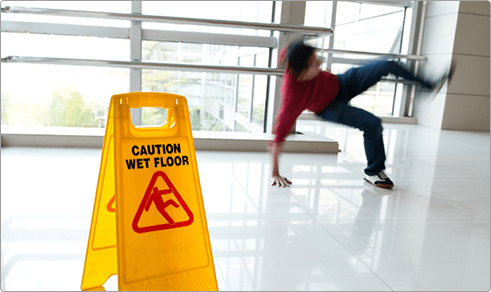
To compound the problem, we are vulnerable to something psychologists call the “Spotlight Effect.” When we think we’ve screwed up—called a prospective employer by the wrong name, tripped over a cord as we made our way to the podium to give a speech, sent the wrong manuscript to an editor—we tendcomedy-credit-writingpad-com-embarrassing-moment-615x461 to freak out, imagining that everyone saw, that everyone now thinks we’re awkward, stupid, incapable. This magnification of our own mistakes has two negative effects: 1) To avoid any risk of humiliation or rejection, we become much more guarded in what we say and do; 2) As a consequence, we drain a lot of the joy from our lives.

Tragedy + Time = Comedy

My husband once set his hair on fire while trying out an expensive cigarette lighter in a posh department store. My friend Pete swallowed a piece of ham tied to a string while doing an experiment on peristalsis. I hauled around my three-week-old son at the bottom of a Snugli, like a sack of potatoes, until a woman in the supermarket told me there was a little button-in cloth seat for newborns. Embarrassing? Well, in the case of the peristalsis experiment gone awry, maybe more frightening than humiliating. The point, though, is that these anecdotes, told and retold over the years, have become the source of much hilarity and bonhomie. As comedian and writer Steve Allen said: Tragedy + Time = Comedy. Our most embarrassing missteps become our funniest stories, the ones everyone asks us to repeat.

filmywar.com
filmywar.com

But what if we just cut to the chase and start laughing at our foibles the moment we spill the lasagna all over our lap, drop our cell phone down a restaurant toilet, forget to attach the CV to our job application? Life should come with a beeper, warning us when we’re about to screw up, but it doesn’t, so we need to adopt the ability to laugh at ourself.

My dad could be ornery, and he was not much with the compliments, but he could always laugh at himself. It’s probably the most important thing I learned from him. I remember one time in a restaurant, he was fixing his coffee. “Geezus, this cream is thick,” he remarked as it fell in chunks from the little pitcher into his cup. “Oh no,” my mom cried, “that’s my blue cheese dressing. I asked for it on the side.” Now, my dad could have blamed his mistake on the low lighting or the waitress’s failure to set the blue cheese next to my mom’s plate or the stupidity of a restaurant that would put both cream and blue cheese in identical pitchers. But he just laughed. Because it was funny. Because there’s no point in pretending you didn’t do what you did. Because no one is perfect. And then he ordered a fresh cup of coffee.

Mistakes—we all make ‘em. So, laugh it up. And if the people around you can’t cope with this very human reality, maybe you just need different people.

comedy-two_people_laughing


Some Progress Is Always Better Than No Progress

Don’t judge each day by the harvest you reap, but by the seeds you plant.  (Robert Louis Stevenson)

Along with debates, campaign speeches, and a slew of primaries, election years seem to bring out the cynics among us, all of them asking, “What’s the point?” Undoubtedly, there are some born-to-be-negative cynics, but I suspect most cynicism springs from disappointed idealism. People who hold a much-cherished Big Picture of a perfect world, and feel cheated and angry when it fails to materialize. All measures short of complete victory are tantamount to failure.

In all this, the Little Picture—the stories of real people in real time, their welfare, their fate—tends to get lost.

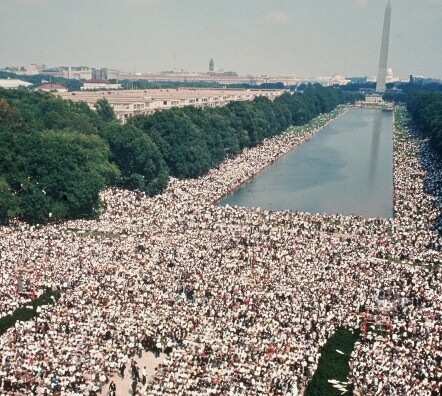
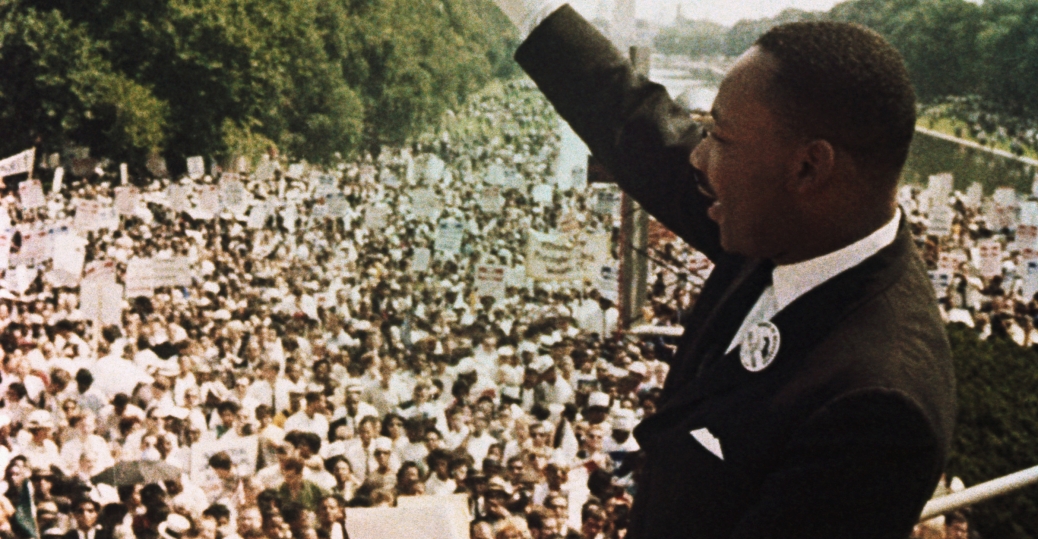
AUG 24 2 mlk_march_on_washington-PLet me be clear: Having a Big Picture view is essential to progress. Big Picture thinking allows us to see the connections between seemingly disparate events. It enables us to consider the extent of a situation: Is it local, national, global? An isolated incident, a series of coincidences, or a systemic issue? Grasping the Big Picture is key to formulating long-term goals and strategies. As the folk song says, it’s about keeping our “eyes on the prize.”

But, the Little Picture is where we live.

It’s where those featureless pixels in the Big Picture become recognizable faces, grow names, sprout human needs. Where a family of refugees tugs at your heart because you have a family, or have lived through a disaster, or are the child of immigrants. It’s the picture in which we recognize our humanity in the faces of others.

The Little Picture is not a selfie. It’s not about viewing the world from the comfort of your own armchair and asking “What’s the problem? I’ve got mine, Jack.” Not the egocentric attitude expressed by Mel Brooks’s character in The 2,000 Year Old Man: “Let ‘em all go to hell except Cave 76!”

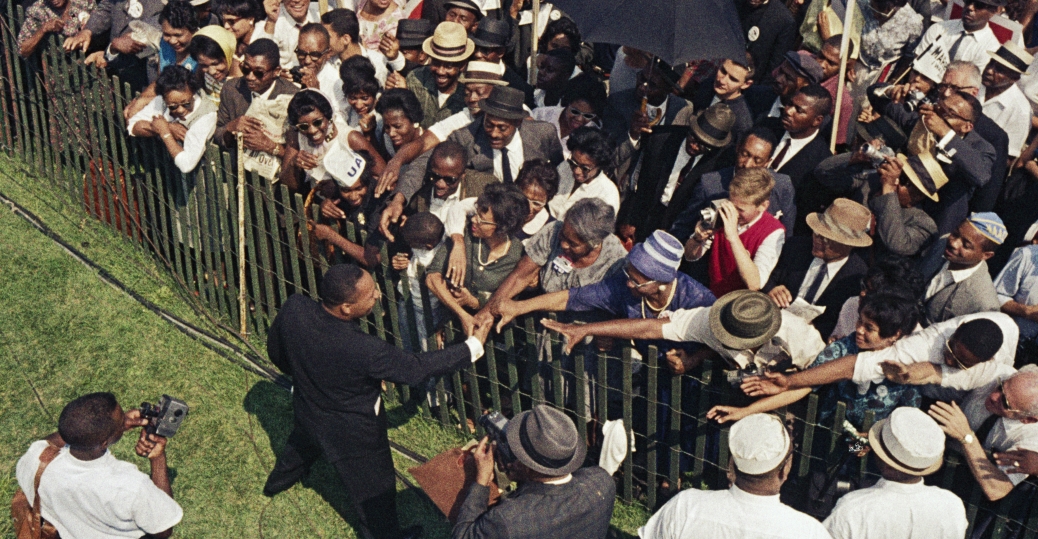
It’s about seeing the actual lives behind the numbers. It’s about the significance of helping someone even when you can’t help everyone. It’s about remembering that someday, somewhere, that someoneAug 24 3 mlk_shaking_hands-P in desperate need of immediate aid may turn out to be your child, your parent, you. It’s the answer to “What’s the point?”

I was reminded recently of the significance of the Little Picture—how far its ripples on the larger pond can travel— in an e-mail from North Carolina Policy Watch. It seems that Americans tend to be pretty blasé about the routine nuts and bolts of our democracy, such as the selection of federal judges (which, by the way, is directly related to who’s in the Oval Office and who has the majority in the Senate). The federal judiciary is not the stuff of pumped-up passion and fireworks. Many of us would be hard-pressed to name even one federal judge. Yet, it wasn’t the Supreme Court, but the United States Court of Appeals for the Fourth Circuit that struck an “… immense blow for the future of democracy, inclusion, and the effort to combat discrimination” when it ruled North Carolina’s voter suppression law unconstitutional on July 29 of this year (NCPW). Similar U.S. Court of Appeals decisions have come down recently in Texas and Wisconsin.

Are these individual state rulings as good as Congress restoring the Voting Rights Act in its entirety? No. Are these decisions, which enable several million students and non-white voters (both targets of voter suppression) to have a voice in our elections, better than waiting for Congress to restore the VRA? Undeniably.

Waiting for Godot: The Perfect vs. the Good

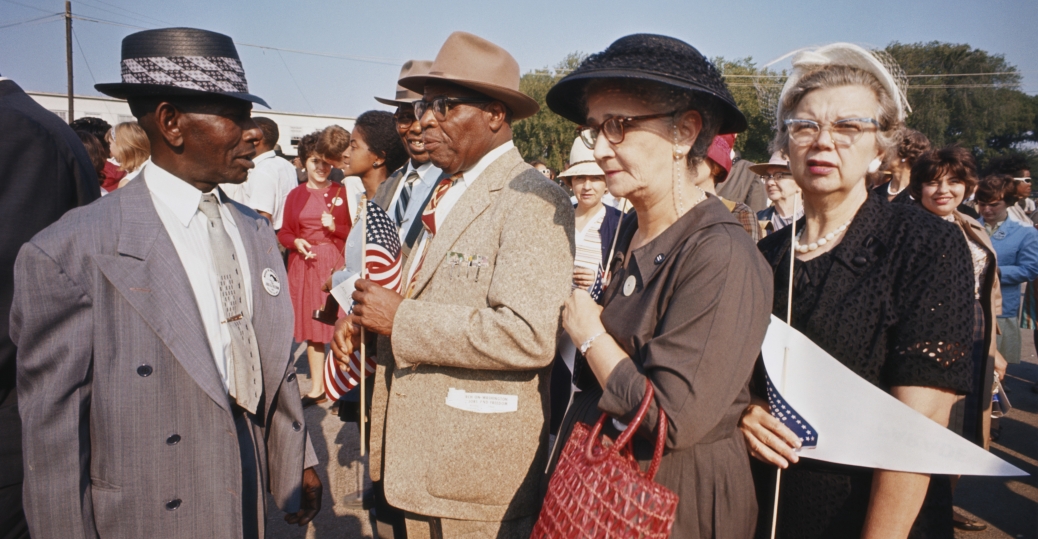
Aug 24 4seniors_march_on_washington-PVoltaire wrote: Don’t let the perfect be the enemy of the good. The Big Picture is often the image of an ideal: Health care for everyone. Adequate housing and education for all people. Environmental standards that not only halt damage to the planet but actually reverse the destruction to our air, water, and soil. An end to all violence worldwide.

These Big Picture goals are admirable, majestic, profound. But the roughly 20 million Americans who now have health insurance, thanks to the Affordable Care Act, are not just numbers. They are diabetic teens and adults who did not die due to a pre-existing condition. They are children who did not die from a strep throat or a ruptured appendix because their parents cannot afford to pay $800 a month with a $3,000 deductible—in essence, paying an insurance company $10,000 a year and then having to pay for most or all of their healthcare expenses. They are people working 2-3 part-time jobs, whom no one will hire full-time because that would mean giving them benefits, including healthcare coverage.

So, is the ACA a failure because 30 million Americans still remain uninsured? As one of the millions of self-employed workers for whom it made healthcare possible, I am grateful every day. As one of the 7.4 billion human beings on this planet, I know we still need to do more.

But waiting for a perfect world, a perfect system, the perfect candidate—it’s like waiting for Beckett’s Godot. It just ain’t comin’. And nothing in history supports the idea that it ever will. So we can sit on our hands in protest at the imperfect or we can dive into the fray, do what we can to improve things for more people, and make good with what we get. In truth, I’m convinced it’s the only way to achieve anything. The journey of a thousand miles always begins with a single step. We start with the Little Picture and strive to paint a larger, wider canvas from there.

The Civil Rights Act of 1964 speaks to this eloquently.

The CRA came about:Aug 24 5 core-P

Because in 1961, black and white civil rights activists rode interstate buses into the segregated South. These “Freedom Riders” wanted to highlight the Interstate Commerce Commission’s failure to enforce earlier Supreme Court decisions that had ruled segregated public buses unconstitutional (Irene Morgan v. Commonwealth of Virginia, 1946; Boynton v. Virginia, 1960).

Because in 1960, four black students held a sit-in at a whites-only lunch counter in Greensboro, North Carolina. Within a week, the movement grew from four to 300, and the sit-ins fanned out to other segregated lunch counters in Greensboro, then to other cities and states across the Jim Crow South.

Because in 1957, the “Little Rock Nine”—nine black students, registered by the NAACP and escorted by federal troops—became the first black pupils to attend the all-white Little Rock Central High School.

Because in 1955, Rosa Parks sat down on a bus and refused to give up her seat to a white woman when the whites-only section was full, thus sparking the Montgomery Bus Boycott.

Because a woman named Sarah Louise Keys had done something similar in 1952, as had Bayard Rustin in 1947, and Irene Morgan in 1944. Back and back to Sojourner Truth and Frederick Douglass.

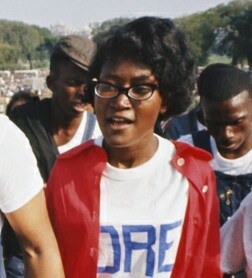
None of these actions freed all black Americans forever from discrimination and the savage violence of racism. Sadly, more than 50 years later we have ample proof of that. But that doesn’t diminish the Aug 24 next to last crop Aug 24 5 core-Psignificance of these advances or the courage of the participants or the outcomes of their actions. Taken separately, they are all Little Pictures. But they are also pieces of a much larger picture, one we are still painting. And despite setbacks, despite backlash, they have added up to real change for many, many Americans. That we still have a long way to go does not negate the lives improved, the lives saved. Each of them is, after all, someone’s only life.

The Starfish Story

I first heard the Starfish story when I was doing my M.Ed. It goes something like this:

A man is walking along the ocean and sees a beach where thousands and thousands of starfish have washed ashore. Further along he sees a young woman picking up one starfish after another and tossing each one gently into the ocean.

“Why are you throwing starfish into the ocean?” he asks.

“Because the sun is up and the tide is going out and if I don’t throw them further in they will die.”

“But,” the man says, “don’t you realize there are miles and miles of beach and starfish all along it! You can’t possibly save them all, you can’t even save one-tenth of them. In fact, even if you work all day, your efforts won’t make any difference at all.”

The young woman bent down, picked up another starfish, and threw it into the sea. “It will make a difference to that one.”

Everything we do that makes life a little better for another person matters.

And that’s the point.

Aug 24 6 closest crop core-P

Source: All photos from the March on Washington, August 28, 1963:

http://www.history.com/topics/black-history/march-on-washington/pictures/march-on-washington/core-members-at-march-on-washington


One Disaster At A Time

“Life is just one damn thing after another,” American writer Elbert Hubbard once observed. Ah, if only it were that simple. In my experience, life is usually dozens of damn things, converging all at once like a bad pile-up on the Interstate.  But somehow, we’ve got to manage all the craziness bombarding us, so I’ve put together a little blueprint for meeting the challenge.

Acceptance

Two things to know here: 1) Life is always chaotic. 2) As humans, we are always trying to order this chaos. But how do you manage a thing like life? As with some fantastical dragon of yore, it seems to sprout two new heads for every one you slay. Revisions of one book teeter atop a stack of research for the rough draft of another, e-mails pile up in the Inbox, there’s nothing in the fridge for dinner, you’ve got a dental appointment, and your body is threatening mutiny if you don’t get to the gym soon. Over it all, dust settles on every surface and rolls in drifts across the floor like tumbleweed. A good day is when nothing arrives in the mail requiring your immediate attention.

Prioritizing, that mantra of you-too-can-be-organized gurus, is useful and arguably an absolute necessity when you’ve got a deadline (especially the sort involving contracts, lawyers, and money). But let’s be practical—sooner or later, someone’s gotta unload the dishwasher.

Posit #1: It is not possible to do everything at once. It is not even possible to always do the most important thing first. If you’re rushing to get edits done and the pipe bursts under the kitchen sink, are you going to finish Chapter 12 or call the plumber and start mopping?

This is where perspective comes in handy.

Perspective

overwhelmed man behind wheel photo-1434210330765-8a00109fc773

In the 2015 film, The Martian, during a manned mission to Mars, Astronaut Mark Watney (Matt Damon) gets struck by debris, then lost, in a whammy of a dust storm. The biometer on his spacesuit is now busted and quits chirping, leaving the rest of his crew to assume he’s dead. In peril themselves, they boogie out of there. Watney regains consciousness to find himself alone, on Mars, with no working communications gear, a length of antenna lodged in his gut, and a limited supply of food in “the Hab” (the crew’s martian living quarters). His only hope is to survive until the next scheduled crew lands at the Schiaparelli crater 2000 miles away in four years.

I would argue that life doesn’t get more challenging than that.

Posit #2: If you’ve got most of your body parts, a working mind, and you haven’t been stranded on another planet, then there’s hope.  

But it helps to recognize and respect our human limits. Multi-tasking, that great savior of the ‘80s, turns out to be more myth than fact. Our computers may be able to open 12 windows at once, but we cannot. And trying to do so just results in a lot of stress, silly mistakes, and badly-burned dinners.

Which leads to the necessity of developing some basic life philosophy about our limitations and how to deal with them.

Basic Life Philosophy

When I was raising kids and teaching school and writing a book and doing the cooking, laundry, et cetera, I realized I would go right smack out of my head if I didn’t figure out some way to juggle the chaos. As with most things, necessity proved to be the mother of invention. One evening, with dinner bubbling on the stove, two dozen cupcakes baking in the oven for a fundraiser, and a pile of federal tax forms waiting on my desk, my daughter informed me we needed to do a science experiment that night for her class project the next day. She began listing the many items we would need. Wiping a strand of hair from my (tired) face, I gave her one of those smiles parents employ to keep from committing hara-kiri before their children’s eyes. “One disaster at a time,” I told her. Thus was born my succinct philosophy for managing the impossible.

Posit #3: You don’t need a 48-hour day (though if you know where one can be obtained, please write me immediately!). You need to exercise your power of choice.

Making Choices

CHOICE rHBf1lEaSc2nsbqYPQau_IMG_0177

A few weeks ago, I was feeling overwhelmed by all the stuff that needed doing RIGHT NOW.  And a tad cranky about how this was affecting the overall quality of my life. In a fit of take-charge/can-do, I made a list titled “Life Crushers.” (Okay, I was feeling very cranky.) On it were 11 items that felt like five-ton weights around my neck because it seemed: 1) I had to do them and there wasn’t time; 2) I wanted to do them and there wasn’t time; 3) I was just generally consumed with anxiety about them. Weirdly, I felt better as soon as I finished the list. Looking it over, I began to see choices rather than musts. I could work on two books simultaneously, or focus solely on the revisions for one, or take a break from writing. I could allot one day a week to deal with routine house stuff, tackle it in small doses daily, or wait until we have our next party. I could blog twice a month, once a month, never again. I made a list of 3-4 alternatives for each life-crusher. In most cases, my choices reflected my original goals, but the exercise helped me to see that I had more control and flexibility in my life than I’d realized. And that very little has to be done by any particular date.

Posit #4: You can slow the merry-go-round any time you want, rearrange the horses, or get off it completely. Yes, there are consequences for your decisions. Choice is not about escaping consequences. It’s about deciding what things you’re willing to pony up for and how high the price you’re prepared to pay.

At the close of The Martian, Matt Damon’s Watney (safely back on Earth) explains the reality behind their dreams to a class of wannabe astronauts. “At some point,” he tells them, “everything’s going to go south on you. You’re going to say, ‘This is it. This is how I end.’ Now, you can either accept that, or you can get to work. That’s all it is. You just begin … You solve one problem and you solve the next one, and then the next. And if you solve enough problems, you get to come home.”

Hey, it’s one disaster at a time. It’s what we all do. It’s really all we can do.

It is enough.

UNSUBSCRIBE ME, PLEASE!

“You’re in a mess, and in excess.”  Billy Strayhorn

I am a person who cares very deeply about the planet—how can I not? It’s my home. I also have a great fondness for humanity. As Ruth Gordon so aptly put it in Harold and Maude: They’re my species. I love cats UNSUB Global hands-600497_960_720and dogs, elephants, tigers, and the giant panda. I even have a soft spot—at a respectful distance—for the bees that pollinate the crops from which so much of our food comes.

Because of these various and numerous carings, I am the recipient of a staggering quantity of e-mail petitions and donation requests. Three-hundred is a “good” day, but a closer average is 500. More than that and you can hear me whimpering softly into my keyboard Please, let me have a life.

Well, problems demand solutions, so I have recently decided to weed through the druck and click on that little life-saver Unsubscribe Me. (I should have done it years ago, but I was too busy … answering e-mails.)

I’m not doing a Thoreau here and disappearing into the woods. I realize these are desperate times, and as such call for desperate measures. Or at least a quantity of $5 and $10 donations, and a daily dozen of signed petitions. So, how to separate the wheat from the chaff? Well, I believe there are situations whereUNSUB stacks of dollar-499481_960_720 our democracy needs lawyers on the ground, sometimes hordes of them, so I won’t be axing the ACLU. Likewise, I won’t part company with Planned Parenthood, People for the American Way, Democracy Now, the Union of Concerned Scientists, or the World Wildlife Fund. And I want to reassure the Humane Society that I’m still going to donate my lovely 2001 Ford Focus. I just need the use of it for another six weeks.

But, not all that screams READ ME THIS INSTANT is gold. So, gone is the magazine I declined to renew back in 2009, but which continues to send me weekly come-ons. (Read this woman’s lips: No means no.) History, too, are the BIG! SALE! NOW! adverts for clothing, designer cookware, and high-tech gadgets from companies I’ve never patronized.  It’s also arrivederci to the guy who’s always yammering on about tinnitus (I can’t hear you anymore.)

www.mailbait.info
http://www.mailbait.info

And though it pains me, because I think many of them are very good people, it’s time to be honest with myself and confess that I cannot possibly fill the campaign coffers of all 187 Democrats in the House on a writer’s income. (Democrat #188, Rep. Fattah  from Pennsylvania, saved me the trouble by resigning in June after being busted on corruption charges.)

Don’t worry Lizzie Warren. You are my hero, and you will always have my heart, my vote, and whatever spare change I find beneath the sofa cushions.


This purging of my Inbox is no small task, but already I feel wonderfully exhilarated. It’s made me consider what else in life I might unsubscribe to. A sort of thinking outside the (in)box. So far, my wish list of things I’d like to vanquish with the click of a mouse includes:     UNSUB dirty-dishes

1)Any repetitive task involving cleaning—washing dishes, scrubbing toilets, mopping floors, sieving the cat box. Bye!

2)Junk mail consisting of credit card come-ons, solicitations for “free” dinners to discuss investment strategies for the 401K I don’t have, and ultra-posh catalogs ($275 for a pair of shorts? I’ll think about it when I stop laughing).

3)All yardwork that involves heavy weeding. We have—and I want to emphasize this—a very, very small yard. We chose our house with its wee lot because we DO NOT LIKE yardwork. We like writing and reading, bicycling and enjoying a gin-and-tonic on the deck. Yet, despite the terraced garden I created to cover the front lawn, and the pavers we laid down for a patio to cover the back yard, I still dig and clear 35-40 giant bags of what our landfill correctly labels “yard waste.”

Credit City of Cincinnati

How is it possible that palm oil deforestation is wreaking havoc on half the world and here in my puny 4,000 sq. ft. lot, a jungle abounds?

4)Speaking of havoc in the larger world, unsubscribe me from TV, radio, and print pundits who just spout whatever outlandish drivel comes into their heads for the sole purpose of ramping up their ratings, while sowing discord, escalating tensions, and mongering fear (I’ve always wanted to use monger as a verb!).

5)Related to #4, I would like to cancel the 24-hour news cycle, period. Possibly the worst innovation to come out of the media explosion cable TV introduced, it leads otherwise reasonable newscasters to say things like, “Michael Jackson will only die once.”

6)Also high on my list of things to delete is that phone-answering set-up where an improbably zombie-like computerized “woman” asks you questions, then insists you speak your answer into the void. No matter how slowly and clearly you enunciate, “she” never quite “hears” you.

www.thewhy.com
http://www.thewhy.com

Sample “conversation:”

Zombie woman: Are you experiencing any fever? Just say yes or no.

You: Yes.

ZW: I’m sorry. I didn’t quite understand your reply. Could you repeat that?

You (perspiring heavily): Yes! My temperature is 104!

ZW:  I’m sorry. Can we try that again?

You (swooning): 104! My temperature is 104! I’m burning up!!!

ZW: Let’s try a different question.

You (dead):

7)And last, but certainly not least, please save me from any political “debates” where candidates compare the size of their hands, ears, nose to any other part of their anatomy as if it had any relevance to world hunger, global warming, or the desperate needs of refugees.

I mean, seriously, Beam me up, Scotty!

Paramount/Everett/Rex Features

The Thing That Cannot Be Changed

And while the future’s there for anyone to change, still you know it seems
It would be easier sometimes to change the past. . .
(“Fountain of Sorrow” Jackson Browne)

Sometimes, it’s something we truly earned—and didn’t get. The career-making job that would have launched our dreams. Sometimes, it’s something we never had, but always craved. Parents who could love us. And sometimes it’s just one terrible moment: The car we failed to see in time. Whatever it is, in most of our lives there lurks The thing that cannot be changed. It’s the moment, the decision, the situation that all our effort and talent and endurance cannot alter or undo.

Successful writers and actors, business people and ballplayers, if they’re honest, often mention the role luck played in their achievement. Along with the hard work and long hours, they confess to being in the right place at the right time. No one mentions the opportunities that went to someone else, the love that never materialized, the awful accident of standing in the wrong place at the wrong time.

THING fantasy-1275253_960_720And that’s the hardest part about The thing that cannot be changed. It’s almost never the result of our own doing. Perhaps that’s why it looms so large. It lies outside our control, and people like to control their own lives. When someone else denies us our most basic needs, tramples our dreams, we experience it as an injustice, and injustice bites deep. Its grip is tenacious.

Yet, we must learn to live with The thing that cannot be changed. Thrive in spite of it. Not let it swamp us internally or accept it as a judgment of our own worth. There’s a myth that only losers suffer from The thing that cannot be changed. That successful people simply leave adversity in the dust. Would that it were it so easy.

“The Places That Failed Us Before”

Tennessee Williams was a two-time Pulitzer prize winner and hailed as one of the greatest dramatists in 20th-century American theater. Decidedly a brilliant writer and a great success. But he was never able to stare down The thing that cannot be changed.

 For Williams, The thing was twofold: The abusive, alcoholic father who disdained and bullied a son he considered weak; and the controlling, puritanical mother horrified by all things sexual. Williams heard their message loud and clear: “You are wrong as you are.”

chicagotribune.com
chicagotribune.com

In one particularly harrowing incident, his father hauled him out of the University of Missouri after he failed a military training course in his junior year, and put him to work in the factory of the International Shoe Company where the senior Williams was an executive. Tennessee hated the daily grind and eventually suffered a nervous breakdown.

After he recovered, Williams enrolled in another college, and later studied at the Dramatic Workshop of The New School in New York City. Speaking of his early days as a dramatist, collaborating with others on a play for an amateur summer theater group, Williams wrote, “The laughter … enchanted me. Then and there the theatre and I found each other for better and for worse. I know it’s the only thing that saved my life.”

The hope in that last sentence is moving; its subtext, haunting: If I just work hard enough, long enough, I can write my way free of my pain. But he never did. Despite using that pain to create some of the most memorable characters on the stage (Big Daddy, Amanda Wingfield), he remained trapped within The thing that cannot be changed. Elia Kazan, who directed many of Williams’s plays said, “Everything in his life is in his plays, and everything in his plays is in his life.”

In 1939, with the assistance of his agent, he received a $1,000 grant from the Rockefeller Foundation for a play he was writing, Battle of Angels. The play foundered when it opened, but Williams was on his way. And yet, a poem he penned that same year reveals how badly The thing that cannot be changed dogged him. Cried the Fox speaks of an animal, running in ever-narrowing circles—frantic, desperate, lonely—always coming back to the places of past hurt and doubt.

Williams once remarked that “A high station in life is earned by the gallantry with which appalling experiences are survived with grace.” But the undertow of those experiences finally claimed him. He died of asphyxia, an accident related to the quantity of alcohol and drugs he consumed over the last 30 years of his life. His obituary in The New York Times (February 27, 1983) paid homage to him as “a master of dramatic moments who created lost, tortured characters struggling for dignity and hope in a world that often denied both.”                                                                


Beyond Her Own Pain and Anger

Helen w/ Annie Sullivan

Helen Keller became acquainted with The thing that cannot be changed at 19 months, when a severe illness left her blind and deaf. Imagine the terror of that. Your world goes dark and silent, and you are too young to even grasp why. By all accounts, Helen spent the next five years in a rage, rejecting every attempt to reach her. It was only when the young teacher, Annie Sullivan, at last broke through that dark silence and communicated with her, that Helen understood there might be something beyond her own pain and anger.

As an adult, she used that discovery to help other people afflicted with blindness. She joined the American Foundation for the Blind. For 40 years, this organization served as her global platform to advocate for people with vision loss. She saw to it that state commissions for the blind were established, rehabilitation centers were built, and education was made accessible to children without sight. She also championed the rights of working people and women’s suffrage.

It is a hard thing for us humans to accept, but the bottom line is this: We cannot control other people and we cannot change the past. We can only control our own actions and responses. So when The thing that cannot be changed brings us to our knees, as it sometimes will, we must learn to breathe with it. As Helen Keller discovered, it is one aspect of our personal story, but it is not our whole story. So we own it, and then we rise up. And carry on.

THING summer-1458129_960_720