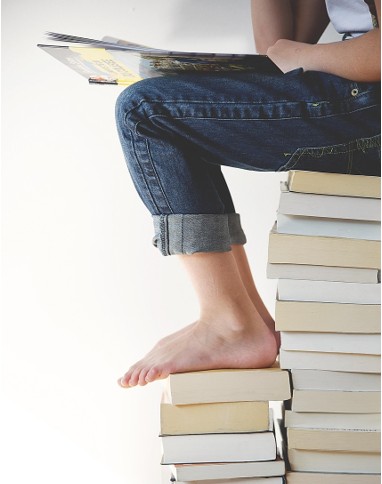
(NOTE: I took this month’s post title from the wonderful organization of the same name. Founded by Margaret McNamara sixty years ago, Reading Is Fundamental is the very definition of a labor of love. Eager to put books into the hands of every child in underserved communities—free books they could take home and keep—McNamara started buying used titles with her own money while tutoring children in Washington, DC. Her efforts really took off when the Ford Foundation gave her a grant of $150,000. And the good work she began continues today as RIF provides 100 free books, through a reading app called Skybrary, to any child, anywhere in America, who wants them. Thank you, Margaret. Your work has never been more essential than it is today.)
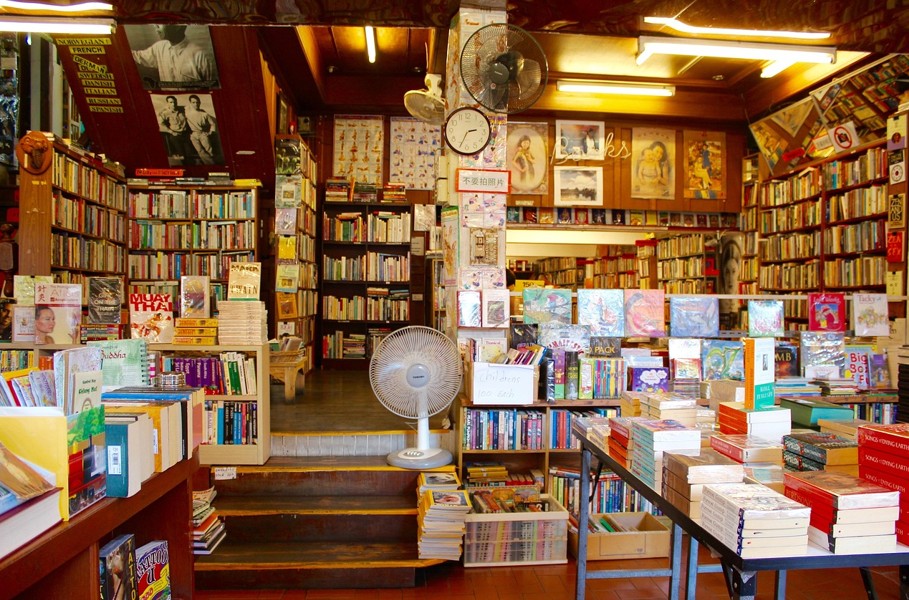
Every year, on the last day of our London trip, we make three stops: Foyles on Charing Cross Road, possibly the most magnificent bookstore in the world—six enormous floors stuffed with books (and that’s not counting the very tasty café where we always pause for lunch and the events auditorium above that). Then, it’s on to the Waterstones flagship store in Piccadilly Circus, said to be the largest bookstore in Europe, before winding down the day at Hatchards, London’s oldest bookshop founded in 1797. At each of these—every one a bibliophile’s dream—Ed and I both grab a hand basket, arrange a time and meeting place, then diverge to sift through the offerings (some 200,000 titles each at Foyles and Waterstones, and 100,000 titles at Hatchards) and load up our favorite finds. When time’s up, we go to the main counter—where we do a quick check to make sure we’re not buying any duplicates—and arrange to have our purchases shipped to the States. We’re like two kids set free in a candy store. And man, do we stuff ourselves! This year, though, the shipping costs to the States charged by Waterstones and Hatchards—in retaliation for Trump’s tariffs—almost doubled the price of each book, so we had to put our marvelous finds back on the shelves and then order them online from Alibris at home—thanks a lot, Rumpy!
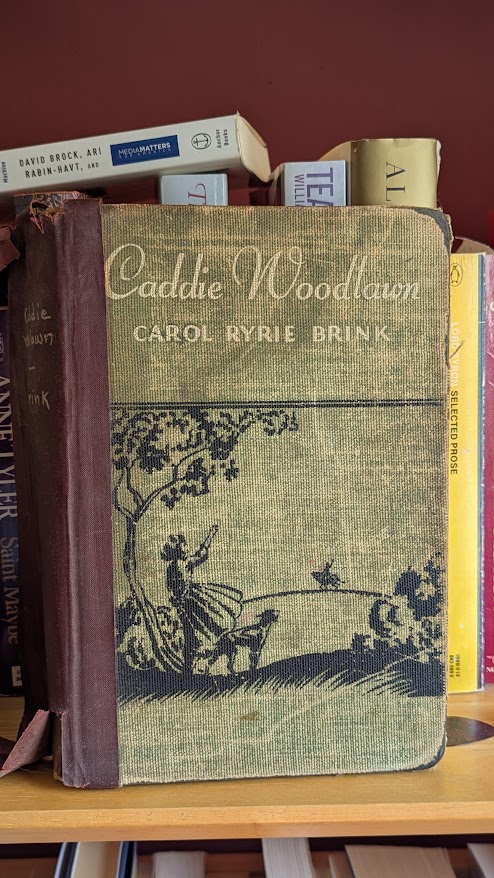
But our disappointment was soon assuaged when we received the Foyles books two days after our return (they ship amazingly fast!). Twenty-four new titles in all! Never mind that our modest three-bedroom home is already bursting at the seams with books, one of the oldest among them Caddie Woodlawn, by Carol Ryrie Brink, the story of a spirited, untamable ten-year-old tomboy running wild with her brothers on the Wisconsin prairies during the Civil War. A book my mom found at the local library tag sale. A treasured tome I had read at least ten times before I was Caddie’s age.
Never mind that our TBR piles will undoubtably last us well into our second century on the planet. As a woman reading to her toddler in the Foyles café remarked when we told her of our annual book spree, “Why, of course. You don’t wait until you run out of groceries to buy more.”
Exactly.
Priorities, Priorities!
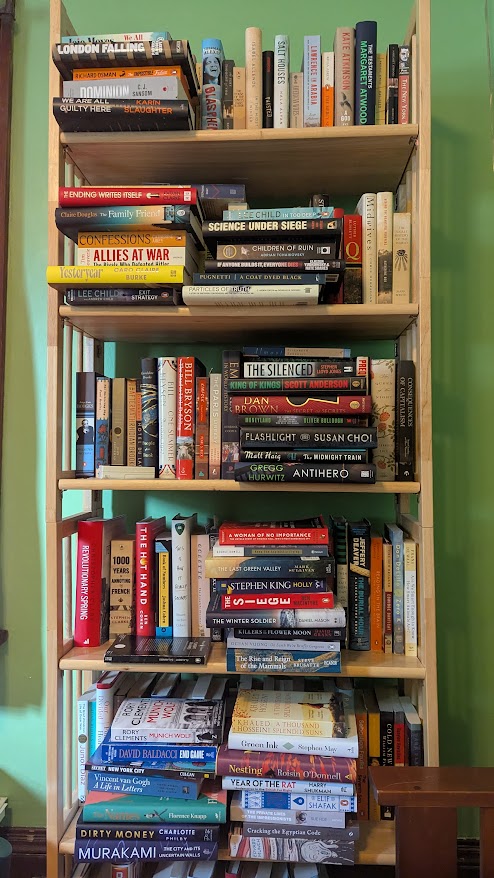
In our house, reading is fundamental. So what if the sofa’s a tad threadbare. Or the dining room chairs are a bit scuffed up (OK, maybe more than a bit). We must have books! Reading is pleasure, reading is discovery, reading is knowledge. Reading is power! The power to understand the world around you. Its people. The tangled web of their deeds and interactions (good and bad). To grasp in all its complexity the human condition. How we got here. Why things are the way they are. Who is behind this progressive reform or that racist atrocity. Where we may be headed.
Sadly, though perhaps not surprisingly, the U.S. ranks 36th in literacy in the world, and even that statistic carries a caveat: Of the 79% of U.S. adults deemed literate, the vast majority of these read at or below a sixth-grade level. And an astonishing one in five adults are functionally illiterate. Their inability to read or write leaves them woefully unable to navigate daily life. Medical forms. Job applications. Legal agreements. Written instructions of any kind. Reading IS fundamental.
The Gift of a Lifetime
My mom was a woman who had her problems. A talented artist in the era of “No wife of mine is going to work outside the home,” time hung heavy on her hands, so she read to me and read to me and taught me how to write the alphabet. By age four, I was reading on my own. Simple children’s picture books soon gave way to Charlotte’s Web by E.B. White and The Boxcar Children by Gertrude Chandler Warner. By age 7, I was enjoying Louisa May Alcott’s Little Women (with a bit of help from Merriam-Webster). I never received a greater gift than that of literacy. When I have owned nothing else, I’ve always had shelves of books.
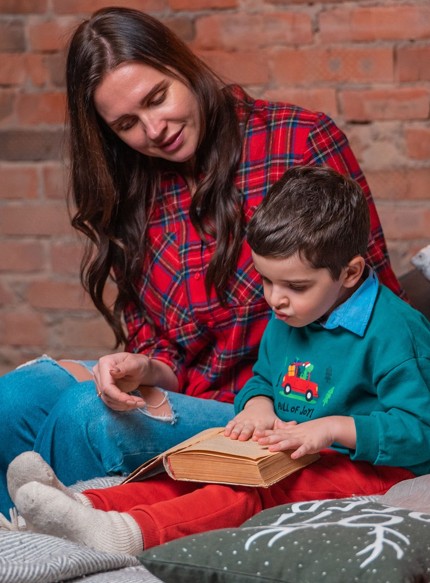
And I passed it on to my children, that lovely lifetime gift. A rainy day would find the three of us snuggled together on the sofa, a stack of storybooks on the coffee table, whiling away the afternoon as I read aloud the tales they had chosen. When the Scholastic book orders arrived each month in their classrooms, I could always spot my kids’ books when I arrived to pick them up—the largest pile in both cases. On the day my son left home at age 18 to teach English in China, he took my dogeared copy of John Steinbeck’s East of Eden. I was thrilled when I saw it peeking out of his backpack. In recent years, he has set himself a to-be-read list of books that any college literature major would recognize. When he’s home for the holidays, he selects one for us to read (or re-read) and discuss. This past December it was George Orwell’s Keep the Aspidistra Flying. Sharing books. Talking books. Exploring the past, present, and the imagined future.Reading IS fundamental.
And yet, reading for pleasure—or knowledge—has taken a precipitous drop in America. Forty-four percent of adults in the U.S. did not read a single book in the past year.
Sound Bites and Earbuds and Screens, Oh My!

Walk down any street. Survey the patrons of any coffee shop, subway car, or other place where people congregate. What do you see? Faces absorbed in screens, eyes glazed over, not the least sign of acknowledgement that those around them exist. Add those little white earbuds and the barrier is complete. Sadly, the future appears to promise only more of the same. The screen time for one-year-old kids now averages 53 minutes a day. By age 3, those screens consume almost three times that amount—a seriously sizeable chunk of the day for a toddler struggling to grasp the workings of the world around them. And many parents aren’t reading to their kids. We now have a generation of adults who, themselves having grown up on screens, are less inclined to read, and so regard reading as “a subject to learn” rather than a pleasurable or enriching activity.
Their children are adopting the same attitude. Even for those reading at or near grade level, the culture of social media has left its dark mark. Kids today get their info in sound bites and blurbs. They cannot attend to something as “huge” as an entire book. All those pages and pages! Some educators are tossing in the towel and giving kids bits of books. Excerpts. But our world—if we are to save it—demands its citizens be able to grapple with complexity.
Books Tell Us Where We’ve Been and Where We May Be Headed
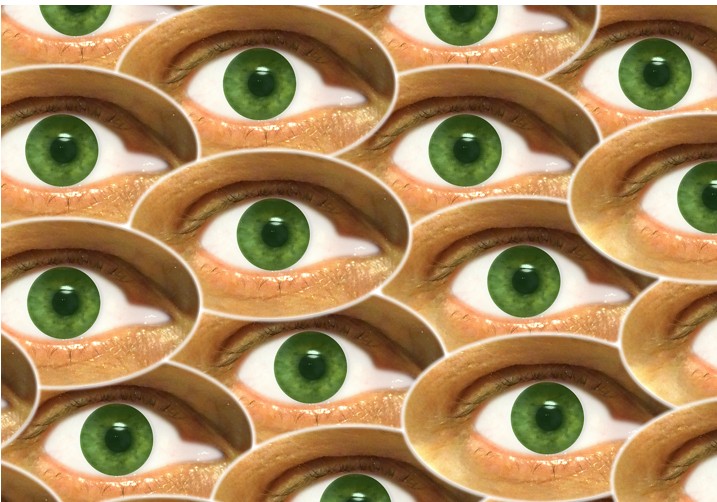
If books like John Steinbeck’s The Grapes of Wrath have something to say about where we’ve been, George Orwell’s 1984 has sounded the warning of where we may be headed since its publication in 1949. It depicts a future society held in blind obedience to The Party and its leader Big Brother, described in the book by one adherent as “the embodiment of The Party”, suggesting BB is more a myth than a real person—a convenient mechanism to control people through fear. And man, does it work. Citizens are constantly monitored via two-way telescreens, hidden cameras and microphones—never mind the host of civilian informers—as they go about their lives (beneath posters that remind them every minute Big Brother is Watching You). Anyone can be arrested by the Thought Police for even contemplating unapproved ideas. Offending The Party or Big Brother doesn’t end well, I assure you.
When our “Dear Leader” was elected the first time in 2016, following Obama, a president who gave us The Affordable Care Act and brokered the deal with Iran that prevented them from further nuclear weapons development—without spending billions or closing the Strait of Hormuz or killing a single soul—well, when that happened, there were enough concerned citizens, enough thoughtful readers still left in America to send sales of Orwell’s 1984 into the stratosphere. The book’s publisher, Signet Classics, reported sales increased nearly 10,000 percent in the days just following Trump’s first inauguration.
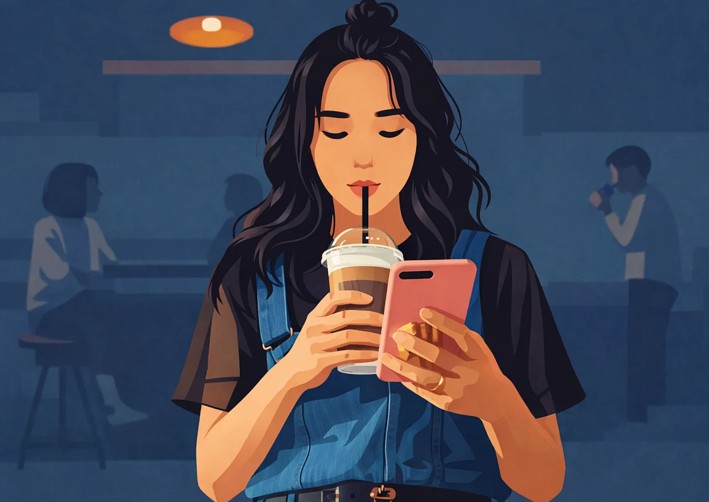
But now a decade has passed. The number of Americans who read for pleasure has dropped. As I noted above, more than forty percent of Americans read no books last year. And the number of Americans who read newspapers has also declined—by nearly two-thirds. Even cable TV news shows and websites are feeling the pinch these days. So where are people getting their news? Social media and video networks. TikTok and YouTube. We get our news in snippets and soundbites. Just like our kids.
As Vibhas Ratanjee noted in his article for Forbes: “Perspective comes from wandering across history, fiction and biography—where ideas collide and recombine into something new. Reading teaches us to hold ambiguity and to wrestle with contradictions.”
We desperately need a thinking population, a nation of people who can evaluate, compare and contrast, make connections. Who can read!
Only We Can Prevent This
For me, the most terrifying scene of the future world ever conceived came, ironically, not from a book, but from the 1960 film adaptation of H.G. Wells’ post-apocalyptic 1895 novel The Time Machine that I happened to see on an oldies movie channel when I was 12 (don’t worry, I ran right out to the library, checked out the book and later bought a copy—I wanted to know the whole story).
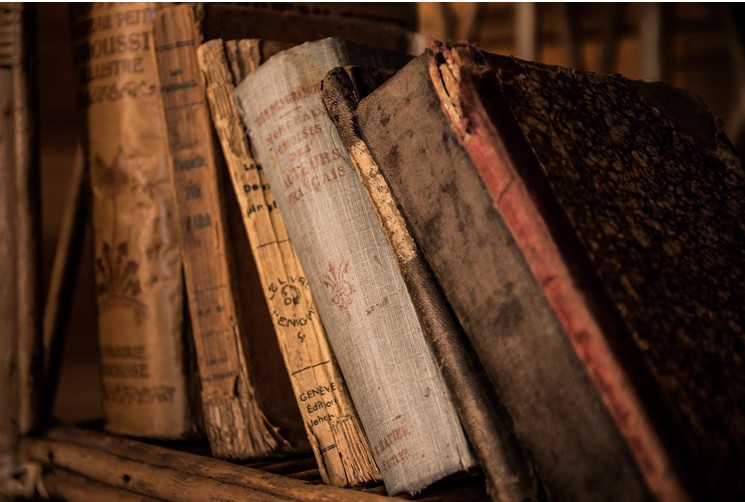
In the scene that broke my heart, and still brings tears every time I watch the film, the main character, the Time Traveller, witnessing the sorry state of the far future, asks the Eloi if they have any books. Yes, they assure him. They have books. But as it turns out, the single shelf of books they show him crumbles to dust at his touch. Long neglected. Now gone. Forever.
There are plenty of greedy, soulless people out there counting on your ignorance to make their deadly dreams come true. Don’t let them get away with it. Read. Read. Read.
READING IS FUNDAMENTAL!


Terrific essay. Terrific analysis of a discouraging situation. It’s incredible that 44% of adult Americans didn’t read any books last year. Sad, sad, sad. I know intelligent people who rarely if ever read books. So, not everyone in that 44% is an ignoramus. Still, the implications of the issues you raise and discuss don’t bode well for the future of the USA.
LikeLiked by 1 person
So glad you enjoyed the post, Neil. I think, at some point (growing up, college, etc.) you MUST read or you would be an ignoramus, but it’s certainly possible–though sad IMO–to have been a reader who no longer reads without becoming brainless. Though, I did a look around just now and there are numerous articles from reputable institutions on why reading continues to be important throughout life and how it supports brain health. Here’s one example https://newsletter.nesslabs.com/posts/ness-labs-brain-benefits-of-reading , and there’s another Harvard study. At this moment in history, I am most concerned with 1)people not following what’s going on, therefore leaving the door wide open to a “1984” scenario; and 2) reading/books becoming “a thing of the past”, so that all our stories, our histories, are left to crumble, leaving us woefully ignorant and easily preyed upon. Thanks, as always, for stopping by.
LikeLiked by 1 person
Another wonderful post. As your companion in life and in bibliophilia, I well know and appreciate the joyful wonder of a bookstore. Unlike you, I was not an early reader, but I “turned the page” in high school, where I was fortunate enough to have book-mad teachers and book-enthusing fellow students who nurtured my tastes and enabled the blooming of another reader after all. When we two met, one of our first dates was to the Barnes & Noble in our neighboring town, and I knew I was in safe and compatible hands. As your post implies, reading for pleasure does something magical to your free time and to your free mind. I never travel anywhere without a book, because you never know when you may find yourself at a dentist’s office or in a traffic jam or in a hostage situation or being abducted by aliens–and what would you do without a good book?
LikeLiked by 1 person
YES! Reading “tunes us in”–to what is within us (our emotional journey, the common and historical threads of the human experience on this planet) and what is without us (this moment in time and where the human race may be headed–a road into the future we may affect now IF we are aware). Too bad there’s not a prize for stuffing the most books into the smallest space–we’d win for sure! And I’ve enjoyed every moment we’ve spent talking books, shopping for books, reading side by side in parks and cafes. May we continue this wonderful life together as long as our TBR pile remains because that, I am certain, will be forever! Thanks, as always, for reading.
LikeLike
I am willing to commit to not leaving this planet until our TBR piles are depleted.
LikeLiked by 1 person
Thanks, Amy! Your description of Foyles and Waterstones brought back happy memories. I don’t know Hatchards–we’ll have to visit on our next trip to London.
LikeLiked by 1 person
Hey Tom, wonderful to hear from you! I came across your Christmas card the other day and wondered how you and Kevin are doing. Hopefully GREAT! Hatchards is just two or three doors down from Waterstones on Piccadilly. You and Kev MUST go. FIVE floors of great books! Thanks for reading and stopping by.
LikeLike