The Human Condition (BLOG)

The Quality of Mercy

CROP QUALITY OF MERCY heart

“In spite of everything, I still believe that people are really good at heart.”  Anne Frank 

In the rearview mirror of history, everything emerges with razor-sharp clarity. Villains do their evil deeds. Heroes leap forth to foil them and save at least some part of the day. The present is always hazier, less certain. Millions of refugees from Syria, Nigeria, and Iraq flee across our TV screens, their children pressed close, hearts beating wildly. And, as people around the globe did in 1939, we look on and wonder: Who will stop this?

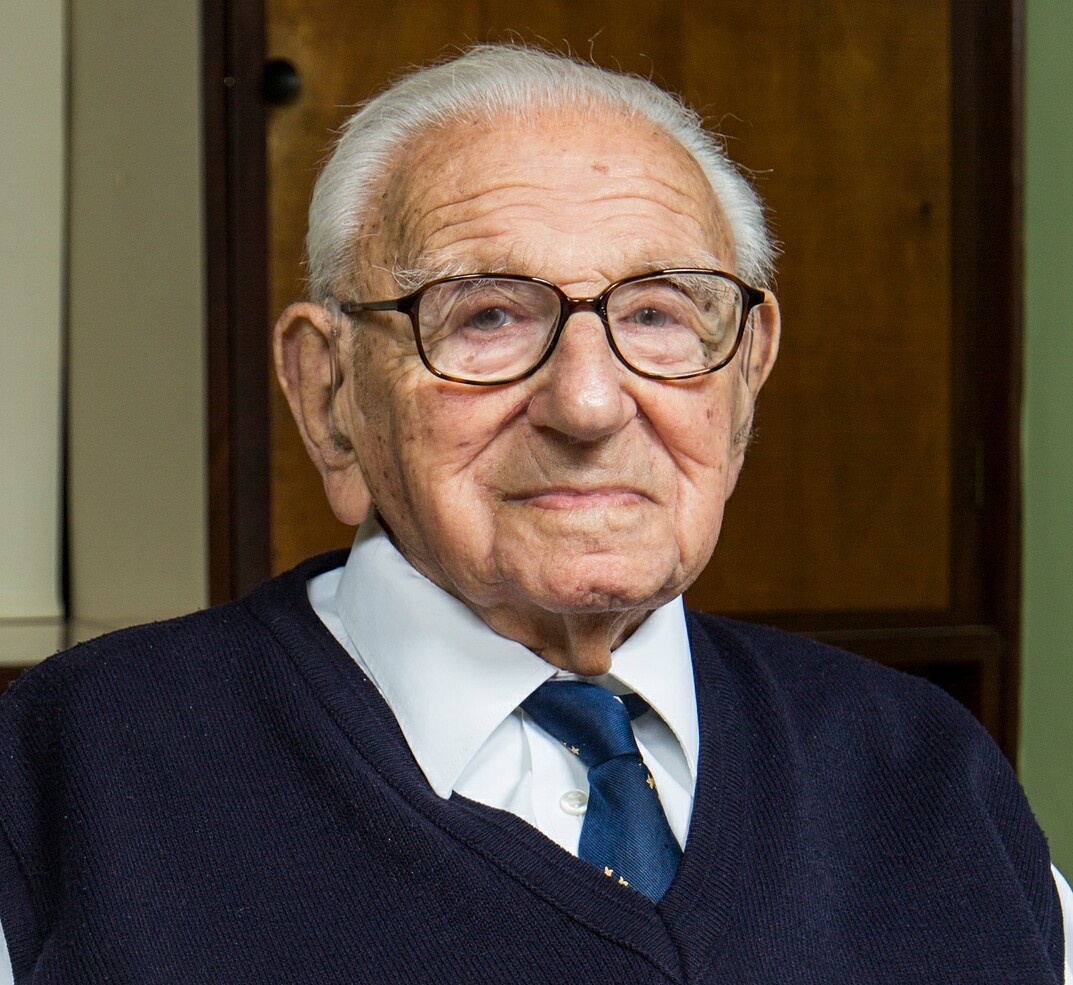
Recently, I shared a friend’s post on Facebook (thanks, Wayne). It concerned a man, Sir Nicholas Winton, who saved 669 children from the Nazi death camps. Moved, I dug around for more stories. Below is a small sample of what I found, but it suggests that the impulse for good is a global human quality. These men and women had nothing to gain and everything to lose. They did what they did because they could not look away from the wrongs of the world and the suffering of others. If you ever despair of the human heart, I think this list is proof that Anne Frank got it right. I have provided a link for each person at the end of their story, in case you would like to read more.

Sir Nicholas Winton
David Levene for The Guardian

Winton was a young London stockbroker when he received a call from a friend in December 1938, asking him to come to Prague. There, he was introduced to the British Committee for Refugees from Czechoslovakia. Prague was teeming with a quarter million people fleeing Germany, Austria, and the Sudetenland, most of them Jews. When Winton decided he could at least help the children, he was besieged by families anxious to get their sons and daughters on his list. He and his colleagues took photographs and details of each child, and began to organize their evacuation to England. The first 20 left in January 1939. Winton returned to London where he procured more travel permits. Frustrated by the slowness of British bureaucracy, which still thought war unlikely, he made newspaper appeals and organized the children’s placements himself. Following the Nazi invasion of Czechoslovakia in March, he began forging Home Office entry permits. Eight rail transports of some 600 children made it through, but the Germans cancelled the ninth transport, sending its 250 children to concentration camps.

Winton’s heroic work was not widely known until his wife found the book with the children’s names decades later. She encouraged Winton to try to locate them, which he did with the aid of the BBC. In 1988, a TV program was made about the rescue operation. Winton was in the audience when the program’s presenter said, “Stand up if you owe your life to Nicholas Winton!” Everyone stood. They were the adults whose lives he had saved nearly 50 years before. (Learn more)

Raoul Wallenberg

Having observed the Nazi state in action during a business trip, Swedish architect and businessman1389.9 Holocaust B Raoul Wallenberg accepted an offer from President Roosevelt’s new War Refugee Board to serve as Sweden’s envoy in Budapest, with the aim of helping Hungary’s Jews escape. By the time he arrived in July 1944, some 400,000 Jews had already been sent to the death camps. Intent on saving the rest, Wallenberg designed a protective pass that identified the carrier as a Swede awaiting transit out of Hungary. Observing the German and Hungarian authorities’ love of the flashy, he printed the passes in bright colors and emblazoned them with Sweden’s coat of arms, adding a bevy of official stamps and signatures. The passes had no actual legal value, but Wallenberg used bribery and extortion when necessary. In this way, he was able to increase the number of permitted passes from 1,500 to 4,500. Off the record, he tripled that number, and hired a “staff” of several hundred Jewish workers. One of his drivers remembers Wallenberg climbing atop a trainload of Jews bound for Auschwitz, ignoring commands to halt and dodging Hungarian officers’ bullets as he handed out passes through the doors. He then led the pass holders off the train to a caravan of cars, marked in Swedish colors.

When the Hungarian Nazis officially seized power in October 1944, they declared the passes invalid, but Wallenberg befriended the foreign minister’s wife who helped reverse the decision. He also rented out 32 buildings under the Swedish diplomatic umbrella, declaring them Swedish territory. These buildings, which sheltered 15,000 Jews, were draped in Swedish flags, and bore labels such as “The Swedish Library” and “The Swedish Research Institute” on their doors.

In January 1945, just before the Soviet Army occupied Budapest, Wallenberg threatened Eichmann with prosecution for war crimes in order to stop his plan to blow up the Budapest ghetto, home to 70,000 Jews. Wallenberg is said to have saved 100,000 Hungarian Jews from the death camps. (Learn more)

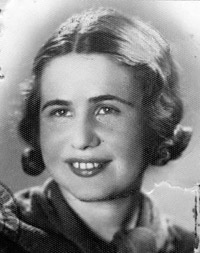
Irena Sendler

Irena Sendler no credit neededDespite being Catholic, Irena Sendler’s family had a history of fighting anti-Semitism. Sendler herself got into trouble as a student at Warsaw University for opposing the institution’s segregationist policies. When the Nazis invaded Poland, she was working for the Warsaw Social Welfare Department which provided services to the poor and infirm. She extended these services to the Jews in the Warsaw Ghetto, where thousands of people were dying each month from hunger and disease, by finagling permission from the Epidemic Control Department to check refugees for infectious diseases. Inside the Ghetto, Sendler began arranging for the children to be smuggled out and sent to Polish foster families. She recruited people for each of the ten SWD centers to work with her. Together, they issued hundreds of forged documents and transported the children out in ambulances. It was painful for their families to part with them and dangerous for the families who took them in—Poles aiding Jews were executed—but 2,500 children were saved.

Sendler, who always wore the yellow star to show her solidarity with the Jews, was caught by the Nazis, tortured, and sentenced to death, but her friends helped her to escape. She was nominated for the Nobel Peace Prize in 2007. (Learn more)

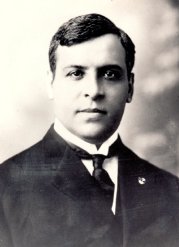
Aristides de Sousa Mendes do Amaral e Abranches  

Aristides de Sousa Mendes do Amaral e Abranches, the Portuguese consul to Bordeaux was not a manAristides SOUSA MENDES  no attribution needed who trembled before power. Despite the Portuguese government’s stern directive to all its diplomats to deny safe haven to refugees—especially Jews—Sousa Mendes began issuing visas in late 1939, shortly before the Nazi invasion of France. The visas granted Jews and other persecuted peoples safe passage across Spain to Lisbon, where they would be free to travel to other parts of the world. Time and again, the Portuguese dictator Salazar warned him to stop. Sousa Mendes ignored him and began issuing visas off the books, making up whatever details he thought necessary. “From now on, I’m giving everyone visas,” he told his son. “There will be no more nationalities, races, or religions.”

As the German occupation took hold, the number of refugees increased dramatically. The consulate was packed with hungry, frightened people, all of them needing transit visas to escape death. When Portugal tried to stop the Spanish from letting Sousa Mendes’s refugees through, he countered by personally leading groups to a border post that had no telephone to report his actions. He was stripped of his position in June 1940, and ordered to leave France. He ignored the directive for weeks, eager to save every life he could. On his return to Portugal, he was forced to rely on Jewish relief charities to feed his family. Sousa Mendes died in poverty, but his daring had opened an escape route that was to save millions of refugees throughout the war. (Learn more)

A few more:

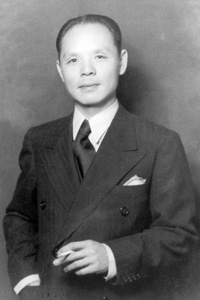
HO FENG-SHANAfter the Kristallnacht attacks in 1938, the situation for Austrian Jews became critical. That’s when Ho Feng-Shan, a Chinese diplomat in Vienna, went against the express orders of his boss–China’s ambassador in Berlin, who wished to curry Hitler’s favor–and issued thousands of visas to Jewish families to travel to Shanghai. At the time, Shanghai did not require entry visas, but one could not leave Austria without such a permit. (Learn more)

LISE BORSUMLise Børsum was a Norwegian housewife who smuggled Jews out of Nazi-occupied nations into Sweden, often through her own home. She was arrested and sent to Ravensbrück, but survived the war and went on to write about her experiences. (Learn more)

THE human SCALE

In 1970, Alvin Toffler published a little book that rocked the world: Future Shock. As we passed from an industrial to a “super-industrial” society, he predicted, change would no longer be the steady plodder it had been, but an exponentially increasing cruise missile. People would be left feeling disconnected and stressed out—wandering disoriented like victims of a bad hangover.

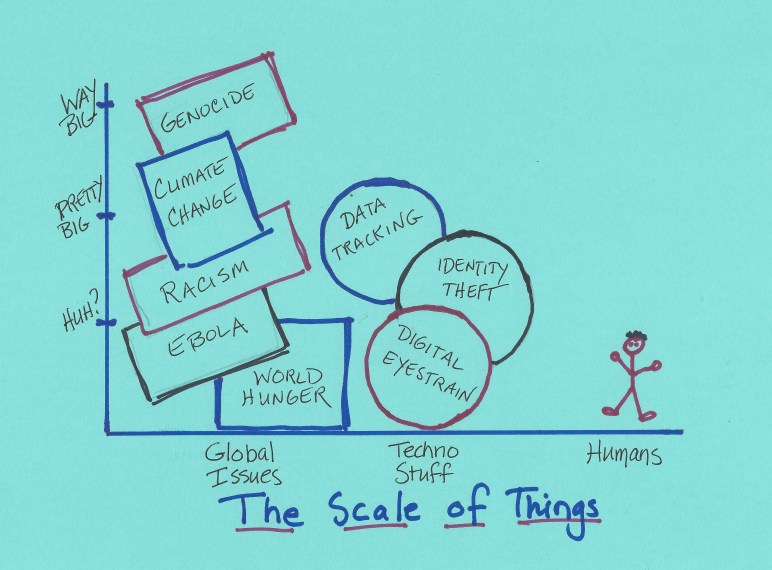
As is true for all restless, brilliant people who peer into the future (Orwell, Marx), Toffler got some of it right and some of it wrong, But he was dead on about the shock we would get from the rapid, large-scale technological and social changes we face today. We find ourselves in a world that has completely outstripped the human scale. We want to act, but how? Where to start? If you’ve ever tried to straighten out a problem with Google, you know exactly what I mean. It’s like that moment in Paddy Chayefsky’s Network where thousands of New Yorkers open their windows and shout, “I’m mad as hell and I’m not going to take it anymore!” But the question is: Who’s listening?

“The average individual knows little and cares less about the cycle of technological innovation or the relationship between knowledge-acquisition and the rate of change. He is, on the other hand, keenly aware of the pace of his own life—whatever that pace may be.”
Toffler Alvin. Future Shock. 1970.

Some years ago, I moved into a house across from the Quabbin Reservoir, a massive water supply source for Boston that was built in the 1930s, forcing the inhabitants of four communities from their homes. I did a lot of research on the subject for a piece I was writing at the time. It reminded me that throughout much of human history, the most common experience was to be born, grow up, and die in one place. This certainly has its drawbacks, but it also provides people with an identity, a stable community, and lifelong friends—three basic human needs that are currently on the endangered list.

In those Quabbin towns, you were a known quantity to your neighbors and they to you. You were also likely a butcher, a baker, a candlestick maker. You did work you could accomplish with your own hands, the rewards of which were tangible and immediate. You planted tomatoes, you tended tomatoes, you harvested tomatoes, you ate tomatoes—or sold them at your local fresh air market. If carpentry was your thing, you bought the boards from your friend who owned the local sawmill, spent some days sanding, fitting, joining, and varnishing. Then you sold the finished product–a dresser, a cupboard–to your neighbor across the meadow. That’s human scale.

Many of our surnames also reflect our ancestors’ connection to their work. Names such as Smith, Wainwright, Baker, Funar (Romanian: rope maker), and Bagni (Italian for public bath house attendant—love that one) once told people who you were. If this naming principle applied today, who would we be? Mr. Clouddeveloper? Ms. Derivatives? Weirdly enough, we have invented a world where we feel small and indistinct. A global society where corporations are people, and people are non-entities: consumers, website clicks,  data points on an algorithm.

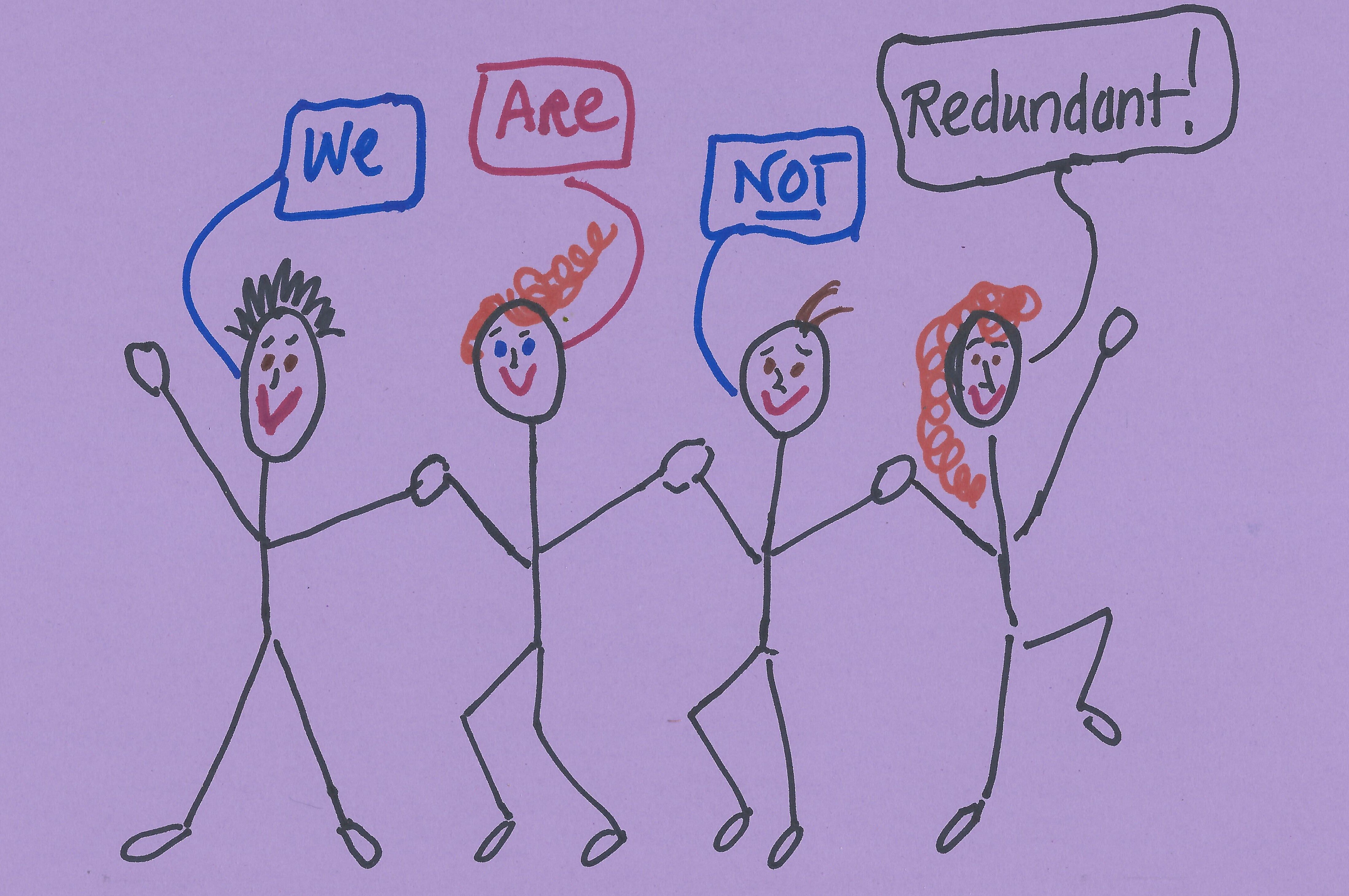
Argh croppedThis devaluation of human beings has its roots in the industrial revolution. I mentioned Marx at the beginning of this post. The thing that stuck with me most from Das Kapital was the example of the guy who worked at a spinning machine in a factory. The man worked the machine, a treadle affair, with his right hand and foot. Until some bright boy of industry came up with this idea: If spinners can produce X amount of yarn in twelve hours with one hand and one foot, they could produce 2X that amount if  they worked a second machine with their left hand and foot. It had everything to do with expanding profit margins and nothing to do with people. I’ll cut to the chase: Marx’s poor spinner went bonkers. People have limits. They grow tired. They get frightened. They waver, uncertain. They require tenderness.  This is not a sign of redundancy. It is the sine qua non of our humanness.

Recently, there’s been a lot of whining about our “age of narcissism,” evidenced supposedly by the craze for “selfies” and a surfeit of oversized egos who (how dare they!) demand to be respected as people. I admit, the guy with the selfie-stick in Florence got on my nerves a bit, as he filmed himself prattling about every place he was walking away from. But, I think the narcissism-cops may be missing a crucial point. What if all those selfies are a validation: “I’m still here!” What if the Facebook posts and the Tweets are really a cry: “I’m a person. I need to be known.” What if those “egotists” insisting on respect for their personhood have got it . . . exactly right?

I don’t buy that we’re a narcissistic or apathetic lot. I think it’s just that we often feel like we’re on a treadmill without a pause button. We can’t even slow the speed. I go to my local supermarket. I check out through an automated line. At the bank, a machine swallows my paycheck, then regurgitates my cash. I try to make a $10 online donation for Syrian refugees. I get rejected because there’s a $5 minimum. (I know—this doesn’t make sense.) I hit the “contact us” button. A form pops up, but it’s impervious to all my attempts to enter my info. In frustration, I try the e-mail reply button, and type a detailed message to someone named Ken. I never hear from Ken.

Globalization certainly offers a lot of positives. People like Malala Yousafzai have a world stage to champion human rights and female education. Rapid response to hurricanes and other natural disasters, made possible by computer technologies, brings life-saving aid to millions. But global awareness also brings everything rushing in—the painful plight of Syrian refugees, mass shootings, the melting of the Arctic ice cap—like some mad tidal wave. As we struggle to swim faster and faster, post-modern life can feel a lot like drowning. Not being able to address everything can wind up making us feel we can effect nothing. In this vast world, spinning at digital speed, all we have is our humanity. And each other. But if anything can save us, it will be exactly that. We can each do some one thing, one piece of meaningful work to reclaim our world. Together, we can do many things. In the spirit of Steve McQueen’s Papillon, we must link arms as we jump into the swirling waters of this crazy planet, and affirm, in unison, “We’re still here!” That will, indeed, be a brave, new, human world.

we are not redundant cropped

Moving Fast/Moving Slow

Capture PAUSE symbol

                                PAUSE: A Nod to Tortoises

When adding the Goodreads “Currently Reading” widget to my website, I wavered over whether to include Peter Ackroyd’s Foundation: The History of England, Volume I. In the months to come, wouldn’t some alert follower wonder why I was still reading that book? Oh, maybe not in October, but by Thanksgiving surely someone would notice. Perhaps take pity. Poor girl, a shame she can’t finish that book. Maybe she’s dyslexic. Such a challenge for a writer. A tad self-conscious, I wondered: Should I nudge it over to my “have read” shelf? Treat it as a total aberration (“How did that get there!”)? Plead its excessive shelf-life as necessary background for the book I’m now writing—and how to square that with the fact that Ackroyd starts somewhere in prehistory and ends 80 years before my characters step onto page one?

The truth is I’m a slow reader. I flip back to page 36 to recall exactly what Aunt Fanny told Little Marcie about the stranger living in the attic. I pause to look up an obscure reference to the mud volcanoes of Italy (messy but fascinating!). I muse on the motives of a shape-shifting, time-travelling Transylvanian crossdresser (or would, if I ever encountered one in a novel). I like to sip a good book. Roll its words and images over my tongue. Taste its meaning.

Before I give the impression that I’m impossibly dysfunctional, let me assure you: I can prepare a salad without pausing to research the history of the avocado, devour a slick thriller without stopping to ponder its ruses (well, almost), and empty the garbage with only a brief reflection on how much trash 7.3 billion people generate and where it all goes.

It’s just that I’m . . . a tortoise. I savor the journey. Many things intrigue me as I travel through this life and, like any self-respecting three-year-old, I have a zillion questionsstockvault-turtle114902 I’d like answered. “Need to Know” is not just an espionage term bandied about by James Bond. For savorers, it’s where we live.

I approach most things this way. After buying a century-old house situated in the middle of a small, but entrenched urban jungle, I spent four years digging up every weed, root, and rock on the lot. The black plastic tarp laid over the yard to discourage weeds became a standard joke in our annual holiday letter. There were certainly days—and years—I was tempted to fling my shovel far into space.  But, as I battled thorny bushes and cursed the tenacity of bindweed, I developed a connection to this plot of earth. From its untamed weediness, I imagined the shape it could assume. In year five, I brought in rail ties and terraced the front for a tiered garden. Last year, we laid down pavers in the back, leaving islands of lilac and rhododendron, and a large rectangle of naked dirt—this year’s new garden. I’m okay with the slow struggle. I like to see what emerges in its course.

Savorers have taken a serious dive in status since the invention of the nano-second, but history owes much to its tortoises—those contemplative slowpokes who just kept on. Wondering. Thinking. Envisioning. Inventing.

Case in point: atomic theory. About 2500 years ago, the Greek philosopher Leucippus, gazing at the visible dust drifting in a ray of sunlight, came up with the idea that all matter is made up of bits that move in a vacuum. He called these bits “atoms.” Inspired, his pupil, Democritus, started wondering what would happen if a piece of matter was divided repeatedly. Would there come a point where it couldn’t be divided anymore? Would it finally yield an indivisible particle from which, as Leucippus suggested, all things were composed? Democritus called it his “theory of the universe,” and it became the foundation of atomic theory. You can see a very simple, cool little timeline here that shows the progression. It’s a tortoise masterpiece.

Tortoises probably miss a lot of meals, or eat them cold. They see something, and they just have to keep following it—a thought, a sunbeam, an oddity. Ivan Pavlov, the Russian physiologist, was studying stomach acid secretions and salivation in dogs in response to the amounts and kinds of food they ate, when he noticed something odd: sometimes, stomach secretions and salivation were present even though the dog had not yet eaten. Pavlov could have said, “This has nothing to do with my experiment,” or “It’s late, and I’ve got tickets for the opera,” but instead, he asked, “What’s going on here?” The thing that was going on was that the dogs had learned to associate the sight of their feeder—even the sound of his tread—with chow. Feeder sighted → chow is on the way → salivation. We know it today as classical conditioning, one of the basic learning processes.
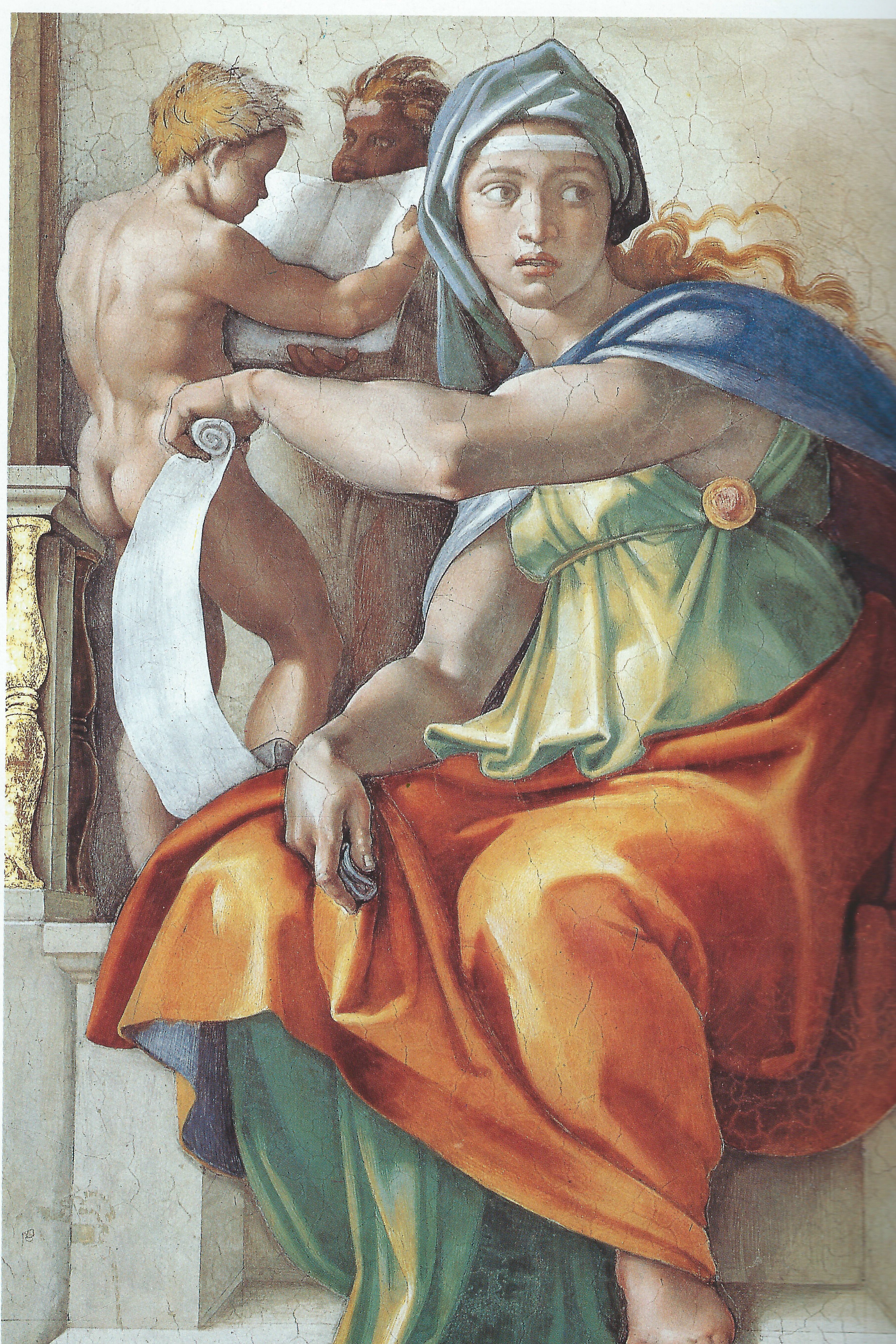
Michelangelo The Delphic SibylOne more. In 1508, the pope had this room at the Vatican, the Sistine Chapel. He wanted 12 giant apostles painted on its ceiling, so he hired Michelangelo. But Michelangelo, gazing at that ceiling, began to develop other ideas. He argued for his vision, and spent the next four years laying down wet plaster, applying the paint inch by inch, creating 343 figures to tell the stories of the Old Testament, and centering it all on that amazing image “The Creation of Adam.” Would 5 million people still visit the Sistine Chapel each year if he’d simply slapped on the apostles, taken the money, and run? Of course, they come because it’s Michelangelo, but then again, if Michelangelo hadn’t been the sort of inquisitive, determined, visionary tortoise that he was, would they come at all?

The rewards for the speedy in this world are obvious and instantly measurable. Fast track promotions. Bigger houses. More money. Loads of prestige. Less obvious are the attractions that drive the savoring tortoise: the pursuit of curiosity; the joy of knowing; the articulation of a dream; chance encounters with the unexpected, the counterintuitive, the just plain odd.

In some imagined universe, a sign hangs above my door: “Everything takes longer than you think, so come in, have a seat. I’ll make tea and we’ll gaze at the dust motes drifting through sunbeams. Let yourself be a tortoise and savor this marvel that is your life.”

The journey goes so fast.

CROPPED COPY KJyFV5SZSweiYGhMhrqC_MD4817 gray ground blue sky road leading over hill

Welcome to my blog.

BECKONINGS

(Why Study The Past?)

What continually calls us to the past, those of us who feel compelled to cast a backward glance? What do we seek, turning the yellowed leaves of a journal penned in faded hand?  With what expectations do we unpack the moth-riddled contents of a grandmother’s trunk?

As a child, I was fortunate to be twice present at the gathering of my geographically far-flung aunts and uncles. Distance wasn’t the only thing that separated these five siblings. My eldest uncle had been twenty, married, and out of the house when my mother (the baby) was born. But collectively, they possessed a remarkable fount of memories. Variously, they had ridden in rumble seats. Rolled their own cigarettes. Listened to baseball on the radio.  Been devotees of the Saturday matinee film serials. Jitterbugged to Benny Goodman on 78 rpm vinyl. Coveted zoot suits. Worn saddle shoes. Listening to them reminisce, I hunkered low, barely breathing, so that I might not break the spell they cast. I was happy to be wrapped in the blissful cocoon of their nostalgia. It was only much later that I wondered how these memories reflected the larger, darker forces that had shaped their young lives: the Great Depression, World War II.

While still a college student, writing for a local paper, I covered Angela Davis’s visit to our campus. A powerful speaker, she cautioned us: “Never forget from whence you came.” It was all too seductive, she said, the shiny elitism of the university. It could blind you to your humbler origins, make you forget your roots. Her words resonated with me. Despite the suburban affluence of my childhood, my mother was the only one in her family to finish high school. My grandmother’s education had ended with grade eight.

Recently, I googled Davis’s warning, certain it must be part of some larger quote. My search turned up the African “Sankofa,” both an Asante Adrinka symbol, and a word from the Akan language of Ghana that has been translated literally as “reach back and get it,” and more meaningfully, “If you don’t know from whence you came, you will not be able to move forward.”

As Americans, we pride ourselves on moving forward. We are a nation of chameleons, re-inventing ourselves, shedding former skins as fashion and desire dictate. Why look back when anything/everything is possible in the future? In the abstract, it’s true: anyone could grow up to be president. But in reality, we all carry our baggage forward. We can’t invent our future from whole cloth; can’t simply wish it into existence. We are awash in our personal and collective history and helpless to look away from it, for the past keeps moving into the present. Much of the conflict in the Middle East today has its roots in the 1919 Treaty of Versailles which redrew the map of the Middle East, carving up ancient empires in ways that suited the European victors, but not the region’s inhabitants. The same treaty’s harsh demands for war reparations from Germany helped elect a mediocre Austrian painter with a funny little mustache who went on to occupy most of a continent, murder millions, and start a second world war. Closer to home, the decision in 1619 to bring the first Africans to work as slaves in the tobacco fields at Jamestown led to a civil war more than two hundred years later, and haunts us still in the headlines of Ferguson and Charleston. We are each the product of many things, many experiences—the current expression of a long, tangled strand of lives. Far from being irrelevant, the past holds out to us the opportunity to understand ourselves, our times, this world. The chance to use the wisdom of the ages to better our future. We ignore it at our peril.

As a child, I would beg my grandmother, “Tell me about when you were a little girl.” Her life was a story I needed to hear. She died when I was thirteen. My only regret is that I did not ask more questions.