Hang Up And …Live!

“The only time you ever have in which to learn anything or see anything or feel anything, or express any feeling or emotion, or respond to an event, or grow, or heal, is this moment … You’re only here now; you’re only alive in this moment.”   Jon Kabat-Zinn

(NOTE: This is an “ancient” (meaning anything older than three months in today’s vernacular) post, but I think it’s even more germane today than when I penned it in 2017. And I needed some pithy words to post here while I regain my sanity in London. See you all next month with fresh words.)

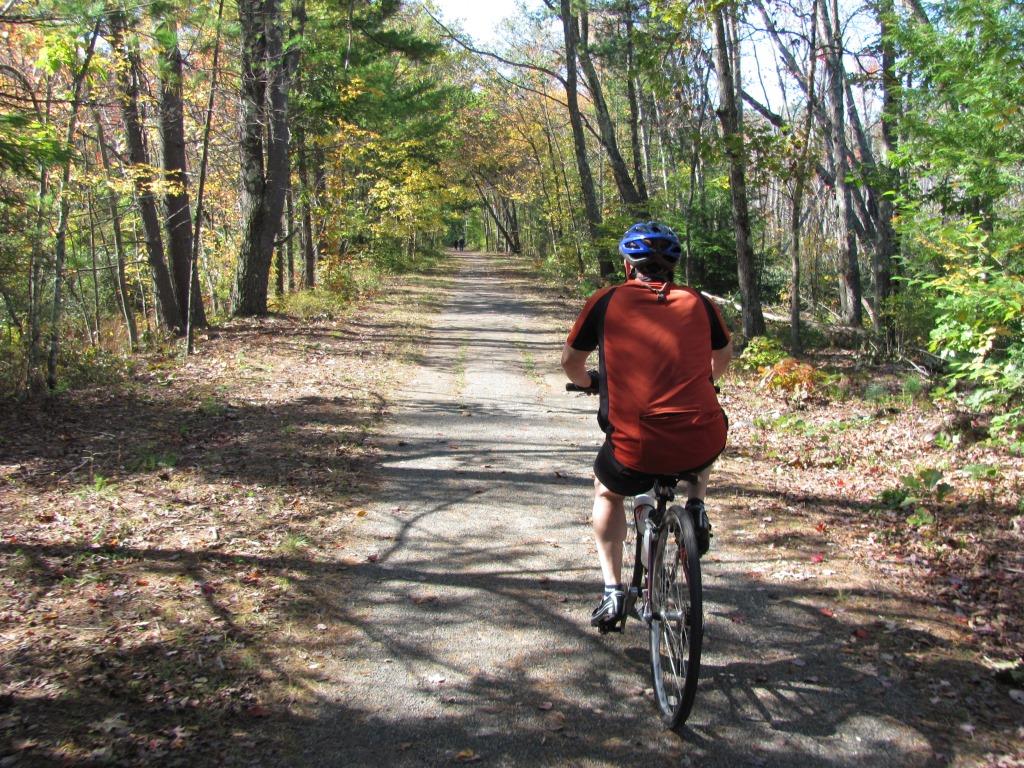
I’m lucky to live in a state that has over 300 miles of rail-trails, so when I’m done with the morning’s writing (and it’s not January), I often go for a bike ride. Lose the tension in my shoulders. Let go of whatever problems my characters have posed for me that day (and those pesky people can cause real trouble when they choose).

My favorite loop, about ten miles out and back, takes me to Look Park, a vast oasis of  green lawn and blue ponds. The trail there mostly goes through wooded areas. At one spot, chickens and ducks waddle along the verge, scouring the long grasses and wildflowers for a snack to supplement their caregiver’s feed. The first time I saw them, I worried for their safety—so many bicyclists whizzing by—but over the years, I’ve come to realize they are proof of Darwin’s law:  Adapt or perish. They are obviously smart fowl.

At another spot, the land falls sharply away from the trail, and I glimpse the skeleton of a 1940s truck, blue in the patches that rust hasn’t eaten. Time. It’s always there, at some moments shouting, at others whispering.

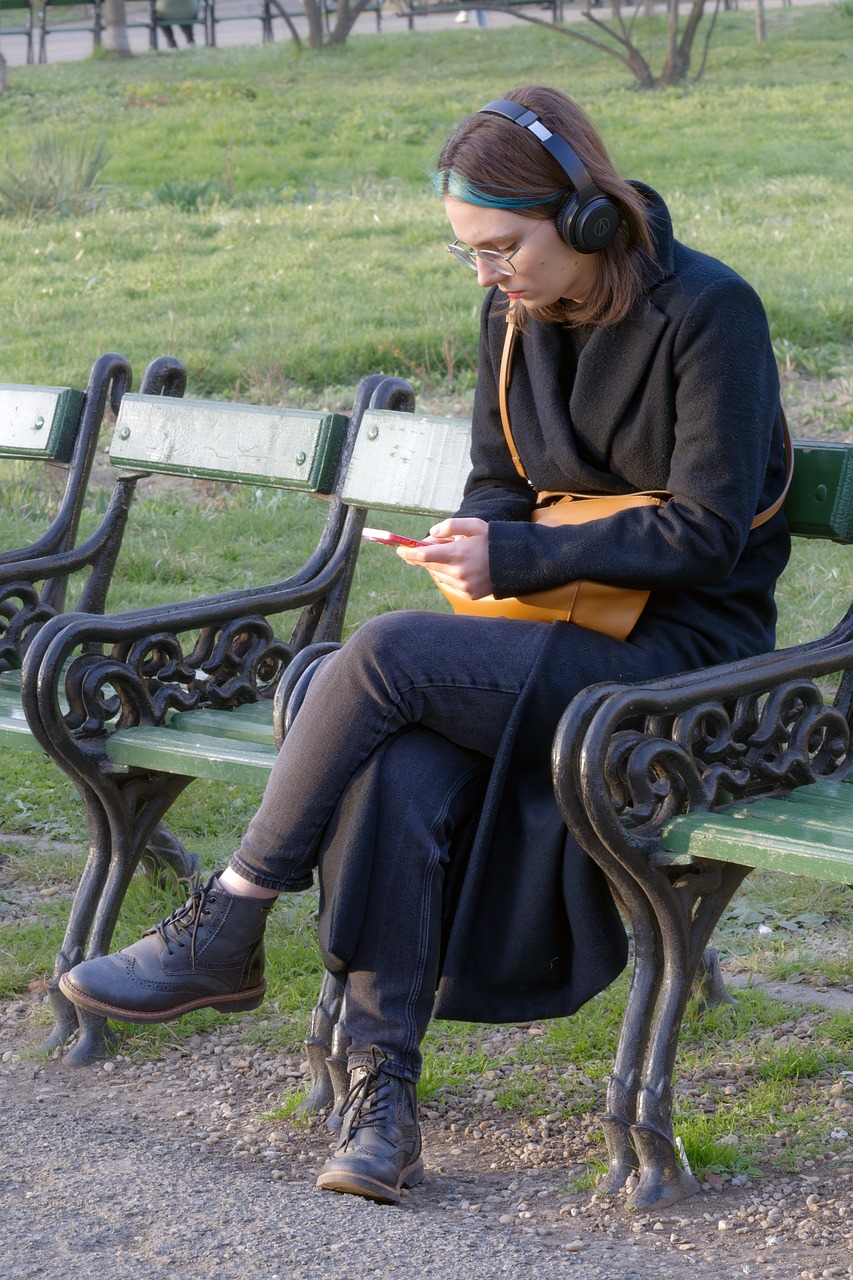
No matter how scorching or muggy the day, a breeze lifts my hair, cools my skin, empties my busy brain, and I tune into the birdsong, tranquil. Which is what makes it all the more jarring when I pass a woman, walking with her toddler and talking into her cell phone. Seconds later, I cycle past another walker, this one with ear buds connecting her to an iPod while she texts on her phone, fingers flying over the keyboard. There’s even a bicyclist—and I’m not making this up—pedaling along while texting two-handed.

It’s lovely that all these folks are out here enjoying the rail-trail, but my question is: Are they actually enjoying the rail-trail?

Selfie Madness

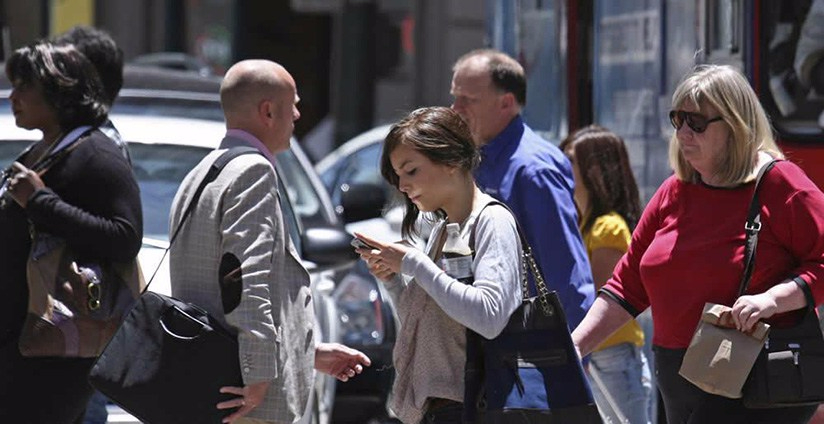
We’ve all seen the absorbed texter (maybe even bumped into them!) walking through the airport, oblivious to others and their luggage or, like an errant pinball, caroming down a crowded city sidewalk only to step off the curb into traffic, unaware.

CAMERA cellphone user on busy sidewalk caminar-mirando-el-celular3People speak of life passing you by, but our digital addictions are causing us to pass by life without pausing to register its pulse. Texting. Tweeting. And then there’s selfie-madness.

In June, I was at a Yankees-Red Sox game with my husband. Since we only go once a year, we treated ourselves to field level tickets along the first base line. These seats aren’t cheap, so I was surprised at how many people around us spent the entire game taking selfies, their backs to the ball field. They seemed to prefer snapping photos of themselves attending a Yankees-Red Sox game to actually watching the play on the field. And it was a great game. Tense. The lead bouncing back and forth. Close score. But it often felt like my husband and I were the only ones following the action, a task not made easier by the bodies hurtling through our line of sight in search of the perfect location/angle/backdrop for a selfie.

The Digital Invasion

I first glimpsed signs of what would become our digital mania in 2003 while vacationing in Florence, Italy. We were visiting Il Duomo (Santa Maria del Fiore) when I noticed a man walking about with a video camera, filming, his wife and kids doggedly trotting after. Although camcorders still used videotape at this time, they had shrunk considerably in size from their dinosaur predecessors of the mid-1980s. And this man was determined to make use of their newfound mobility.

He continued filming as we strolled about the piazza, admiring Ghiberti’s Gates of Paradise—ten dramatic bronze reliefs that depict Old Testament scenes on the doors of the Baptistery—and Giotto’s polychromatic marble-faced campanile with its della Robbia panels.

The camera remained glued to his face when we entered Il Duomo beneath the clock designed by Uccello, and traveled up, up, up the 463 steps to stand amazed beneath Brunelleschi’s architectural miracle of a dome, its interior graced with Vasari’s frescoes of the Last Judgment.

I never saw his face that day. In my mind, he remains a figure ambling about with a large camera where his head should be. I’ve often wondered if he and the family ever got around to watching the hundreds of hours I’m guessing he filmed during his Italian vacation. Or did he just move on to the next destination, camera at the ready, missing more moments of his life amid the wonders of the world? Perhaps he morphed into the guy I saw a decade later during another trip to Florence, a selfie stick strapped to his forehead, a camcorder suspended from its top, dutifully recording everything he was walking away from in the Piazza della Signoria, his face in the foreground.

Ain’t Nothing Like the Real Thing

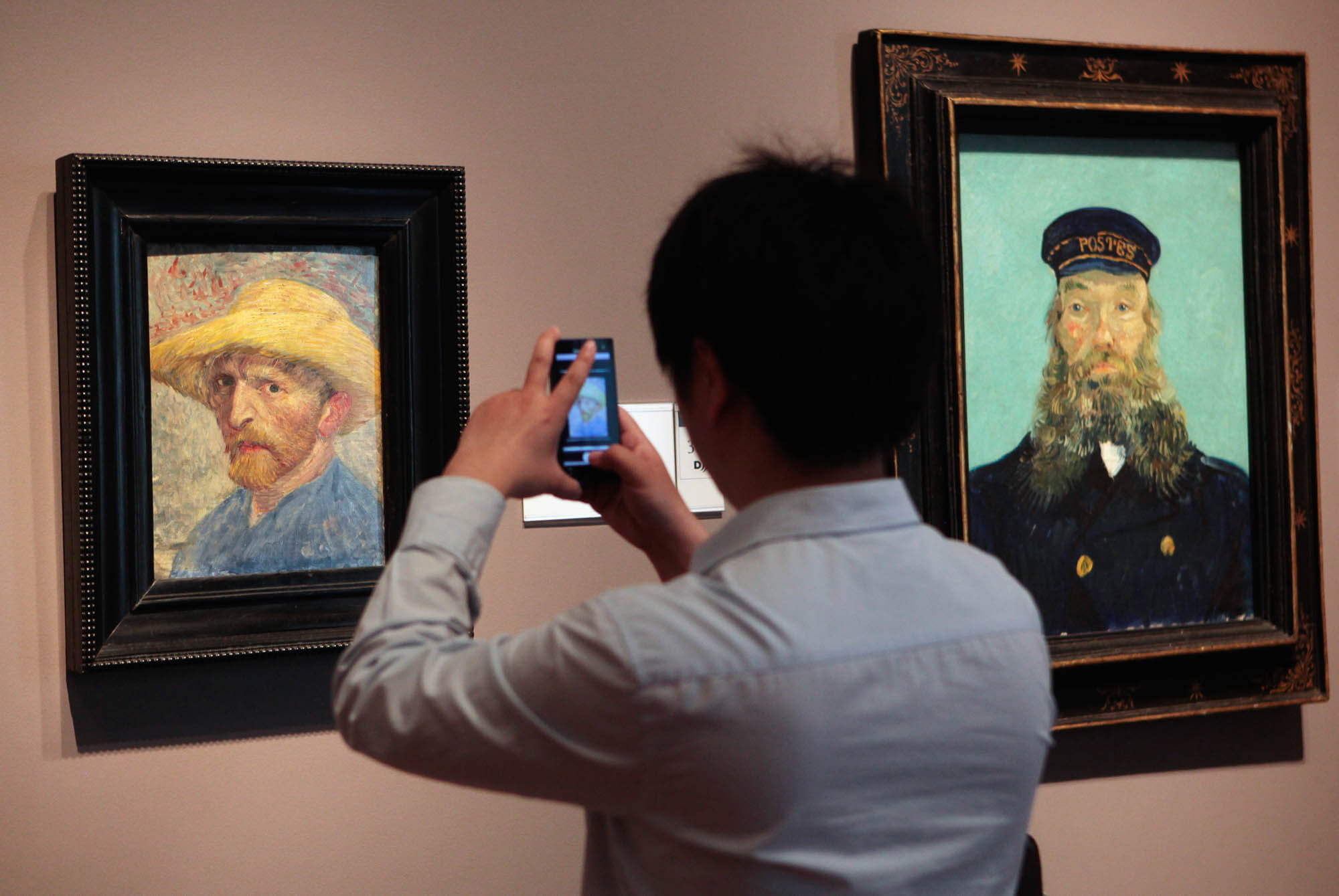
With smartphones, the capture of every moment is only a click away. On the same trip that took us to Yankee Stadium, we spent a morning in the Metropolitan Museum of Art. We were hanging out in European Paintings 1250-1800, soaking up the dark mysteries of Rembrandt, the pink fulsome flesh of Rubens, the broad Flemish landscapes of Bruegel. Darting all about us, like a gnat you can’t seem to lose, was a woman snapping photos of every painting. And not only the paintings, but the little description cards that accompanied each work. Snap. Snap. Snap. She paused only a nanosecond to capture Vermeer’s Young Woman with a Water Pitcher before buzzing off to give Franz Hals’s Portrait of a Bearded Man with a Ruff the same blink of her camera.

I can report she missed not a single painting, but in another, more significant way she missed them all. If that seems an exaggeration, pick up a postcard of Van Gogh’s extraordinary painting of a chair, called reasonably enough Van Gogh’s Chair, and compare it to the original that hangs in London’s National Gallery. A picture may be worth a thousand words, but an amateur photo of a major artwork is… squat.

Patti LuPone Takes On The Texters

And when we’re not filming, we’re texting. Two years ago, while starring in Shows for Days, actress Patti LuPone grabbed the cell phone of an audience member in the front row who had been texting through the entire first act. The cast and audience had already endured four separate cell phone rings during that day’s show, so tempers were somewhat frayed.

“She was sitting in the light, so everyone could see her texting. It’s ridiculous,” LuPone said.

Lupone returned the phone after the performance was over, but gave vent to her distress. “I’m defeated by this. It’s not changing, it’s only getting worse … If something isn’t done, I will think twice before I get back on a stage again.

“It’s not [about] theater etiquette,” she explained. “It’s human etiquette. We’re living in an isolated society, the phone controls our every move, and we’ve lost sight of our neighbor, the people surrounding us.”

One of the great ironies of our cell phone addiction is that it was preceded by an innovation that freed us from our phones: the answering machine. They were a revelation, a revolution. No longer did you have to worry about missing an important call. It would be there on the little cassette when you got home. You were free to go about your day, or travel the world, without once thinking of your phone. It was a golden time, however short-lived.

Surprise: Pop Quiz!

Okay, I’ve had my moment on the soapbox. Now it’s time for you to play along.

When did you last:

-Take an evening off Facebook and Twitter to hang out with friends and neighbors?

-Visit an art gallery or museum using only your eyes, no camera (photos of you and loved ones in front of the museum don’t count here)?CAMERA couple both on cellphones Who-is-more-important-your-spouse-or-your-phone

-Pick a dining spot in a city not your own by walking along the streets “window shopping” restaurants and cafes rather than googling TripAdvisor or Yelp?

-Enjoy a cup of coffee or glass of wine at a cafe with your significant other and no cell phones in sight?

-Browse a brick-and-mortar bookstore–with actual shelves and real books you can open and read–rather than surf Goodreads for recommendations, then order from Amazon?

-Go for a hike or a bicycle ride “naked”–no iPod, no earbuds, no smartphone?

If you can’t recall the last time for any or (yikes!) all of the above, I suggest you get out into the world immediately. Talk to real people. Listen to the sounds of summer—the buzz of bees, kids laughing, birds trilling, the lap of water at the beach. Literally, stop and smell the roses.

And give your texting thumbs a rest. For there are more things in heaven and earth, Horatio, than are dreamt of in your mobile apps.

Where There’s Life, There’s Hope

The onset of Spring in the Northeast is marked by the blooming of the first flowers. Daffodils, crocuses, hyacinths. Usually, this occurs mid-March but this past winter, the high-40s/mid-50s weather that brings these blossoms came early in a surprisingly mild February. Valentine’s Day saw the first buds appear on the bank of daffodils that line my driveway. Like the unexpected reprieve from the usual snow, ice and freezing temps of winter, the sight of these early buds both lifted my spirits and worried me. Climate change, with its spikes of unseasonable warm winter weather, followed by a freeze, had killed the local peach crops in 2023, and this February “heat wave” made me fear these buds, too, would die before they ever bloomed. After all, we had a long stretch of winter to go. I resigned myself to this likeliest of fates. Next year, I told myself. Maybe next year.             

When the daffodils actually blossomed in the first week of March, I was cautiously happy: Well, at least I’ll enjoy them for however long they have. Then came a frost. Nighttime temps dipped into the low 20s for several days. Cold winds buffeted the garden at 20 miles an hour. The daffodils slumped, heads downward, and I thought, Okay, they’re over.

But the following week brought several days of bright sun. Despite the cold winds still blowing, the flowers seemed to lift in this welcome light.  At first, I thought it was just my wishful thinking, but as I checked them daily, I realized they were, in fact, not simply hanging in there but getting stronger. Then one morning after two days of rain, voila!, they looked great. No longer tentative, but hale and hearty! They even survived an early April ice storm. I recalled the poet Emily Dickinson’s famous verse:

Hope is the thing with feathers,
That perches in the soul,
And sings the tune without the words,
And never stops–at all.

Hope–the life raft we cling to in times of trouble.

Bad News on the Doorstep

The late winter weeks were not an easy time for me. In mid-February, my dentist informed me I had an infection in Tooth #31 that would require the tooth be extracted. Since the drug I take to build bone density carries a risk of jaw necrosis (meaning “death of the jaw”—not good!) for such procedures, no regular dentist wants to touch it. I had to schedule an appointment with an oral surgeon ASAP. But as we all know well, everyone is “scheduling out” for months in advance. After some gentle but steady pressure on my part, I was able to secure an appointment for the end of March. By mid-March, my tooth and jaw were really aching, but a round of antibiotics eased the pain. Just two weeks to go, I thought. I can make it. Everything will be okay.

And then I got a summons for U.S. District Court. Two months of on-call jury duty for May and June. The problem? Ed and I had booked flights and rented a flat in London many months earlier for—you guessed it—May. Ten-thousand dollars, non-refundable.  

I answered my summons online and pleaded my case. I got an email reply that same day. My service would be postponed until August/September. September—the month we were already booked to travel to Rome for our anniversary. I searched my summons papers for a phone number to call. Nada. Just an automated check-in line for jurors already on duty.   

I replied to the email that same afternoon. Happy, I said, overjoyed, I stressed, to do the jury thing in July and August. Or October and November. I’ve been summoned for jury duty 10 times in my life, I emphasized, and other than the summons during the dark months of COVID (when it posed a risk to Ed), I’ve never asked to be excused or postponed. Please. Please. PRETTY PLEASE!

No reply. I decided to give it a week. After all, people get busy.  

Hitting Bottom                                                                                                                                 

Four days later, I heard not from the court, but the oral surgeon. Could I come in today? The office had a cancellation and he could pull my tooth that afternoon—a week ahead of schedule. Yes! Sooner meant less risk of serious jaw infection.

The oral surgeon turned out to be excellent and I followed the usual “eat only applesauce/yogurt/pablum” post-surgery diet for a week. I was relieved, but the jury thing was still out there. I wrote the court a second time, mindful to include our previous correspondence, and crossed my fingers. A week went by, then another. Silence. Meanwhile, though the area around the pulled tooth was healing well, all kinds of pain was occurring in other teeth, my sinuses and the back of my jaw on both sides. The soonest my dentist could see me was April 11. Two…whole…weeks…away. More of a wait than I wanted but what can you do? I asked them to let me know if anyone cancelled before that date, and returned to my diet of soft mush, Advil—and hope.

Then in the early hours of April 2, I woke with a pain so intense in my left jaw, I couldn’t worry about or even imagine the future. April 11? In that moment, it felt like the 12th of Never. Ed retrieved the ice pack—a gift of the oral surgeon—from the freezer. I wrapped it snug around my head and took two Advil.  

I was enjoying a light doze when the phone rang at 7:15 a.m. No one calls at that hour unless it’s important, so I jumped up and retrieved the phone from my dresser. It was the dentist. There’d been a cancellation. Could I come in now? There was no time for a shower, so I did a quick spot clean, brushed my teeth, and headed out the door. The upshot? Jealous of all the fuss the extracted tooth (Tooth #31) had received, Tooth #15 was now yammering for a root canal. My dentist set up an appointment with the endodontist for that same afternoon. Ed and I went to work in our usual coffee shop for a few hours, then headed 20 miles north to seek salvation. Three hours later and $1,800 lighter, I emerged painless.   

A Celebration and the Gift of Hope

Two days later, I celebrated my birthday quietly with Ed, watching movies and playing Scrabble, while the ice storm I mentioned up top raged outside. I was just glad to be pain-free. The next evening we had dinner out at a favorite local eatery, High Brow. Our town has never really recovered from The Plague restaurant-wise. Many places closed and those that remained open seem to largely survive through take-out orders. More than once, Ed and I have been the sole table in a restaurant, while people came and went, picking up their take-out food. But High Brow hops on a Friday night. Friendly staff. Excellent food. Always a lively crowd. It was a real celebration and it refueled my hopes. Hope for a world where people value and enjoy a communal life. If we can come together, we can support one another, solve our problems, take courage—and joy—in the knowledge that we are not alone.

Even a brief one-on-one encounter with another person can boost hope as I was reminded three days later when, out for a walk as the Total Solar Eclipse reached the Northeast, I stopped to chat with a young man who was viewing the phenomenon through a pair of special eclipse glasses. He asked if I’d like to take a look. The “black” moon with its fiery orange sun rays was indeed amazing. I thanked him and continued home. A five-minute exchange at most, but I’m convinced our mental health, happiness, hope depend on these human connections—big and small.    

When You Have Exhausted All the Possibilities, Remember This: You Haven’t (Thomas A. Edison)

So, the tooth was good—just waiting for a crown. The birthday was happy. The daffodils had been joined by a few tulips. But there was still the jury duty thing. Keeping to my long-standing mantra of “one disaster at a time,” I had let it go for a couple of weeks, simply checking my email daily in hopes of a reply. So far…nada. I would have to figure out the next step. Soon. Real soon.

The night after the eclipse, seeking some, any idea on how to proceed, I googled “postponing jury duty.” Scrolling through the results, I was excited to discover that one could request a specific postponement date on the state government’s website. Why had this not been mentioned on the summons? Or the original email I received from the Clerk of Court? I went to the website the next morning. I had my juror number, but you also needed the pin number from your summons. My summons had no pin number. Scrolling, scrolling, I discovered a helpline for answers in filling out your request. I called and got A Real Person! I explained my situation, the correspondence that had ended in limbo. “No problem,” this lovely person replied. “I’ll just schedule you for the week after you return from Rome.” Three minutes later, I had an email in my Inbox, confirming the new date. The stress of the past two months fell away in seconds, like the ice from the daffodils had done the week before. By the time I picked up my youngest from the train station that afternoon for a much-anticipated visit, my heart was light, joyful.

Hope, as Eternal as the Stars

I have written here about the stars on several occasions. How, sitting on my deck on a clear night, the sight of them fills me with hope. They are eternal. Whatever mess of things we mortals make down here, however stupidly, dangerously we risk the future of our planet and all its abundant life, the stars will survive. My stressful weeks from late February to mid-April happened to coincide with a long string of cloudy evenings. The stars were not in evidence just when I needed them most. But one night, I thought It’s okay. Though I can’t see them at the moment, they’re still up there, exactly where they should be. Obvious, I know, and yet profoundly comforting.     

I leave you with a haiku I composed in the shower the morning we “sprang ahead” to Daylight Savings Time on March 10:

Today the light’s one
Hour longer, the dark recedes,
Our hopes grow stronger.


NOW IS THE TIME 

Hundreds, if not thousands, of books have been written on the subject of Time—what it is, how we perceive it, how to manage it. From Einstein’s Relativity: The Special and the General Theory to Kevin Kruse’s 15 Secrets Successful People Know About Time Management, time—that elusive thing that keeps on ticking, ticking, ticking—continues to baffle us.

But for my money, no one has captured the truth of the matter better than James Baldwin, American writer and civil rights activist, who said: There is never a time in the future in which we will work out our salvation. The challenge is in the moment; the time is always now.  As much as we duck and dodge, delay and defer—time for that later, once everything is settled, when I feel less harried—there’s no denying Baldwin nailed it. Tomorrow never comes. It is always now. Now is the time.

Say It Now                                           

One of the most tragic figures to ever grace the literary world is the poet Sylvia Plath. Plath’s Ariel, a collection of poetry written in the last months of her life, would rock the world and catch fire with the burgeoning women’s movement of the 1960s. Her novel, The Bell Jar—after initially being rejected by numerous American publishers—would become a fixture on required reading lists in high schools and colleges. For Plath, however, the recognition would come too late. On February 11, 1963, Sylvia Plath killed herself. She was 30 years old. She had two children. And her husband had recently dumped her for another woman. On the night Plath left plates of food by her children’s bedside, then sealed off the kitchen with wet towels before turning on the gas oven and inhaling its poisonous fumes, she already knew Hughes’ lover was pregnant.

It would be a mistake, though, to conclude that Plath and Hughes’ marriage (achieved within scant months of their meeting) broke down solely over his infidelity. That was more the result than the cause. In many ways, their marital troubles can be ascribed to a simple truth—as two fiercely ambitious aspiring poets, they were in love and they were in competition. But as a man, in a time when men “knew best,” Hughes was in a position to assert his authority. It was he who insisted they return to England in 1958, a year after they’d moved to America where Plath had accepted the teaching position Smith College had offered their talented alumna. Hughes had managed to get a gig lecturing at nearby UMass Amherst, but he didn’t like teaching. He told Plath he was determined to earn a living as an author and poet.

One wonders at this distance why Hughes didn’t simply do that from America? At least for a few years, to let Plath fully engage with the post she’d been given. He’d already won the prestigious Somerset Maugham Award for his collection of poetry, Hawk in the Rain, which Plath had faithfully typed up for him. He could have written from anywhere.

Plath decided she, too, would focus solely on her poetry, but the birth of their first child in 1960 vied for her time and attention. Her first collection, The Colossus and Other Poems, was published that same year. Though well-received by critics, it did not win a prestigious award. If Plath was disappointed, her response was to write more poetry, better poetry. She wrote at a feverish pace, excited about where her new verses were taking her. Then Hughes walked out just months after their second child was born in 1962. The emotional strain was intense but Plath completed the collection of poetry for what would become the crowning literary achievement of her short life, Ariel. At her death, she left detailed instructions as to how the poems should be ordered in the book. Hughes was familiar with the verses, for Plath had shared many of them with her estranged husband on those occasions when he visited the children after he moved out.   

Hughes did see Ariel through to publication, spending two years on the project, but he changed Plath’s arrangement of the poems. He also omitted some poems, while adding others. These changes would earn him decades of rebuke from the new wave of feminist writers and academics who assumed Hughes had deleted Plath’s most damning verses against him. To compound the perceived offense, it was discovered that Hughes had burned Plath’s final journals.

Hughes’ “interference” in Plath’s manuscript would remain a point of contention and speculation until the publication in 2004 of The Restored Edition: Ariel, the collection of Plath’s poems as she had intended at her death. Meghan O’Rourke, writing for Slate, argued a “good case could be made that Hughes’ version of Ariel is actually superior to Plath’s,” for it included poems written in the final weeks of her life, poems she herself predicted would Make my name.

Eighteen years after Plath’s death, Hughes would edit and publish Sylvia Plath: The Collected Poems, the works Plath had published in her teens and 20s in such esteemed publications as The Atlantic Monthly, The New Yorker, Harper’s Magazine, and The Christian Science Monitor. To this, Hughes added some of Plath’s poetry he had omitted from Ariel almost two decades earlier. It would seem the ghost of his late first wife continued to haunt him. But the world would not realize just how fierce this haunting was for Hughes until the 1998 publication of Birthday Letters in the final months of his life. This collection of poetry from the man who was then England’s esteemed poet laureate—a man frequently cited as one of the twentieth century’s great writers—would reveal just how shattering Plath’s suicide had been for Hughes, how it had haunted him every day of his life for 35 years. Professor of English at Williams College, Lynda K. Bundtzen, noted that many of these new poems were direct responses to Plath’s own poetry. “They address her as if she’s still alive, as if he can talk to her,” Bundtzen said.

For me, the most poignant—and revealing—poem in Birthday Letters is “The Machine,” with its closing lines: …Blackly yawned me Into its otherworld interior Where I would find my home. My children. And my life Forever trying to climb the steps now stone Towards the door now red Which you, in your own likeness, would open With still time to talk.

What if Hughes had opened up his true self, his real feelings to his wife in those final months? What if he had said, “I’m sorry. What I’ve done is less than honest. Your talent feels threatening sometimes. It both amazes and scares me.” Words left unsaid are never heard. Our best intentions, our deepest feelings are never known unless we make them known. If you love someone, tell them now. Apologize for those harsh words now. Admit the mistake you made now. Express your gratitude now.  

Do It Now    

Time has a way of creeping up on us. We mean to do something, but in the hurly-burly of day-to-day life, we often put off making a decision or taking action until—poof!—the moment is gone when we can do so. Perhaps nowhere in modern history has this played out so tragically as it did in Germany when Hitler and his Nazi Party came to power in 1933.

Hitler—and this is essential in understanding people’s response—did not simply waltz into Berlin and “seize” power, as is often supposed. In fact, the Nazis (the National Socialist German Workers’ Party) had been rather small potatoes in the wake of the German Empire’s collapse after WWI. The new government, known as the Weimar Republic, considered itself a democratic institution. It held elections. It had a constitution. Under this government, Hitler spent some nine months in prison for treason when his attempted coup failed in 1924. The Weimer Republic believed the growing popularity of the German Communist Party to be a much greater threat.

National Archives

But as I said, time has a way of creeping up on us. In Germany, the economic devastation caused by the post-war Treaty of Versailles, with the huge reparations it demanded for France and Great Britain, became unbearable as the world economy collapsed in the Great Depression. The Nazi Party was only too happy to lay the blame for Germany’s economic woes on the Jews and the Communists. With their message that true-blooded Germans were the real “chosen people”, the Nazis began to unite a sizeable chunk of the country. By 1932, they were winning a third of the votes in parliamentary elections—an achievement no other party could claim. German President Paul von Hindenburg at first refused to grant Hitler’s demand that he be appointed chancellor, but after various backroom deals with conservative politicians who assured him they could control the Nazi’s leader, von Hindenburg ceded to his wishes. Hitler became Chancellor of Germany in 1933. When Hindenburg died nineteen months later, Hitler had already engineered a bill—with a little intimidation and much suspected fraud—that merged the offices of President and Chancellor into one, making him the sole leader (Führer) of Germany. The Nazis then seized control of the government and booted democracy into the gutter.

picryl.com A chart illustrating the Law for the Protection of German Blood and Honor, which forbid Jews and Germans to marry, and established a complicated, mathematical definition for who was a “true” German and who a Jew.

But it was a gradual coup, and the passage of time lulls people, prepares them in many ways to accept circumstances they would have once found intolerable. Acts like a narcotic— anesthetizing its victims with the thought If things get worse, then I’ll act, I’ll leave then… Because, let’s face it, leaving your homeland—your family, your house, all you’ve ever known—is the hardest thing anyone can do. And the Nazis manipulated this gradual dance with cruel brilliance.

Even before President von Hindenburg’s death, the strength of the Nazi Party in parliament had made it possible to pass laws banning Jews and other political opponents of the Reich from holding civil service positions or practicing law, with a few exemptions. But the pace of persecution kicked up a notch once Hitler took full control. The infamous Nuremberg Laws of 1935—the Reich Citizenship Law and the Law for the Protection of German Blood and German Honor—proclaimed Judaism not a religion but a race, distinct from and inferior to the German race. Therefore, Jews could no longer vote or hold public office. As non-Germans, they had no legal rights. In 1936, Jewish doctors were banned from practicing medicine. In 1938, all Jews were required to register any property held within the Reich and Jewish students were barred from German schools.

And then Kristallnacht (Night of Broken Glass) happened and everything exploded. This wholesale attack on all things Jewish saw synagogues, hospitals, and schools destroyed. Jewish shops and homes were burned and looted. At the end of that fiery, violent pogrom on November 9/10, ninety-one Jews had been murdered and some 30,000 Jewish men were sent to concentration camps.

Dachau, built in 1933, was the first concentration camp, a forced labor camp originally built to imprison Hitler’s political opponents—Communists, Social Democrats, and trade unionists. In the ensuing years, Jehovah’s witnesses, Gypsies, and gay men swelled the ranks, as well. Few Jews, though, were to be found at Dachau unless they belonged to one of these groups or had violated the Nuremberg Laws. Until Kristallnacht. After that, German Jews could no longer hope or believe that the Nazis were just an annoying but not mortally dangerous blip on the timeline of history—that things would surely return to normal soon, democracy would be restored. Now, every Jew in Germany understood they must leave ASAP.

U.S. Holocaust Memorial Museum: SS guards force Jews, arrested during Kristallnacht to march through the town of Baden-Baden, Gremany. Onlookers watch from along the street and walls. November 10, 1938.

Though emigration for Jews was still encouraged in 1938 by the Nazis—the fewer Jews in Germany, the better—that didn’t mean the process was smooth or, for many, even possible. To emigrate, you needed paperwork, mountains of it, much of it difficult to obtain. You needed a destination country willing to take you in. If you managed both those things, you still faced having to find some way of setting up once you arrived. Before 1938, the financial struggles of the Great Depression made many countries reluctant to take on more residents. By 1939, when emigration became easier and quotas rose in both the U.K and the U.S., the Nazis had placed a heavy emigration tax on Jews and severely restricted the amount of money they could transfer abroad from German banks. Though many would make it out, one-third of the original Jewish population would still be in Germany in 1941 when emigration was banned by the Nazis and Hitler’s “Final Solution” took effect, with its forced internment of Jews in the rapidly sprouting number of death camps. Now, it was too late.

Although genocide remains an active evil in our world—just turn on the news—most of us will not face such a dire threat, where every moment lost to hesitation, to inaction may spell the difference between life and death. But we still struggle with the human tendency to “kick the can down the road.” We put off leaving a job that bores us. We remain in a relationship that’s making us unhappy. Or we postpone getting those medical tests the doctor urged us to have.

Why do we hesitate? Perhaps a task seems difficult—too laborious (I can’t imagine undertaking all this). Or we’re not sure how to proceed (What if I make a mistake?).  Maybe we’re fearful (What if the tests come back positive?). So, we put off taking the first step and thus this thing that matters—it never happens.

Revel in the Now     

It would seem that no one would need to be exhorted to enjoy the moment, to revel in the now, and yet, many of us tend to come up with a lengthy list of reasons to put off pleasure when confronted with the opportunity to relax or take up some project we’ve been longing to launch into. Even something as simple as scheduling a definite date to meet up with old friends—those ones we keep messaging on Facebook: Let’s get together for drinks on our deck this summer and catch up. But June slips by, then July, then August, and “this summer” too often becomes never.  

Recently I was reminded how precious—and fleeting—the “now” is. Every Sunday evening during our annual jaunt to Barbados, Ed and I go to Surfside, an open-air club on the ocean sands that features live steel pan bands on that day. For three hours, we revel in the songs of Bob Marley, Jimmy Cliff, Neil Diamond, the Village People, Jimmy Buffett and a jillion other steel-pan classics. We—and when I say “we”, I mean everyone in the place—sing along with “Sweet Caroline” and do the hand motions to “Y.M.C.A.” People flock to the “dance floor”—a narrow sandy strip between the bandstand and the tables—to boogie in whatever style moves them, or no particular style at all. It is People. Feeling great. About being ALIVE.

The last Sunday of our stay, as we were munching on shrimp and drinking Rum Punch, the band struck up ABBA’s “Dancing Queen.” Ed and I looked at each other and headed for the dance floor. It’s a great song to dance to, but as I started whirling and twirling around, the lyrics played in my head: You are the dancing queen, young and sweet, only seventeen…Having the time of your life. For a moment, my heart clutched. So much time gone by never to return. How did it slip by so fast? But then I looked at Ed, at the night, the people, the stars above. Felt how much I loved it all. How much I loved this moment.     

James Baldwin was spot-on. The time is always now. Say it Now. Act Now. Above all, Revel in the Now.

The Value of What Came Before

“History never really says goodbye. History says, ‘See you later.'” (Eduardo Galeano)

[NOTE: Though I wrote this post more than five years ago, it could not be more timely, or urgent, than now.  I’m on the road this month, but I’ll be back with a brand new post in March. Meanwhile, keep hollering and harbor hope. We still have a democracy, however flawed–and we must keep it.]

My husband and I are having dinner at a local farm-sourced, regional-brewers kind of place when I notice the TV set over the bar is playing Whatever Happened to Baby Jane, that 1962 cult classic, mental/emotional slugfest between a manipulative Joan Crawford and a deranged Bette Davis. Both of them on the far side of their ingénue years.

When the server—a young woman in her mid-20s—comes to take our order, I ask if she knows the film. She scrutinizes the action on the TV screen and shakes her head. Never heard of it. I give it a strong recommendation. It may be camp, but it’s first-rate camp and it was nominated for five Academy Awards.BEFORE Bette_Davis_and_Joan_Crawford_

This exchange got me thinking about the increasing transcience of culture and knowledge. How what’s happening in the ever-changing nanosecond fills and floods our attention to the exclusion of everything that came before.

The Seduction of Now

It’s very seductive to think of the past as something finished. Over. That it has no connection or relevance to who we are now or where we’re headed. That we can re-invent ourselves at will, without a backward glance, and no price to pay.

Our high-tech world, with its rapid flow of new, disposable “product” and seemingly endless streams of “content” not only encourages this attitude, but practically demands it. When something “brand new” happens every 15 minutes, our attention is sorely taxed just scrambling to keep up. Who has time to reflect? To make connections?

Though each of us has a personal life that begins with our birth and ends with our death, we’re also part of a much larger world with a long and complicated past that affects our little blip on the timeline.

Okay, no one is going to argue that Whatever Happened to Baby Jane is a force to deepen ones understanding of the world. But an existence composed solely of what’s-happening-now leaves us with no compass to steer by, no yardstick for comparison on serious, larger-than-our-lifetime issues—say, global warming or the worldwide resurgence of nationalist movements. Without an understanding of what “went before,” we might not even realize it is a resurgence. That the current global trend toward nationalism has roots in the European fascist movements of the 1930s and the Jim Crow laws of the American South—the latter going back to the Civil War and that defender of slavery, John BEFORE blind-followers-nationalism- CROP revisedC. Calhoun. That nationalism is not without links to the European conquerors of Columbus’s “new world.” All of it a shorthand for the belief that some people are created more equal than others. That some people don’t even have the right to exist.

Without a sense of how today’s headlines fit in along the timeline of human history, we’re left vulnerable to all who would prey on that ignorance. And they are out there.

In a State of Disconnect: Clueless about History

A quick survey of polls targeting common misconceptions (and just plain ignorance) about history makes for fascinating—if frightening—reading.BEFORE simpsons sky-1-the-simpsons-panel-0f82a41

A 2006 poll by the now defunct McCormick Tribune Freedom Museum found that one in five Americans could name all five Simpson cartoon family members, but only one in a thousand people could identify all five First Amendment freedoms.

A 2012 ACTA survey revealed that fewer than 20% of college graduates could correctly identify the effect of the Emancipation Proclamation.

A 2010 survey, cited by The Atlantic, reported more Americans knew that Michael Jackson composed “Beat It” than knew that the Bill of Rights is a body of amendments to the Constitution. And one in three did not know that the Bill of Rights guarantees the right to a trial by jury.

Fifty percent of Americans surveyed also suffer severe timeline confusion. They identified the American Revolution as happening after either the Civil War or the War of 1812. And more than a third had no clue at all in which century the American Revolution occurred. One can only hope continued sell-out performances of Hamilton will provide some hints.

BEFORE Puerto rico shirt Rico-696x470In light of the video that went viral this summer—a man harassing a woman for wearing a shirt with the flag of Puerto Rico (“You should not be wearing that in the United States of America!” he shouted repeatedly.)—it’s worth noting that a 2017 poll revealed almost half of Americans don’t know that the people of Puerto Rico are United States citizens.

Perhaps the most shocking—and saddening—statistic I came across was cited on NPR’s All Things Considered: Forty percent of Americans cannot identify what Auschwitz was.

In fact, fewer than half of Americans know that Hitler did not take control of Germany by force, but was democratically elected. We’ll return to this later.

Why Does This Matter? Why Should We Care?

Not knowing what came before, as I said, renders us prey to spin doctors, Russian hackers, unscrupulous politicians, and hucksters of every stripe.

It leaves us vulnerable to the lies of others, told for their own nefarious purposes. 

“I watched when the World Trade Center came tumbling down,” said then-presidential candidate Trump at a 2015 Birmingham rally. “And I watched in Jersey City, New Jersey, where thousands and thousands of [Muslims] were cheering as that building was coming down. Thousands of people were cheering.”

Trump stirred up a lot of anti-immigrant feeling with these words, sowing the seeds of support for his notorious Muslim Ban, but politifact.com gave him a “Pants on Fire” rating for that speech. That’s code for one big fat whopper.BEFORE The-American-Muslim-Creative-Mission_Overcoming-Religious-Polarization

PolitiFact cites a September 17, 2001 Associated Press report that debunked “rumors of rooftop celebrations of the attack by Muslims” in Jersey City. And wildfire rumors of Muslim-Americans cheering the fall of the World Trade Center in Paterson, N.J., turned out to be a nasty lie spawned by chain e-mails and fanned by shock jock Howard Stern.

The historical truth? Muslim residents of Paterson mounted a banner in that city saying “The Muslim Community Does Not Support Terrorism.”

We fall for solutions that have failed us before.

Trump sold his tax cuts for the rich by promising American workers that with more money in their boss’s pocket, they would benefit from increased wages and bonuses. It was gonna be “beeeeautiful.”

If there’s one thing we should be wise to by this point, it’s the bald-faced lie of trickle-down economics—that when you let the rich keep all their money, out of gratitude they will pass pots of it along to the peons who made them rich in the first place. William Jennings Bryan, a three-time Democratic presidential candidate, exposed the nonsense of trickle-down more than a hundred years ago in his Cross of Gold speech:

There are two ideas of government. There are those who believe that if you just legislate to make the well-to-do prosperous, that their prosperity will leak through to those below. The Democratic idea has been that if you legislate to make the masses prosperous their prosperity will find its way up and through every class that rests upon it.

The term “trickle-down economics” was coined by American humorist and commentator Will Rogers to ridicule President Hoover’s dismal stimulus efforts to cure a Great Depression many economists feel he played a large hand in creating. Hoover, a BEFORE getting rained on trickle downcheerleader for “rugged individualism,” believed that only the voluntary action of “socially responsible capitalist leaders” (know any?), not government intervention, would restore economic order.

Trickle-down economics failed in the close of the 19th century. It failed in the Great Depression. It failed in the massive tax cuts to the rich known as “Reaganomics” that started an almost 30-year slide into the financial crash of 2008. And it is failing under Trump. A 2018 analysis of Fortune 500 companies reveals that fewer than five percent of workers will get a one-time bonus or wage increase from the Trump tax cuts. If they still have a job. AT&T and General Motors both cut 1,500 jobs. Kimberly-Clark dumped 5,000 workers. It seems that most companies poured virtually all of their tax-break money into stock buybacks, making the richest folks even richer.

Trickle-down economics does one thing and one thing only: It robs from the poor and middle classes, and gives to the rich.

Blinds us from seeing how attacks on others are attacks on all of us.

Recently, I read a piece (sorry, I didn’t copy the link) where psychologists discussed how people tend to mentally catalog only those things they perceive as affecting them directly. For example, if you’re not a union member—a teacher, a nurse, an auto worker—you might think that current efforts to cripple or destroy unions have little to do with you. “Right to work” laws, attacks on overtime pay. But you’d be wrong.

History shows that the advantages labor unions have fought for and won (starting with the right to unionize) have generally benefited all American workers.

Before there were unions, many people worked six, even seven days a week for an average workweek of 61 hours. It was the unions, waging massive (and sometimes bloody) strikes in the late 19th/early 20th centuries that brought us the 8-hour day and the weekend. A half-century of struggle culminated in the passage of the Fair Labor Standards Act of 1938. BEFORE striking workers Capture

When unions are strong, the middle class tends to flourish. When they are weakened, as is happening now, income inequality increases for all workers and the purchasing power of the middle and poor classes shrinks. A lot. Benefits disappear, too.

Speaking of benefits, it was the rise of unions in the 1930s and 1940s that we have to thank for employer-sponsored health insurance. When unions used their numerical clout to negotiate health care for their members, many other employers scrambled to stay competitive by offering the same.  By 1950, a majority of employers offered some type of health insurance to their workers. With the current two-pronged effort of the GOP to weaken unions and sabotage the ACA, the future of employer-sponsored healthcare is something to keep on your radar.

In its first national convention (1881), the American Federation of Labor started the ball rolling to end child labor. State after state responded to this call until the 1938 Fair Labor Standards Act abolished child labor nationwide.

Allows those in power to cheat us of our rights.

If you don’t know the Bill of Rights guarantees you a trial by jury for criminal cases and serious civil cases—and inhibits the court from overturning a jury’s finding—you might be bulldozed into waiving your right to a jury trial in exchange for one heard (and ruled on) solely by a judge. This is increasingly a power tactic of corporations who feel juries tend to be sympathetic to individuals claiming damage or loss rather than to the big companies alleged to have screwed them.

It’s easy to take from people what they don’t know is theirs. Remember those 999 people out of 1,000 who could not name the five freedoms guaranteed in the First Amendment? BEFORE jury trial attorneyThey are at risk for believing the current propaganda that a press who criticizes the president is un-American. They may fear to speak out because some politician with an agenda says protesting government actions is “illegal.”

Well, here they are, the five freedoms guaranteed to all Americans under the First Amendment to the Constitution (at the very top of the Bill of Rights):

Congress shall make no law respecting an establishment of religion, or prohibiting the free exercise thereof; or abridging the freedom of speech, or of the press, or the right of the people peaceably to assemble, and to petition the Government for a redress of grievances.

We are allowed to holler with all our might against those who would violate or destroy our democracy. And we should.

We fail to recognize the signposts of eminent danger when they’re right before us.

Recently, a guest on MSNBC’s All In with Chris Hayes said of the current fight against widespread attacks on voting rights, “The Civil Rights Movement continues. It is eternal.”

Ditto the fight against fascism. Fascism did not end with the surrender of the Nazis any more than white supremacy died with Abraham Lincoln’s signature on the Emancipation Proclamation or the passage of the 13th Amendment.  BEFORE hitler nuhremberg laws maxresdefault

I mentioned up-top a poll that found fewer than half of Americans know that Hitler did not take control of Germany by force, but was democratically elected. As Emory University history professor, Deborah Lipstadt, explains, “The Nazis didn’t come into office on January 30, 1933, and decide on a genocide the next day. They slowly broke down a democracy. They destroyed it.”

She goes on to cite the “steady drumbeat of attacks” that began under Hitler. “First on the press, then on the courts, then on institutions, [the] slow takeover of institutions.”

Sound familiar?

Connecting the Dots  

To have a solid grasp of what came before is to have a richer understanding of what we’re seeing now. A guide to sift truth from lies. A way to answer the always-pertinent question: From whose viewpoint is this coming and what do they stand to gain by pushing this particular agenda? Instead of bouncing from tweet to tweet, history gives us a telescopic lens to pinpoint the connections. And it cannot be said enough: Everything is connected.

The films and books, the music and paintings and theatre of the past have messages for us, too. Not perhaps the kitschy romp of Whatever Happened to Baby Jane?, but there is much worth our attention in the dusty archives of film, the overflowing shelves of the library, in Shakespeare’s plays and John Donne’s poetry.

One book that Americans are rediscovering is a little dystopian novel, 1984.

BEFORE Orwell second one 19845-01

Written 68 years ago by English author George Orwell, it’s been flying off the shelves, as they say, topping the best-seller list at Amazon in January 2017—after Kellyanne Conway coined the term “alternative facts” to justify Trump’s complete fabrication about the size of his inaugural crowd.

That tells you what happened. It doesn’t tell you why it matters. To do that, I will close with a paragraph from an article written by Adam Gopnik for The New Yorker in 2017, “Orwell’s 1984 and Trump’s America”:

“And so, rereading Orwell, one is reminded of what Orwell got right about this kind of brute authoritarianism—and that was essentially that it rests on lies told so often, and so repeatedly, that fighting the lie becomes not simply more dangerous but more exhausting than repeating it. Orwell saw, to his credit, that the act of falsifying reality is only secondarily a way of changing perceptions. It is, above all, a way of asserting power.”

To know what came before us is a great gift–enriching, fascinating. It is also a warning.

SOMETIMES YOU JUST GOTTA SAY “**** IT.” 

Ah, January. The month of resolutions. Exercise more. Eat healthier. Get more sleep. Get organized (How? When? Add 10 hours to every day and the problem will solve itself). Nearly 40% of Americans make some kind of New Year’s resolution. Most say they are “very or somewhat likely” to keep those vows. Someone should do a follow-up in February.

Regular readers of this blog might recall that I, too, succumbed to resolution mania last January.  Sick of the stress overload many of us are suffering, I bravely, if naively, declared that 2023 would see me “…Saying NO to counting minutes. NO to stressing over the mind-numbing roster of repetitive daily chores. NO to replaying ad nauseum the cock-ups of life or the rude slights of others (who are doubtless stressed themselves). And YES to life. YES to time without a stopwatch, time as process—to be enjoyed, relaxed with, contented in. To bask in the great good fortune of being ALIVE.”

Well, you can’t fault me for being a pessimist.

Okay, confession: While I no longer hyperventilate over a lost ten minutes or resist having to unload the dishwasher for the 1,978,244th time, I’m still having some—okay, more than some—issues regarding life’s stressful cock-ups. I want to solve problems as soon as they arise. As for the rude slights of others, like a needle stuck in the groove of an LP, my brain replays their angry words—what inspired them?  

Case in point: A few weeks back, at the end of a lovely day of holiday shopping, Ed and I waited in line to check out our basket of purchases. When our turn came at the register, the saleswoman was hostile from the moment I laid the first item on the counter, even telling me to be silent as I was talking to Ed. Afterward, at lunch, I was still feeling the sting of her sharp words and combative manner. Ed encouraged me to put it out of my mind, to not let it warp the happiness of the day, which had extended to the meal we were now enjoying—a sunny table in a relaxed atmosphere, pleasant exchanges with our server and the bartender. I knew he was right. F*** it, I thought. Let it go. And thus, this post was born.

So, going forward into the new year, whenever the insanities and inanities of life sling their arrows of “outrageous fortune” my way, I’m not going to waste time and energy on things gone awry or people behaving badly. I am turning off the “replay ad nauseum” switch in my head and dismissing all annoyances, great and small, with these two little words: F*** it.

Not even an exclamation mark to punctuate. Just a calm, determined choice.

The Waiting Game

I actually had an opportunity to apply my new resolution immediately after that post-shop lunch. Six days before, I had emailed twelves invites to our annual Winter Solstice Party—a high-spirited gathering where the brandy and eggnog flow freely, the table is heaped with savories and sweets, and the conversation is lively until the last guests depart 4-5 hours later.    

So, what was I angst-ing about? I had only heard from three people. How was I to shop for a party when I had no idea how many people might show? I sent “hope you can make it” reminder emails and texts a week before the party. I tried contacting several old friends through Facebook in the event their email addy had changed. Then, Ed and I had our holiday shopping outing. Afterward, I decided I would just send my customary cheery date and time reminder to everyone on the list a day before and F*** it, we’d celebrate with whoever showed up.   

Two days before I emailed the reminder, I got three more yesses, one no, and a maybe, pending recovery from a recent surgery. In the end, most everyone showed up and it was one of our best parties ever. I could have saved my head and heart the numerous replays of “what if” and “why aren’t they?” The outcome would have been exactly the same.

As is the case for the following:

Stuff That Doesn’t Work the Way It’s Supposed To

Ed and I take several trips a year—travel is our passion. Until this past September, though, we’d never experienced a cock-up in getting from one place to another. Long lines at security, yes. Annoying passengers in front of us who launch their seats so far back, we can’t use our meal trays—yes. But that’s part and parcel of life on the road (or in the air). Well, this fall when we flew to Copenhagen, there were no direct flights, so we booked a Boston to Munich/Munich to Copenhagen flight going over, and a Copenhagen to Frankfurt/Frankfurt to Boston flight coming back. All on an airline whose name rhymes with Woof-bonza.  

After the customary knee-breaking backward-thrust-of-seat by a decidedly unfriendly man in the row ahead, we queued up our movies, ordered a drink and away we flew. Our flight had departed 30 minutes late, but we still had almost an hour to make our connection. No sweat. In Munich, however, we had to sit on the ground for another 30 minutes, waiting for a gate to open. By the time we made it inside the airport, we had a scant twenty minutes.to make our flight. I ran daily for more than 25 years and never were those leg muscles put to better service than my sprint to the next gate where the attendant waved us on, calling out encouragement as if we were in some World Cup race. We made it, but… our luggage did not. We arrived in Copenhagen with nothing more than our passports and a package of cookies we got on the plane. Apparently, this happens so often with Woof-bonza that they had cartons of packets containing a toothbrush, toothpaste, and deodorant. We each took one and caught the metro to our Airbnb in the clothes we had now been wearing some 30 some hours—and would don the next morning until an airport van delivered our luggage around noon. But world travelers are not easily daunted. We greeted our suitcases with unbridled joy, changed clothes and had a marvelous month in Copenhagen. Then…

Unsplash: Osman Yunus Bekcan

Our return flight from Copenhagen to Frankfurt was a full hour late in taking off. Leaving us just 15 minutes to make the Boston flight. Well, you can guess the story. Arriving late in Frankfurt, we again had to wait for a gate. It turned out to be Gate A. The Boston flight left from—and I am not making this up—Gate ZZ80. Not even Jesse Owens, greatest Olympic runner of all time, could have made that transfer, but I gave it my all. On and on I ran, only to find they were packing up the gate and turning off the lights at ZZ80. This time, it was our luggage that made it onto the plane, while we stood in a near-deserted airport, stranded.

Woof-bonza’s claims office booked a flight to Boston for the next morning, gave us a meal voucher for one of the airport eateries, and a train ticket to a hotel thirty miles away. Once again, we would have to wait another 24 hours to lay our hands on clean clothes. Having been victims of luggage-separation once, though, we’d smartly included clean underwear, deodorant, and toothbrushes in our carry-on bag.

I should have said F*** it, gone down to the hotel bar and enjoyed a drink, but instead I bogged down in my exhaustion, greatly annoyed at having to go through the whole flight thing again the next day and losing the money for the room we’d booked in Boston that night.     

Best Laid Plans…    

Our small in-town front yard is a terraced garden, roughly 30 feet long and 15 feet from sidewalk to house. It took me two years to dig through the bindweed left by the previous owners and another two years to terrace the beds and plant them. The task of refining—getting the right mix of colors, heights, greenery—never really ends, but by 2022 I was satisfied with the whole. Hoping to deter the joyous children and manic doggies who romp through and trample the lower garden abutting the sidewalk, I invested in some attractive, heavy-duty garden edging. It arrived just days before our house was to be re-roofed in preparation for solar panels.

The morning the roofers arrived, I came down to breakfast in time to see one of the crew trundling a wheelbarrow through the upper tier of my garden. The entire tier. A third of my garden, flattened. In apoplectic shock, I could only point to Ed and make distress noises. All I can say is it was a good thing I hadn’t yet noticed the roofers’ trucks, parked well over the curb, their tires settled in the garden’s lowest level. All my purple sage, my bee balm—gone.  

When I was capable of rational thought again, I told myself: I’ll wait until the roof project is done and then I’ll set up the edging. Next spring, I can replace the plants.  But the roof project finished just ten days before Ed and I were scheduled to leave for France for a month. By that time, I had a zillion trip-prep tasks. I’ll install the edging when we return in October. Upon our return, however, Ed came down with a cellular infection that landed him in the hospital for a week and kept him off his feet for over a month. The upshot? Hospital visits, taking on all the household tasks and autumn leaf-raking brought me right into early December and the first snows—no garden edging. Next spring, I told myself. Next spring, definitely. The box containing the edging—a sizable mother, 27” x 17” x 17”—sat through the winter, just off the laundry room, at the entrance to the kitchen.

The next spring, I received an unexpected (but very welcome!) one-off bonus from my annuity account, so we decided to use the windfall to re-side the house, something we’d wanted to do since we purchased the place. You can probably guess the rest—a crew of construction workers with sawhorses, scaffolding and ladders everywhere. What plants had escaped devastation during the re-roofing took a hit this time around. And my hopes of installing the edging…

As I write, that mammoth box of edging still stands near the entrance to the kitchen. It’s become a sort of table, a home to a variety of flotsam and jetsam, including a hefty carton of cookbooks we winnowed out some years ago to donate—where???

Someday. Sometime. But for now, heading into winter, I just gotta say F*** it.       

Annoying Circumstances   

My town has just four days—alternate Saturdays—in October and November when you can take your leaves to the landfill. We usually rake about 30 bags each year, but this year, we filled 52 bags. So, getting leaves to the landfill at every opportunity was a priority. We ran multiple trips on each of the appointed days.

Unsplash: Seth Doyle

On Saturday, November 11, I stuffed eight bags of leaves into every possible nook and cranny of my Subaru and drove off on what was supposed to be the first of two dump-runs. The day was beautiful, sunny, with sweeping vistas of hillsides dotted with the last color of the season. It was all going splendidly until…I arrived at the dump to find the gate closed and locked. A sign advised me to go to a second gate down the road—the one where large brush can be dumped. So off I drove only to find that gate also closed. The ride home was not so sunny. I unloaded the bags. Twenty-two bags on the porch. And more to rake in the coming week. I managed to clear a narrow pathway for the mail carrier.

When I told Ed the news, he said, “Oh, it’s Veterans Day.” “But don’t government ops like the Post Office always observe those holidays on Monday?” I asked. Turns out that when it comes to Veterans Day, they don’t. MLK Day, yes. Presidents’ Day, yes, but not Veterans Day. Doing a quick calendar check online, I found that Veterans Day had only fallen once on a Saturday in the fourteen years we’ve lived here, and I hadn’t noticed because pre-pandemic, the town offered two days every week for leaf disposal.  

Petty, ridiculously so in hindsight, as is so much of what we stew over, and definitely deserving of a F*** it.

Anticipation: Why Worry Later When You Can Worry Now?

Just before we left for Copenhagen this past fall, I received a summons for jury duty for October 31. Happy Halloween! I decided not to ask to postpone because I didn’t want to risk getting rescheduled for a time when we were traveling—you can’t ask for a postponement twice on the same summons—and face forfeiting all the $$$ we’d laid out for plane fare and lodging.

Unsplash: Robert Linder

The problem with jury duty is that you have no idea how big a chunk of your life it could lay claim to. You could show up to find they don’t need you and you’re excused. You could serve one, two, three days and be done. Or you could land a trial that lasts for weeks. Not only might my life be thrown into chaos for a lengthy time, but right at the start of the holiday season when family would be gathering. Anticipation, as Carly Simon might have sung, was making me…crazy. Every day after we returned from Copenhagen was a mental back and forth: What’ll I do if…Don’t worry about it until it happens…What’ll I do if… 

On the day-before phone check-in, I was supremely relieved to hear: There are no cases scheduled for tomorrow. Your presence is not required. I should have just said F*** it from the start and let the dice fall as they would. As noted up-top about the holiday party invites, it wouldn’t have changed the outcome, but it would have saved wasted energy for something happier and more productive in the meantime. And that’s true for all things beyond our control.

Into the New Year—Bring It On!

As I write, family has started arriving for the holidays. This time is super-precious as both my kids live some distance away and we’re seldom able to get together more than two or three times a year. I’m sitting here now, thinking I really should give this post one more good edit. Cut it back here. Spark it up there. Revise that one section.

But with just three days to go until Christmas, I’m going to listen to myself. Take my own advice. Sail into 2024 with a lighter heart. This post is good enough, finished. F*** it.