A Thing of Beauty…

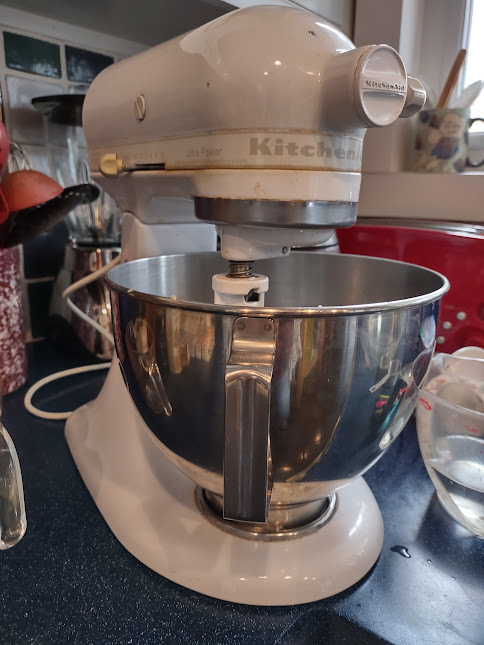
Lugging the stand mixer downstairs from the guestroom where it hibernates from the end of one holiday season to the start of the next, I always think of my cat, Tibby. Each year, when the stand mixer took its place of prominence on the kitchen counter, Tibby would go apoplectic, dancing in circles on the floor beneath it, meowing, salivating, waiting for that first stick of butter to appear. For him, the holidays were about an endless stream of butter wrappers as I baked pies and vast quantities of cookies to be tinned and sent to friends. The butter, softened in preparation for all this holiday hoopla, always left a thin creamy film he would lick and lick in ecstasy until the waxed surface of the wrapper itself had vanished. Tibby is no longer with us. He died in July 2021 after a long and happy life, but this memory always makes me smile.

It’s good—healing, rejuvenating—to reflect on that which we love and have loved. The people and things that sustain us. That give our life purpose and joy. We live in difficult times. High on the stress count. Low on the tranquility scale. Amidst the mayhem and brutality, the pressures of a society—a world—crumbling in on itself, we need to step back periodically and remember what is beautiful, what is worth saving, worth fighting for, so that we may renew our energy to do so.

The holidays—whatever one celebrates—seem like the right moment for a rejuvenation of spirit. Yes, they’re a mindbending whirlwind of coordinating menus and finding extra chairs at the table for Uncle Dave and your stepdaughter’s new heartthrob, of picking up relatives from the airport or train station and trying to remember what size sweater your brother-in-law wears while navigating the Black Friday crowds at the mall or online. But if we can find some quiet moment, carve out some small space for reflection on that which we love, I think it will lighten our hearts. Send us into the New Year restored.

When my kids were little, I’d stay up late on Christmas eve to play Santa, bringing down the presents from their attic hiding place and arranging them under the tree. Then I’d take a post-midnight stroll around our block, the streets so still, so calm, everyone tucked up in their beds, the stars high above. Peace on earth. My little corner of it anyway. Back home, I lit the tree and turned off all the other lights. And sat. And soaked in the serenity, the goodness of being alive. Even writing about it now feels healing. Hopeful. And we need to be hopeful, we who want to save the world from its own worse tendencies.

So, as we wind down one year and await the next, I’m making a list of all the things that sustain me, that give me joy, enrich my mind, nurture my heart and soul. “Those lovely intangibles,” as Fred tells the cynical Doris in the holiday classic Miracle On 34th Street. If this idea appeals to you, I hope you’ll reply to this post and share something from your own list of spirit boosters.

The List:

Music. I don’t know about you, but for me, music is like the soundtrack of my life. Slip in a CD or put on a vinyl disc and music transports me over the years to cherished moments. A song brings back the faces of long-ago beloved friends, dancing and drinking and gabbing the night away in our favorite café bar. A tune recalls the heady freedom of a cross-country drive as I made my way east to a new home in the land of my dreams. A dance tape I made for the occasion brings back the joyous August day I married the love of my life.

Music is also therapy. Every evening, as midnight rolls around, I take a half hour to “decompress.” My favorite songs for this include Joshua Bell’s incredibly beautiful recordings of Dvorak’s Song to the Moon and Schubert’s Ave Maria, which I first heard sung acapella by a man with a breathtaking tenor in the streets of Florence, Italy, twenty years ago.

From the Beatles to the Byrds, from Motown to Mozart, while driving or cooking or relaxing on the lawn at Tanglewood—where I can enjoy Josh Bell live—in music, I feel the strength, the continuity, the joy of my life. And the determination to fight on for my vision of a more loving, generous, peaceful world. 

Books. My greatest joy when I was three years old was the little Golden Book (19 cents!) I would get each week at the grocery store—if I was good, my mom cautioned. I was always good. I couldn’t wait to get home and open that book and discover the story. After my mom had read it to me several times, I had it memorized. By age four, I could read them myself. In college—surprise!—I majored in literature. Shakespeare, Flaubert, Faulkner, George Eliot, Fitzgerald, Hemingway, Gabriel García Márquez. And so many, many more. Reading, reflecting, discussing and writing about what I’d read. That was my “work.”  

And what did books offer me—then and in all the years since?  A multiplicity of mirrors from which to view this complex world. New ways of seeing and thinking about things and people. The ability to dig deep and make connections. And above all, the sheer pleasure of reading itself. My to-be-read pile far, far exceeds not only the limited shelf space of my house, but all reasonable life-expectancy figures. Unless I make it to 140. Hey, I’m up for the game. Bring it on.      

Theatre. When Covid struck, I feared it would be the end of live theatre. I was so relieved to discover that, indeed, the show must go on. Shakespeare at The Globe. Arthur Miller’s The Crucible at the National Theatre. Tennessee Williams’ Cat on a Hot Tin Roof in the West End. Toss in a great musical—Get Up, Stand Up! The Bob Marley Story—and like the line from the song “Take Me Out to the Ballpark,” I don’t care if I never get back.

If you haven’t done much theatre—and a sizable portion of America is a long Uber ride from a professional theatre—you may well ask: What can you get from a play that you can’t get from a film and at a fraction of the price? I would say, in great theatre there is a synergy between actors and audience that leaves you electrified. You come out of a show changed and charged by the emotions, the ideas you’ve witnessed in community with others.

Theatre was the naturally evolving bridge between the ancient storytellers who brought crowds of people together, hungry to hear tales of the human experience, and the later writing down of such tales—the Iliad and the Odyssey, credited to the Greek poet Homer, being two famous examples. But it remains a potent force in storytelling for the same reason the phonograph and the radio did not replace concerts: a live performance cannot be duplicated. The dynamics between a particular audience and the players belong to that moment. Ed and I don’t buy a lot of “stuff” (books being one exception!), but when we go to London, we go to the theatre.

The Natural World. In the great scrapbook of memories, one I often find myself returning to is a sleep-out on the shores of Lake Michigan when I was at Girl Scout camp. A warm summer’s night, the gentle slap of waves upon the sand, one of the counselors singing as she strummed her guitar—a song about becoming a woman—while we drifted off to dreamland, a zillion stars overhead.

Nothing is probably as soothing a balm to the soul as losing oneself in nature. The trees arching high above you. The vast blue dome of the sky. A world of green and calm, rivers and lakes. Nature dwarfs our human dramas, gives us respite from our struggles. I love big cities—New York, London, Paris. Love their energy, their art galleries, museums, theatres and cafes, but even there, I always seek out their green spaces. Central Park stretching from 59th Street to 110th.  The Jardin des Plantes in Paris. Regents Park and Kew Gardens in London. I relish them all, these urban oases. Closer to home, the Quabbin Reservoir in western Massachusetts is a revitalizing 39 square miles of nature preserve with 181 miles of shoreline.

If you haven’t let yourself get lost in the immensity of the natural world lately, I can recommend no better antidote for life’s stressors. Cleansing, rejuvenating, free to all. 

The Faces of Those We Love. Whoever said love is the greatest healer spoke a timeless truth that many physicians today acknowledge. Recall the moments you’ve waited in an airport or train station, searching the faces of the arrivals for the one you love. Suddenly they’re there and your heart leaps with happiness. Everything’s good. In times of trouble, it’s those faces we turn to for comfort. In times of joy, we look to those same faces to share the elation. Nothing can ever match the beauty, the comfort of those we love and are loved by.

Over a lifetime, we connect with many people. Some become good friends. A few become very dear friends. And, if we are lucky, we may find one very special person to share our life with. We may also have children to love and nurture. For me, those beacons of light and emotional sustenance are my husband Ed, my two adult children, Ethan and Lauren, and my dear friends of more than four decades, Pete and Maribeth. Also, my grandmother, Edna. Though all I have of her is a hand-tinted photograph from her childhood, she was the first person who taught me I was worth loving. A lifelong gift of immeasurable value.      

Into The New Year

Books and music. Theatre and the arts. The serenity of nature. The people we love. There is so much worth preserving in the world, including the world itself. And we who care about a more humane, more just, greener planet will have to do the saving. But first we must revive our own exhausted spirits. As 2023 winds down and we look toward the New Year, I wish you an oasis of love and calm this holiday season. The sustaining joy of happy memories with your nearest and dearest, and the creation of new moments to treasure. A thing of beauty is a joy forever. And yes, it is good to be alive.

We Have A Choice

Bless the beasts and the children, for in this world they have no voice, they have no choice. (DeVorzon/Botkin)

I was sitting on my side porch the other day when my neighbor’s cat, Binks, came tearing up the driveway. Usually, Binks ambles over for a visit, a head rub, rolls fetchingly on his back for a belly massage. Not today. Today he was freaked, for right behind him a girl of about nine raced up the drive on her bike, tossing handfuls of pebbles and acorns at poor Binks.

I leapt up instantly. “Stop that right now! It’s not okay to throw things at animals!” The girl, startled by my appearance—my Subaru had obscured me from her view—stammered, “Okay,” and fled across the street, back to the safety of her friend, a boy about seven. For several minutes they threw the stone/seed mixture at nothing. I settled back on the porch.

“I saw this really funny kid video,” the boy said to the girl. “A kid shoots his mom in the back with a really strong nerve gun—you know, the kind that gets you good. And she’s on a ladder painting, so when the gun hits her, she falls backward off the ladder and the paint goes all over her.” The kids laughed and then pedaled off down the street. I continued my surveillance until I was sure they were gone. What remained was my disturbance. A really funny kid video?

You Are What You Eat: Growing Up On A Steady Diet of Violence

A second troubling incident occurred during my daily ramble—a walk that takes me through the ordinarily peaceful streets bordering on the local college campus. On the front porch of one house, a woman was sitting with her two boys, ages about six and eight. I’d seen the kids many times, playing in the yard. That day, however, the boys were busily engaged in opening two large packages that had just arrived. The older one let out a whoop and held up the contents—two AR-15s, toys I think, at least I hope they weren’t real, but with Marjorie Taylor-Greene pushing guns for kids, one can’t be certain. I mean, there are gun manufacturers out there aggressively marketing real firearms for children. Just google “real guns for kids” and you’ll get an eyeful. Top Five Handguns for Kids; How to Choose Your Child’s First Gun; Feels like Mom and Dad’s Gun: U.S. Firm Makes Real Rifles for Children.

The older boy immediately struck a pose with his AR-15, chillingly familiar from news videos of violence around the globe—Iraq, Yemen, Syria, Palestine, Israel, not to mention the endless mass shootings at U.S. schools, shopping malls, and public events like the Harvest Festival in Las Vegas where more than a thousand bullets were fired, killing 60 people and wounding another 400. That last event occurred in 2017, and people began to talk about a time coming when mass shootings would be a daily occurrence in America. Well, we’ve crossed that threshold and left it in the dust. By September 3rd of this year, the U.S. had already clocked 484 mass shootings for 2023.

And kids see it all. Even if a parent monitors TV consumption of violence at home, it’s everywhere. As Common Sense Media warns: Thanks to live-streaming apps… kids can watch actual scenes of real-life violence in their social media and news feeds. They can also interact with it, and they do… commenting, sharing, and using other digital tools to process the raw footage. In one particularly harrowing instance in 2016, a young French woman talked about her sadness and suicidal thoughts. Viewers are said to have encouraged her to do the deed—which she then did by throwing herself under a train. In that same year, an Ohio couple was arrested. The man, age 29, was charged with raping the underage friend of his 18-year-old girlfriend—with his girlfriend’s consent, making her an accomplice as she was the one livestreaming the rape on Periscope. In court, it was revealed that the girlfriend had gotten carried away, giggling in her excitement over the number of “likes” she was getting as she filmed the crime.

Children’s constant exposure to horrific real-life violence and tragedy is not just a problem for those adults currently raising kids. It’s a problem for everyone. It’s our problem. At a time when many states are hollering about the need to crush “woke” agendas in schools that focus on teaching children respect for others and fostering communal empathy, it seems to me we have never been in greater need of peace, love, and understanding.

Dumbing Down the Content and Ratcheting Up the Fascism

What we are getting instead is book bans and radical-right educational agendas, like the videos from unaccredited PragerU that tell children slavery was a good thing for Black people, or at least it wasn’t that bad—better than being killed; that climate change is a bunch of hokum; and (my favorite) that Jesus—who, as Vanity Fair’s Caleb Ecarma points out, predated Adam Smith by more than a millennium—was a free market capitalist.

See an agenda here? Co-founded by conservative talk-radio host, Dennis Prager, and financed by fracking billionaires Dan and Farris Wilks (as well as the Betsy DeVos family and others of that ilk), PragerU has no ties to any accredited educational institution. Its CEO, Marissa Streit claims accreditation “these days is synonymous with controlled [by ‘political elites’].” Much of PragerU’s “curriculum” consists of short videos for grades 6-12 on political and social issues: “Social Justice Isn’t Justice.” “Make Men Masculine Again.” “Income Inequality is Good.” “The Inconvenient Truth About the Democratic Party.”

If you think such materials are B.S., but they’re not teaching our kids it’s okay to throw stones at cats, I encourage you to think again. With a “curriculum” that devalues Black people, indigenous people, gay and trans folks, women, and the poor, what chance do animals have?

As of this writing, Florida has approved PragerU curricula for use in schools across the state. Oklahoma’s State Superintendent of Schools has okayed PragerU videos as “supplemental curriculum,” and New Hampshire’s Board of Education recently voted to adopt one PragerU course on “financial literacy” for its secondary schools. Digging around the Net, I was heartened to discover that these approvals have been met with pushback from many districts in the three states. But history teaches us that what is “optional” or “supplemental” today may well become mandated tomorrow. That any of our children are being exposed to this far-right anti-science, anti-democratic propaganda should concern all of us. PragerU and its “curriculum” are much more than the absence of education; they are indoctrination with a bullet. An agenda that panders to the Christian nationalists and is financed by the uber rich.  

Thought Control: The War on Books

Unsplash: Freddy Kearney

According to Pen America, there have been more than 6,000 book bans in the U.S. in the past two years. Two of the biggest targets—surprise, not—are books that feature characters of color or deal with issues of race, and books with LGBTQ+ characters. Perhaps most important to note is that virtually all of the 2,532 book bans in public school libraries in the past year jettisoned the “proper review process by a committee of educators and librarians.”

It’s easy to dismiss these bans as the megalomaniacal crusade of a few fanatics and extremist cranks, largely limited to far-right states like Florida and Texas. But the numbers keep rising, as do the list of states afflicted. Missouri, Utah, South Carolina, Pennsylvania, Michigan, North Dakota, Virginia, California—all have seen a significant jump in book bans this year. Even bluer-than-blue Massachusetts is not exempt. According to ACLU Massachusetts, the state saw 45 attempts to restrict access to books last year.

And what are these “offensive” titles, these books so “threatening” to our youth that they demand removal from school library shelves? Among the banned are Pulitzer Prize-winner, Maus, the story of author Art Spiegelman’s father’s experiences in the Holocaust (which the Wall Street Journal, hardly a bastion of “woke”, called the most affecting and successful narrative ever done about the Holocaust). Verboten, too, is Newberry Honor winner The Watsons Go to Birmingham—1963, Christopher Paul’s tale of a Black family who journey from Michigan to Alabama to visit Grandma and run smack into the Civil Rights Movement where one of the family narrowly escapes death in the Birmingham Church Bombing. Prominent among the book’s themes are kindness and compassion. Well, we certainly don’t want those “liberal elite” values being taught to our kids.

But it seems we do. A 2022 American Library Association poll found that more than 70% of parents are opposed to book bans. That’s a sizeable majority. So just who are these book-banning fanatics intent on taking away our children’s freedom to read? According to Suzanne Nossel, CEO of PEN America, the current onslaught of book bans “represents a coordinated campaign…being waged by sophisticated, ideological and well-resourced advocacy organizations.” PEN has identified at least 50 groups who aggressively advocate for banning books in our public schools. Prominent among them is Moms for Liberty, a right-wing group who started in Florida in 2021 and has since sprouted 278 chapters across forty-five states. Last time I counted, that is most of America. How has a group that in no way represents what most Americans want or believe spread so rapidly and far? I’ll give you a hint: The reason begins with m and ends with y.

No Time for Learning: The End of Literature?

Unsplash: Nguyen Dang Hoang Nhu

The war on public schools being waged by the far right and the onslaught of book bans—as heinous as they are—are not the only threats to our children’s education and development. For the past twenty years, the pressure of high-stakes testing, beginning in elementary school, has forced many educators to “teach to the test.” Whether it was called the No Child Left Behind Act (2002) or its revamp, the Every Child Succeeds Act (2015), in practical terms the intense focus on standardized testing in our public schools (with the results often tied to federal funding and teachers’ salaries) has led to a time crunch in the classroom. Teachers across the nation complain they must sacrifice reading entire works of literature to focus on those “bits and pieces of books” that will get the kids through the tests. They fear that reading, once a cherished pleasure, has become a loathsome chore. Readicide, as English educator, Kelly Gallagher, calls it.

How is a student to “analyze how and why individuals, events, or ideas develop and interact over the course of a text”—an essential skill every citizen needs to understand and evaluate our world, and a key standard in English Language Arts—if all they receive are disconnected passages from A Tale of Two Cities or The Grapes of Wrath or Romeo and Juliet (removed in numerous Florida school libraries—“too sexy”)?  

The Kids Are Not Alright

Education should prepare our children for the world they are inheriting—it’s history, its present, its future. Today’s kids are facing incredible challenges on multiple fronts—environmental disasters; real threats to drinkable water, breathable air, and the global availability of food; the trend toward fascism around the world with its rising tensions and the resultant hostilities that threaten nuclear war. We desperately need thinking human beings. And right now, many of our kids are crashing and burning.   

Unsplash: Ricky Turner

The National Institutes of Health’s (NIH) 2022 National Healthcare Quality and Disparities Report warns us that: Nearly 20% of children and young people ages 3-17 in the United States have a mental, emotional, developmental, or behavioral disorder, and suicidal behaviors among high school students increased more than 40% in the decade before 2019. Mental health challenges were the leading cause of death and disability in this age group.

The report also cites a study conducted by the Health Resources and Services Administration (HRSA) that shows the number of children ages 3-17 years diagnosed with depression grew by 27% between 2016 and 2020.

Little kids, depressed? Rapidly increasing numbers of middle- and high-school students, anxious to end it all? We should be outraged at these findings. More important, we should be doing something to stop this assault on our kids, our country, our world.  

Who’s Fighting Back

Unsplash: Kristina V

The war against education, against freedom of thought, against democracy itself is not going unchallenged. In June, Governor Pritzker (D) of Illinois signed a bill into law that will withhold state funding from any public library that removes materials because of “partisan or doctrinal” complaints. “Young people shouldn’t be kept from learning about the realities of our world,” Pritzger said. “I want them to become critical thinkers.”

California’s Governor Newsom (D), Attorney General Banta and State Superintendent Thurmond teamed up to write a joint letter warning the state’s educators against pulling books from library shelves. Doing so, they said, may qualify as “unlawful discrimination,” and expose the perpetrators to an examination by the state’s Attorney General’s office. Several cases have already come to the state’s attention—one involving rejection of a social studies curriculum that includes gay rights—and are being aggressively pursued.  

Nine states—New Jersey, Illinois, Delaware, Massachusetts, New York, Maryland, New Mexico, Washington, Rhode Island—and the U.S, Virgin Islands have signed a letter to textbook publishers expressing their dismay that some publishers are reportedly “yielding to…government representatives calling for the censorship of school educational materials.” The states are demanding that publishers “hold the line for our democracy.”

The National Campaign for Justice reports that Senator Brian Schatz (D-Hawaii) and Representative Jamie Raskin (D-Maryland) have introduced a bill to stop book bans and defend the freedom to read. Fifty-two co-sponsors from the House and twenty senators have already taken up the fight.

If Not Now, When? If Not Us, Who?

Unsplash: Yustinus Tjiuwanda

When I was studying for my M.Ed. in 2000, Alfie Kohn, renowned lecturer and author on education (The Schools Our Children Deserve and What Does It Mean To Be Well Educated? among other titles), spoke at the University of Massachusetts. He was addressing the distress many teachers, parents, and kids were feeling about the state’s new MCAS tests to be administered in grades 4, 8, and 10—the final test to determine whether one graduated. Teachers were up in arms—they saw the writing on the wall: Teach to the test!—and many fourth grade teachers resigned in protest. Parents worried that their children, particularly those with special learning needs, would be traumatized by the pressure and fear of failure. Kohn, with his solid background in social science research and best educational practices, advised the packed auditorium: From wherever you stand—school administrator, educator, parent—you must fight this. Be the link in the chain of resistance that will not break.

And here we are, two decades along, but finally a ballot initiative has been filed with the Massachusetts attorney general that would end the MCAS as a requirement for graduation. President of the Massachusetts Teachers Association, Max Page, explains his union’s strong support for the initiative: “All the focused test prep…all the time wasted preparing for this test, has not had the impact …‘ed reformers’ want. It’s time now to change it.”

Unsplash: Ben White

All the time wasted… Yes, twenty years is a long time. But if we never start fighting to reclaim our kids’ future, our democracy, we will never win. Child labor laws have been scuttled or relaxed in Arkansas, Iowa, New Jersey and New Hampshire. More than a dozen other states are attempting to do the same. Many Republican candidates speak openly of abolishing the Department of Education if they are elected, calling it “a prime example of Washington’s meddling in American lives.” The agenda couldn’t be clearer: a Christian nationalist education for the well-to-do and forced labor for the rest of our kids. (Recall the PragerU video, “Income Inequality is Good.”)

Yes, eternal vigilance is the price of liberty. In this moment, vigilance means voting this November 7. It’s true, there’s no “big” names on the ballots in 2023. But there are state board of education members and—depending on where you live—governors, attorneys-general, secretaries of state. There are statewide and local ballot measures. In many communities, there are elections for local schoolboard members. Please don’t sit home because it’s an “off year” election. When we don’t decide our future, someone else will always step in and decide it for us. In these times, there are a lot of dangerous people, backed by big $$$ donors, all too willing to do that.  

The Washington Post is famous for its slogan Democracy Dies in Darkness, an allusion to the silencing of the press. But I would argue that the first threats to democracy are always made in plain sight for all to see. We are there. We must act now. Fight back. Protest. Vote.   

Never Cease Being Amused

“As long as you can laugh at yourself, you will never cease to be amused.”  (Anonymous)

[Note: Some days it can feel like there’s not a whole lot to laugh at out there. But fortunately, we all arrive on planet Earth with surefire comic material–ourselves. So I’m leaving you with a lighthearted post to get you through the psychotic times in which we live. Never mind that you’ve seen it before. It will do you good to see it again. Besides, I’m off to Copenhagen for a bit of R-and-R where I plan to indulge in lots of Danish pastries and tip a pint or two with the locals at my neighborhood “værtshuse.” I’m sure I’ll amuse the Danes no end, starting with my attempts to ask for a beer in Danish. Hold the fort while I’m away and I’ll see you with an all-new post in November.]

Some months ago, a friend shared a story at a party. The NGO she works for is part of a global project involving a half dozen other NGOs. Right in the middle of a networking weekend, no one could get access to the project’s shared online folder. People from Amsterdam to San Francisco were frantically e-mailing each other: Where’s our data?! When the dust settled, it transpired that one of the participants had moved on to another job and wiped the old files from his computer to gain usable space. Unfortunately, he was listed with Google as the administrator on the folder. When he erased his copy, he unwittingly erased all the members’ copies.

comedy-oops-button-5-ways-to-avoid-embarrassing-moments-on-social-mediaEveryone at the party had a good laugh over this little tale of digital mayhem. Probably because: 1) we could all imagine ourselves doing something equally stupid, and 2) we were relieved we hadn’t been the one to do so in this instance.

Since then, I’ve often found myself chuckling over this incident and wondering if its innocent perpetrator saw its humorous side—after all, no one was hurt and though it was a nuisance, the remaining NGO members were able to reconstruct the folder from their individual notes. I hope he can laugh as we at the party laughed, but I’m doubtful. We tend to suffer the embarrassment of our mistakes for a long time. Sometimes to the grave.

There’s a lot of pressure to perform to perfection out there. Mistakes are anathema—heads will roll, et cetera—yet who among us doesn’t make them?

To compound the problem, we are vulnerable to something psychologists call the “Spotlight Effect.” When we think we’ve screwed up—called a prospective employer by the wrong name, tripped over a cord as we made our way to the podium to give a speech, sent the wrong manuscript to an editor—we tendcomedy-credit-writingpad-com-embarrassing-moment-615x461 to freak out, imagining that everyone saw, that everyone now thinks we’re awkward, stupid, incapable. This magnification of our own mistakes has two negative effects: 1) To avoid any risk of humiliation or rejection, we become much more guarded in what we say and do; 2) As a consequence, we drain a lot of the joy from our lives.

Tragedy + Time = Comedy

My husband once set his hair on fire while trying out an expensive cigarette lighter in a posh department store. My friend Pete swallowed a piece of ham tied to a string while doing an experiment on peristalsis. I hauled around my three-week-old son at the bottom of a Snugli, like a sack of potatoes, until a woman in the supermarket told me there was a little button-in cloth seat for newborns. Embarrassing? Well, in the case of the peristalsis experiment gone awry, maybe more frightening than humiliating. The point, though, is that these anecdotes, told and retold over the years, have become the source of much hilarity and bonhomie. As comedian and writer Steve Allen said: Tragedy + Time = Comedy. Our most embarrassing missteps become our funniest stories, the ones everyone asks us to repeat.

filmywar.com
filmywar.com

But what if we just cut to the chase and start laughing at our foibles the moment we spill the lasagna all over our lap, drop our cell phone down a restaurant toilet, forget to attach the CV to our job application? Life should come with a beeper, warning us when we’re about to screw up, but it doesn’t, so we need to adopt the ability to laugh at ourselves.

My dad could be ornery, and he was not much with the compliments, but he could always laugh at himself. It’s probably the most important thing I learned from him. I remember one time in a restaurant, he was fixing his coffee. “Geezus, this cream is thick,” he remarked as it fell in chunks from the little pitcher into his cup. “Oh no,” my mom cried, “that’s my blue cheese dressing. I asked for it on the side.” Now, my dad could have blamed his mistake on the low lighting or the waitress’s failure to set the blue cheese next to my mom’s plate or the stupidity of a restaurant that would put both cream and blue cheese in identical pitchers. But he just laughed. Because it was funny. Because there’s no point in pretending you didn’t do what you did. Because no one is perfect. And then he ordered a fresh cup of coffee.

Mistakes—we all make ‘em. So, laugh it up. And if the people around you can’t cope with this very human reality, maybe you just need different people.

comedy-two_people_laughing

All Together Now

When the films Oppenheimer and Barbie both opened on July 21, I felt a surge of joy and hope. Joy that big-screen films may have survived both the plague and the surfeit of made-for-TV movies streaming in its wake. Hope that the return of such films, bringing us together again in movie theatres large and small across the country—happily munching popcorn, laughing together, crying together, sitting on the edge of our seats as the tension mounts—will mark the beginning of a return to shared cultural experiences. We. Need. This.

Unsplash: Krists Luhaers

For too long now, we’ve been asunder. Pawns in a game of divide-and-conquer that’s been creeping up on us for almost three decades. (More on this in a moment.) Gen Z has never experienced an America that is not riven “twenty ways to Sunday” as my mom used to say. Has never known a United States.

To say this is not to wax nostalgic for some lost idyllic democracy of yore. Our American “melting pot” has always struggled to meld. Has always fallen far short of a true integration of all peoples when it comes to equal opportunities in education, housing, employment, health, and rights. But our shared American culture—movies, music, TV shows, news broadcasts—meant we all listened and danced to the songs of Motown, Queen, Little Richard, the Beatles. We all watched Saturday Night Live, Star Trek, All in the Family. We all saw Titanic, The Godfather, Men in Black. We all got our news from one of three network sources—ABC, NBC, CBS—each barely distinguishable from the others. We all tuned into the impeachment proceedings against Nixon in the wake of the Watergate scandal. And we all witnessed Neil Armstrong stepping onto the Moon in July 1969—“That’s one small step for a man, one giant leap for mankind.” These commonalities helped forge a coherent society. An us.

Raising America’s Collective Conscience: How A Free Press Challenged Us To Be Better

Those cultural bonds also challenged us to look at ourselves. Not just our neighborhood, or even our region, but our entire country. This vast entity called America—who were we? In 1960, our thousands of local and big city newspapers, together with our local and network news stations, all brought the story of Ruby Bridges into our living rooms, as the six-year-old, flanked by federal agents, entered her new school in Louisiana, the first Black child to integrate an all-white school in the South. Three years later, we all saw and heard Martin Luther King, Jr. deliver his “I Have A Dream” speech at The March On Washington.

Those widely-shared stories and images awakened many white Americans to the deep injustices that Blacks Americans continued to suffer, and created a vast support network across the country for the Civil Rights Movement. Freedom Riders—Black and white civil rights activists together—boarded interstate buses in 1961 and rode into the Deep South to challenge Jim Crow segregation. Four years later, the nationally-televised Selma to Montgomery marches in Alabama showed Americans everywhere just how brutal southern resistance to integration was, as we watched Alabama state troopers beat and gas Black activist John Lewis on the Edmund Pettus Bridge, a day that would become known as “Bloody Sunday” in the struggle for civil rights. [Lewis would go on to become the U.S. representative for Georgia’s 5th district, a position he held for 33 years until his death in 2020.] The nationwide televising and reporting of these events not only raised America’s consciousness. They led to the passing of the Civil Rights Act of 1964 and the Voting Rights Act of 1965, both signed into law by President Johnson.

News broadcasts and newspapers also brought the escalation of U.S. involvement in the Vietnam War into our living rooms on a nightly basis, spawning an active anti-war movement in America that numbered in the tens of millions and defined a generation. Life magazine’s cover story on the 1968 My Lai Massacre in Vietnam further galvanized American support for ending that war. Life was another touchpoint of American culture.

That we all experienced the same cultural and political events does not mean we all held hands and danced around a maypole in some idyllic Shangri-la. There is no movie or TV show, no song, no social movement, no political moment that will bring us all into agreement. There always has been and always will be differing tastes, opposing opinions, and just plain bad actors who need to be dealt with—in a non-violent legal framework—when they cross the line. But I would argue this underscores all the more the desperate need for shared cultural experiences through which we can relate to others and build bonds.

Sowing Division: The Rise of Fact-free News and the Silencing of Voices  

So, what do we have now, in this brave new world?

We have Fox News (which first aired in 1996) and One America News (oh, the irony of that name!), and Breitbart News and QAnon lunacy, all lying to us, dividing us by intent, shaping our worldview to suit their own ends. Ends antithetical to democracy itself.

We have a press that has shrunk—and continues to shrink—at an alarming rate. A recent study by Northwestern University’s Medill School of Journalism, Media, and Integrated Marketing Communications found that, on average, two papers go out of business every week in the U.S. In the past 18 years, more than 2,500 have ceased publishing.  “This is a crisis for our democracy and our society,” stated Penelope Muse Abernathy, lead author on the study.

Unsplash: Sarah Penney

We have a Supreme Court, the majority of which has been carefully selected and, in some cases, bribed by billionaires to dismantle our rights, hence, our democracy. Even before they struck down women’s right to abortion and affirmative action in education, SCOTUS was hot on the trail of curtailing our civil rights. In Citizens United (2010), the Court claimed that corporations were “people”, reversing longtime campaign finance restrictions to allow corporations and other outside groups to spend unlimited amounts of money on elections. Three years later, the Court ruled in favor of officials from Shelby County, Alabama, gutting a key part of the 1965 Voting Rights Act. President Obama lamented the decision, saying it invalidated core provisions of the law, upsetting “decades of well-established practices that help make sure voting is fair, especially in places where voting discrimination has been historically prevalent.”

What happened to a nation who rejected Jim Crow? A people who rose up and stopped an unjust war? Who grooved together to the Temptations’ My Girl and laughed together watching Beverly Hills Cop at their local cineplex?

One is the Loneliest Number

Polls suggest that nation is still out there. Seventy percent of likely voters support the Freedom to Vote Act—a majority support that extends across party lines. In a May 2023 Gallup poll, 85% of Americans said abortion should be legal in at least some circumstances. So why has our collective voice been reduced to a whimper? Why has our cultural cohesion become invisible? Why do so many of us stare at each other with suspicion—or fear?    

For too long, we have been isolated, each in our own little bubble. Individually streaming our movies for consumption at home, causing nearly a quarter of America’s indoor cinemas to shutter their doors from 1995 to 2020. And that’s before the pandemic hit.

We individually stream our tunes, too. Music streaming services have revolutionized the way we listen to music, the CEO of Media Music News posted Linked In. They certainly have. From Spotify and Pandora to YouTube and Big R Radio Network (this last, features more than three dozen channels, including something called Yacht Rock, Country Oldies, Post Grunge Rock, and Explicit Top 40), we select our music like menu items at a restaurant, according to our individual taste. But if we always order the Bolognese, how are we gonna know what we might be missing with the Tandoori chicken or the Kung Pao tofu? How can individual streaming provide the kind of social glue that connects us from coast to coast as jazz did in the 1920s, as swing and Big Band did in the 1940s, as rock, blues and soul did in the 1960s, as New Wave, Hip-Hop, and punk rock did in the 1980s?

Unsplash: Ardian Lumi

While it’s true that radio has been diversifying (rock/country/classical) since the 1960s, radio was then and continued to be, until the turn of the millennium, the way America sampled new music, shared tunes, forged a common culture. As Soul Source notes: DJs on “pop stations would pick many soul sides to spins…even when many of the other things given heavy airplay on their station were by…the Beach Boys, the Beatles, the Monkees, Bobby Vee, the Lovin’ Spoonful, Frank Sinatra.” Now if that ain’t a diverse playlist, I don’t know what is. And from my own experience, I can attest that country singers like Kenny Rogers, Glen Campbell, and Dolly Parton were heard on pop/rock stations everywhere. Casey Kasem’s American Top 40 Countdown was a coast-to-coast weekly radio show. “Listening to Casey was as much of a family Sunday tradition as going to church,” Remind Magazine says, featuring the “best-selling and most-played songs from the Atlantic to the Pacific, from Canada to Mexico[emphasis, mine].” A Top 40 for America.     

This hermetic existence many of us are now living—plugged into our personal devices, sealed off from society and our fellow beings—has made for a lonely country and a sad, scared, increasingly-violent people. A divided people easily manipulated by those who know the buttons to press—racism, homo- and trans-phobia, religion—to gain their own ends: a dictatorship of the rich. Can our democracy with all its flaws, but still far superior to a fascist oligarchy, survive these divisions?   

Commonweal: Reclaiming Our Cultural Cohesion

Set of Hamlet (Shakespeare in the Park 2023)

So, that is why I celebrate the opening of major, wide-audience films like Barbie and Oppenheimer. In New York City, I saw groups of children in pink gear, romping noisily together after seeing Barbie, elated at sharing an experience with their peers, something they were denied during the pandemic’s grueling loneliness of online-learning. Why I, who am not an early-morning person, willingly got up at 5:30 a.m. to be on line, literally, by 7:00 in Central Park, with hundreds of other theater buffs, waiting for tickets to Shakespeare in the Park’s production of Hamlet. Tickets that are free to the public for an event in a public space. Why I smile every time I pass my neighbor Louisa’s house with the HELLO sign posted prominently by her front door—a sign, a word, that welcomes and embraces all who pass by.   

I will close with something a friend shared recently on Facebook. It was signed by Ira Byock, a palliative care physician and author. The journalist in me dug around to find its source. Though I cannot definitively say Mead told this exact story, I can tell you it has been widely quoted. And for my purposes here, it is the story itself that matters:

Anthropologist Margaret Mead was asked by a student what she considered to be the first sign of civilization in a culture.

Mead said that the first sign of civilization in an ancient culture was a femur (thighbone) that had been broken and then healed.

Mead explained that in the animal kingdom, if you break your leg, you die. You cannot run from danger, get to the river for a drink or hunt for food. You are meat for prowling beasts. No animal survives a broken leg long enough for the bone to heal.

A broken femur that has healed is evidence that someone has taken time to stay with the one who fell, has bound up the wound, has carried the person to safety and has tended the person through recovery.

Helping someone else through difficulty is where civilization starts. We are at our best when we serve others.

Be civilized.

To that, I can only add my conviction that civilization begins, is nurtured by, survives through what we share in common.  A culture open to and embracing all.

The Day We Plan…And the Day We Get

I don’t know about you, but my favorite days are the ones entirely free of encumbrances. No doctors’ appointments (especially no dentist!). No weekly schlep to the supermarket. No hours lost to the hair salon. No plumbing/heating/appliance breakdowns (rare, but always a time-consuming nuisance). Nothing but a whole day stretching gloriously ahead to use as I choose. Uninterrupted writing time. Unhurried hours to lose myself in a house project of my choosing. Time for a cup of java with Ed at one of our local cafes or taking our books for a leisurely read at the park down the street. A stint playing my guitar. Maybe—dare I hope—time to start an art project. A decoupage, perhaps. Or collage.

That’s the fantasy anyway. And some days, I actually manage to do several of these happy, life-enhancing activities, but all too often (and weirdly, more and more often—did someone put the 24-hour cycle on hyperspeed?), to paraphrase Joni Mitchell, “Stuff gets in my way.” Not worthy stuff. Not interesting stuff. Not some unexpected delight like my recent meet-up with a dear friend I haven’t seen for nine years who happened to be in town for the week, a guest lecturer at the local university. For that, I gladly cut my working day short and even forewent my usual five o’clock gin-and-tonic so Ed and I could have dinner and drinks with M without me doing a faceplant.   

Pounding Headaches

No, the stuff that routinely wreaks havoc on my waking hopes are things both unforeseen and unavoidable. Like two weeks ago when the contractors renovating our house informed me that it’s best to take everything off the walls while they’re re-siding the house because the hammering (and it’s a lot of hammering, weeks of hammering stretching into the foreseeable future) may cause pictures and pottery and all sorts of wall-mounted bric-a-brac to crash.

Michal Balog (Unsplash)

So instead of writing or enjoying a coffee out or strumming the old guitar, I took down all the framed artwork and photos, transferred all the antique bowls and vases from their shelves to the dining room table (where we will eat for the coming weeks is a mystery)—and started to box the 10,000 CDs (slight exaggeration but not by much) stashed in the CD wall-mounted case. Actually, I’m getting ahead of myself here—I first had to find a box to hold the CDs. Make that three boxes. Wide enough and long enough to hold a zillion CDs in alphabetical order—otherwise I’ll lose two days on the return when I have to put them all back into the hanging cupboard.

As of this writing, I am still searching for the floor space to stash these boxes, space where we won’t trip over them every ten minutes as we’re now doing.

One-Sided Phone Tag  

If it was just the house renovation, one could philosophically say, “It will end someday.” Some month. Some year. Hopefully. But that’s the thing about dies interruptus, there’s always something happening. And then there are the things that happen over and over, with slight variations. Like phone tag. Whole mornings, complete afternoons vanish as I wait, and wait…and wait for someone to talk to who can (maybe) resolve my problem.

A recent classic example of this occurred when I tried to do a routine annual renewal for my Carbonite back-up plan (there is no greater fear for a writer than some unexpected catastrophic glitch that erases everything one has written. Essays. Short stories. Entire novels. In a word: one’s life’s work). So, as I was waiting for visiting family to get ready for a much-anticipated day—a river walk and art gallery visit, followed by lunch at a favorite eatery—I clicked on the e-mail link that in under two minutes should have renewed my subscription for the year. The prior credit card I used was now defunct, so I typed in the new info where it said change payment method. No big deal, right? I’ve done it. You’ve done it. One card expires. You use another.

Only this time, it was a big deal. This transaction cannot be processed. No rhyme. No reason. I refreshed and tried again. And again. I scrolled down to the Contact info and dialed the number. We are experiencing an unusually high call volume at this time. Please wait for the next available representative… The mantra of our times.

No fool, I put my phone on speaker and used the time to clear 600-some emails.  A half-hour later, the family was ready to go, so I cancelled the call. Another day. Long story short, it took several more calls, consuming sizeable chunks of several more mornings to get the renewal straightened out. I could have walked to Carbonite headquarters in Boston faster, although it would have been more fun to visit their field office in Paris.

The Doctor is (Not) In 

Last November, I went to my scheduled annual physical with Doctor Z. A nurse did the usual prelim weight check, blood pressure, pulse stuff and assured me, “the doctor will be with you shortly.” I used the time to finish a chapter of my current read (I always bring a book), cleaned up some email on my phone, and waited. Forty minutes passed. No doctor. I went out to the nurses’ station to investigate the situation. “Oh, Dr. Z isn’t here,” one of the nurses gaily informed me. “She has jury duty today.”

Jury duty? Jury duty! Why didn’t someone call me or at least inform me when I arrived? Why did they proceed with the preliminary checks?!

“If you’d like to see someone today,” the receptionist said [Did they think I had arrived for some other purpose??!], “Dr. Y could give you a few minutes between her appointments.”

I will refrain from going into a tirade here about the sorry state of medical care in this country and just say that since I did have a particular concern that day, I took the few minutes Dr. Y could spare. She was wonderful—attentive and supportive for the ten minutes I saw her. On my way out, I mentioned with all the politeness I could muster that it would have been good if someone had called me to inform me about Dr. Z’s jury duty. “Jury duty?” the receptionist said. “She’s not on jury duty. She’s taking a couple of weeks off. She scheduled it months ago.”

I swear, every word of this time-wasting tale is true. But I did get one good thing out of this “lost morning.” Dr. Y. She is now my primary care doc, though making that happen is another loooong time-wasting tale I will spare you here.  

Computer Glitches

It was a beautiful day in early May. Nothing scheduled on the calendar. Following breakfast, I settled into my desk chair, looking forward to an uninterrupted morning of work on my novel, after which I would take a stroll downtown and browse the local bookshops. Ed would no doubt want to accompany me and we’d have lunch on the open rooftop of a favorite local brewery.

Ha. Ha. Nice try, Henry.

I had just opened my manuscript, tweaked my last chapter, added a new twist to my outline, and typed in Chapter 20 when my computer curtly informed me: You do not have permission to edit this file.

Permission? Permission?!! I WROTE THIS “FILE” YOU ****** MORON MACHINE. [For sensitive readers, I have edited out the longish string of expletives here.]

But, of course, shouting at your computer will only take you so far, as in “that and five bucks will still buy you a cup of coffee.” Which is to say, nowhere. So, heaving a big sigh, I started the tortured journey into ascertaining where the glitch lay. I first checked my other files to see if this forbidden thing was systemic. Nope, I could happily edit each of the five files I opened. Next stop: Settings.

After a frustrating half hour of searching likely places to no avail, I googled my problem, jotted down several possible solutions and tried again. Still… nada. Ninety minutes into the morning, I at last located the problem: I had somehow been bumped from the position of “administrator” on my novel. Just who the administrator was for my file on my computer remained a mystery. I returned to googling solutions. Found something that sounded like it might work and, crossing all fingers, knocked wood (my desk), and deleted everything under “administrator”—a string of letters and numbers I didn’t recognize. I then boldly typed my info in. Voila! I could now edit my novel again. What I could no longer do was work on it for the morning or enjoy a stroll downtown to browse bookshops. It was lunchtime.

How We Spend Our Days

I have no snappy words of wisdom to impart here. Only the observation that time is a precious commodity. No one’s time is infinite. If you’ve followed this blog for a while, you know I’m a big fan of writer Annie Dillard’s thoughts on this subject: How we spend our days is, of course, how we spend our lives.  

Some time-busters are one-offs like our house renovation. In a few months, it will be finished. I’ll restore order to the interior and move on. Others are reliable repeats—my thrice-yearly dental visits, the weekly shop. Some are not only time-consuming but utterly maddening—like the repeated attempts to renew my file protection I detailed here.

It does seem that since the Plague broke in 2020, the number of “glitches” one daily encounters has skyrocketed at the same time as easy, straightforward solutions have plummeted, but that’s where we are. And since I don’t see a likely turnabout in this state of things, and moving to a yurt on the tip of outer Mongolia is not an option—too cold, bad internet, no Quik Marts within a zillion miles—I need a way to not let the unending stream of time-zappers deflate my spirits and spoil my day (after day, after day).

When I told Ed the topic for this month’s blog, he laughed heartily and said, “The day you plan, and the day you get? They are not the same. Ever.” But yesterday was one of those rare days. Ed and I took our computers to a coffee shop downtown where I wrote undisturbed for two-and-a-half hours before we moved on to lunch on the shady porch of a café with Mediterranean cuisine. Heaven! Damn, what I wouldn’t give for a week of days like that. But…

This morning, I got a jury duty summons. Then, an incorrect medical bill that had been settled months ago resurfaced, involving a long string of messaging and several phone calls. And one of the brand-new posts for the front porch was somehow badly scratched and chipped in the installation, so I need to get in touch with the builders.

How we spend our days…