Forty years ago, when I was a young twenty-something, I wrote a poem that began with the question: What motivates one man to build a bomb while another plants a garden?
The question was not meant to isolate a gender. Man could just as easily have been person. Nor was it confined to the activities of weapons-making and horticulture. I might have asked what motivates one person to start a private equity firm that systematically destroys the livelihood of tens of thousands of workers, while another person creates a non-profit charity that has fed hundreds of millions of people in crisis worldwide?
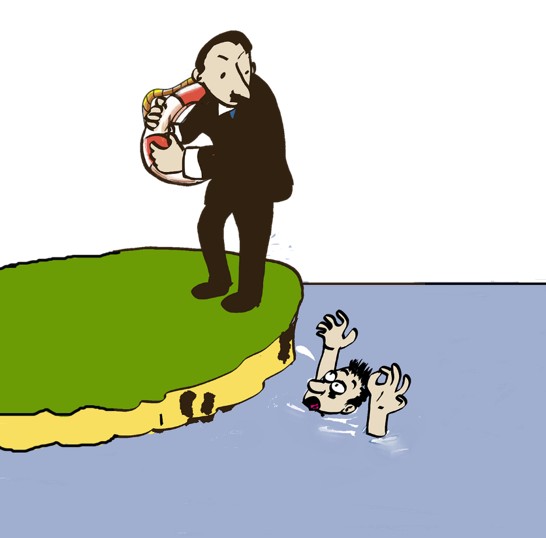
Greed vs. Generosity
In this case, the first person is Mitt Romney (former Utah senator and one-time presidential candidate who lost to Obama in 2012), co-founder and former CEO of Bain Capital, a private equity firm that bought up companies in trouble for cheap, in deals that then loaded up those companies with more debt, resulting in many of the businesses being stripped down for parts, and the assets sold off at a profit—a profit for Bain—not infrequently leaving workers without jobs, healthcare coverage, or the pension funds they’d earned, as Romney and his partners reaped millions.
The second person, the “gardener”, is José Andrés, born in Spain where he trained as a chef before coming to America at the age of 21. Soon after settling in Washington, DC, Andrés began volunteering at DC Central Kitchen, an org whose mission states: We believe that hunger is a symptom of the deeper problem of poverty, and that food is our chosen tool for changing individual lives while addressing systemic failures. Andrés credits DC Central Kitchen with inspiring him to do philanthropy on a BIG scale. In 2010, he started World Central Kitchen in the aftermath of a massive earthquake in Haiti, bringing in supplies and making huge vats of food for the many people who had lost everything in the disaster. That was Andrés’s first foray into charitable work on a global scale but not his last. WCK has kept right on feeding hungry, destitute millions around the world in areas decimated by natural disaster or war for fifteenyears. Last year, alone, Andrés and company provided more than 109 million meals in 20 countries.
Destroying vs. Healing
I could also have asked:
What motivates the CEOs of Big Oil to continue exploiting Earth’s fossil fuels, knowing from their own research, from their own scientists, that climate change is real and that the continued burning of these fuels will cause—is causing—severe damage to the planet? To then bury that research and create a counternarrative, a wildly dangerous lie, to confuse people and block climate action by Congress…
While Alaskan paramedic-turned-nurse Teresa Gray and her team of licensed medical volunteers travel the globe to provide free medical care to victims of natural disasters and political upheavals. Mobile Medics International, as Gray’s nonprofit is called, even went to Romania to treat some of the 4.6 million Ukrainian war refugees forced to flee their homes in what the United Nations has called “the world’s fastest-growing refugee crisis since World War II.”
But poetry demands an economy of words, a concise symbolic representation of a larger concept: evil versus good, greed versus generosity, a disregard for those who suffer versus a desire to work for the common welfare.
Four Traits of the Kindhearted
So, the real question my poem asks could be posed thus: What motivates one person to be grasping and greedy, heedless of who they hurt or how, while another person seeks to alleviate suffering wherever and to whomever it occurs? From observation and experience, I believe the person who feels no need to crush others, no need to “outdo” them in wealth or power, who is generous with their time, resources, and talents—I believe that person possesses four key certainties or traits:
They know what is enough. That if you have a safe place to live, three square meals a day, access to medical care, and some income, you have enough.
They know what truly matters. Life matters. People, the health of the planet—its oceans, forests, lakes, rivers, and all its living creatures. These are what matter, not the money or the power to rape the planet and crush others.
They know the real source of joy. Family, friends, neighbors, community.
They know they are enough. They don’t need to provoke envy—look at me!—or diminish others to make themselves appear more powerful, more important.
In gathering examples of generosity and avarice, I came across a definition of greed and its causes I believe hits the proverbial nail squarely on the head: Greed is the desire to have everything for yourself and to prevent others from having a fair share. And just below that: Causes of greed include egocentrism, insecurity, and individualism.
Yep, that about sums it up, but it begs the question: How do we, as individuals, grow up to be the destroyer or the nurturer? Are we hard-wired from Day 1 to be grasping or generous? It’s a question psychologists and neuroscientists have long been interested in, and as brain research has advanced in the past decade or so, we are starting to get some answers.
When All Is Said And Done
In researching that question, I waded through about a zillion pages of findings on the subject—for example, The Neuroscience of Generosity:Synchronization of specific brain regions predicts generous behavior in monkeys. This Yale University study shows the marked suppression of neural synchronicity between the amygdala and medial prefrontal cortex in monkeys when they engage in selfish and antisocial behavior. Generous behavior occurs when these same regions of the brain show synchronization. Reflecting on the findings, senior author and assistant professor of psychology and neuroscience at Yale, Steve Chang, observed: “We all know there are individual differences in levels of generosity. Maybe Scrooge did not have high levels of synchrony after all.”
And this insightful tidbit from the study, A neural perspective on when and why trait greed comes at the expense of others, where co-authors Patrick Mussel and Johannes Hewig write: “Here, we show that trait greed predicts selfish economic decisions that come at the expense of others in a resource dilemma. This effect was amplified [my emphasis] when individuals strived for obtaining real money, as compared to points, and when their revenue was at the expense of another person, as compared to a computer.”
It’s fascinating stuff, but at the risk of running to thousands of words here, I will close this post with two observations I believe get to the heart or, rather, the heartlessness of the matter:
#1 Big Oil knows what fossil fuels are doing to the planet, the threat they pose to all living creatures. They simply don’t care.
#2 I believe Dr. Seuss [Theodor Geisel], in his beloved children’s classic How the Grinch Stole Christmas!, nailed the root of the problem in words any five-year-old could understand regarding why the Grinch hated Christmas and all the happy revelers down in Whoville:
“It could be his head wasn’t screwed on just right. It could be, perhaps his shoes were too tight. But I think that the most likely reason of all May have been that his heart was two sizes too small.”
The Martian is a sci-fi film starring Matt Damon, adapted from the novel by Andy Weir. It was released in the U.S. in late 2015, but I would first see it in the winter of 2017, after He-Who-Shall-Not-Be-Named had slithered into the Oval Office for the first time. The film felt like a gift from Sanity Central. It spoke so eloquently, so truthfully to what it takes to survive disaster.
In February of this year, history having repeated itself, our situation even darker, the threat more malignant, I pulled out the DVD and popped it in the player. I needed that film. Needed to be reminded of the truth it speaks, the human condition it addresses, the strength and hope it inspires. Weir’s astronaut Mark Watney may be a fictional character, but his methods for coping with and ultimately transcending a very dark experience have much of value to teach us.
The Moment Everything Explodes
Mark Watney (Damon) and his fellow astronauts are in the middle of their mission to explore the Acidalia Planitia—a vast flat plane on Mars that scientists posit may once have contained a large body of water—when a monstrous dust storm erupts, threatening their Mars Ascent Vehicle (MAV) and forcing them to abandon the mission or risk certain death. The crew rushes to safety inside the MAV III, but a quick headcount reveals they’re one short. Watney is missing. Checking the monitors for the surrounding area, they see Watney in the swirling dust, flattened by a chunk of debris. Mission Commander, Jessica Chastain, wants to rescue him, but the storm is intensifying. Every second counts. They must leave now. Reluctantly, she launches the MAV III to rendezvous with their orbiting spaceship, the Hermes. Time to head back to Earth. She cannot risk the rest of her crew to save one man, a man who appears to be dead.
A Brutal Awakening
But Watney is not dead. He awakens hours later to find himself injured and his oxygen tank nearly spent. He hobbles back to the “Hab”, where the crew lived, ups his oxygen and applies antibiotics to the wound in his stomach. But his physical pain pales beside what he knows to be the truth of his situation: He is stranded on Mars with a minimal amount of food and water, no way to get in touch with his crewmates or NASA mission control, 140 million miles from Earth. Because everyone will assume he’s dead, he will have to wait for the next Mars mission, scheduled to arrive four Earth years from now and 2,000 miles away at Mars’ Schiaparelli crater.
He starts a video diary, figuring if he doesn’t make it, someone may still find the journal and know what he did to try to survive. Because that is his intention: To survive. It’s either that or lay down and die right now. Any way you look at it, he has nothing to lose by trying.
One, the Loneliest Number
I think we can all agree it doesn’t get any darker, any scarier than the situation Watney awakes to. The threats we face in this moment are many and undeniably serious: We might lose our healthcare (ACA, Medicaid, Medicare); our job, especially if we work for the federal government (this happened to someone I know); our Social Security. A drastic reduction in income might mean we lose our home. And losing our healthcare obviously poses serious, even life-threatening dangers (more on this later). In such times, it’s hard to focus on anything but our fears, to feel anything other than distress, but I think we can all agree that we have been spared the worst fate. Unlike Watney, we are not alone. So, what can we do? Again, The Martian has something useful to teach us.
Assessing The Situation
Food, water, shelter. The most basic and vital of needs. Abandoned at the midpoint of the mission, Watney has the Hab for shelter, but a very limited supply of food and potable water. Maybe 6-8 weeks’ worth because the rations were intended for a larger crew. Certainly nothing like the four years’ supply he will need. Thus begins his assessment, which leads to taking action on the most immediate problems.
His check of the food stock reveals a bit of luck—a stash of potatoes reserved for an upcoming Thanksgiving meal for the crew. As a botanist, he knows you can plant whole or parts of potatoes that have “eyes” (sprouted) and reap new ones. The Martian soil will need to be fertilized, however, for the potatoes to grow. Fortunately, the crew’s bio-waste stored in the Hab will work. He tills the soil, mixing in the human waste, but he still needs water. This he accomplishes by extracting the hydrogen from the leftover rocket fuel and burning it with oxygen. Voila—water! His giant field of potatoes will thrive.
Assessing his situation, exploring what is at hand, acting on the possibilities gives him purpose, calms his fears, and enhances his chance of survival. A win-win which brings some real light into a very dark situation.
What We Can Do
Give up and wait for doom OR be proactive and fight for our rights, our healthcare, our environment, our schools, the Social Security we’ve paid into all our working lives, our very democracy itself—that’s the choice we all face. Watney had no line of communication, but we do. We can contact our elected officials—our U.S. senators and reps. Even if they’re lackeys to Trump, especially if they’re lackeys, let them know in stark detail the harm you, your loved ones, and your community are facing, how you feel. And don’t overlook your state senators and reps. My state rep, Lindsay Sabadosa, has been a tremendous help on several occasions, once cutting through bureaucratic red tape during The Plague and telling a local business that was refusing to follow new state policies that they must do so—it was the law. And they did. Pronto.
If your U.S congressperson hasn’t offered a Town Hall since Trump’s inauguration, demand one now. It’s your right. Get your neighbors and friends to do the same. Tell any U.S. rep attempting to hide in the shadows while our democracy is dismantled—tell that congressperson THIS WILL NOT DO. In many districts across the country, where Republican congresspersons are refusing to hold a town hall, afraid to confront the anger and distress of the people they supposedly represent, Democrats are stepping in, holding gatherings, packing rooms to the max (sometimes having to relocate to handle the record-breaking crowds), and listening to the fears and grievances of the American people.
Persistence Pays Off
Having taken care of his basic survival needs, Watney turns his attention to modifying the crew’s rover—a jeeplike vehicle—in preparation for his future trek to the Ares IV MAV at Schiaparelli Crater. He then takes the modified rover on a one-month journey to recover the Pathfinder probe—a communications system from a prior mission that can link him with NASA. He gets Pathfinder up and running. As it turns out, NASA has suspected Watney survived. Satellite images showed that equipment had been moved around near the Hab. But it’s only with Watney’s resurrecting the probe that NASA is able to send a software patch to link the rover to the probe and establish communication.
Yay! Everything’s working out. It’ll be a long wait for the rescue, but the rover’s up and running, he’s in communication with Earth. Things are definitely looking brighter. Patience, hard work and determination win the day!
And then…
Another Disaster
The water-making process Watney uses to grow food releases hydrogen into the Hab’s atmosphere. Over time, a lot of hydrogen. The air in the Hab has become highly flammable. One day while Watney’s going about his chores, a small quantity of oxygen escapes his mask. Yes, oxygen combined with hydrogen forms water as noted above—that’s how Watney’s been growing potatoes—but too much hydrogen explodes when it encounters oxygen. A big bang that blows out the Hab’s airlock, destroying the potato crop in seconds and fracturing one of Watney’s ribs. He can—and does—repair the airlock, but his food supply is just about tapped out. Good thing he’s in touch with NASA now. They quickly arrange to send a shipment of food, enough to last until the Ares IV mission arrives. Relief. Problem solved. BUT. Anxious to get the supplies to Watney, some routine safety inspections are skipped at NASA and the spacecraft disintegrates after launch.
Always Be Prepared
There’s a good reason, as Watney’s story shows, for heeding that old Scout motto: Be prepared. S#*t happens, and the more resources we have to hand, the better our chances of surviving whatever befalls us. Now’s the time to make a list of potential threats you face:
Issue: Losing your healthcare, losing your Social Security or having your student loans suddenly called in, especially if the situation leaves you struggling and possibly homeless. Not many of us have $100,000 lying around for “a rainy day.”
Action: Check with your city/town and state officials regarding measures they may have to prevent you from losing your home if you can no longer afford to pay property taxes. Do the same for medical assistance programs if you lose your healthcare (Medicaid/Medicare). Policies and programs vary from state to state, but it never hurts to know what options/safety nets exist should you need them.
Regarding healthcare, it is a federal law—the Emergency Medical Treatment and Active Labor Act (EMTALA)—that all hospitals in the U.S. must treat you in the emergency room even if you don’t have insurance, even if you cannot pay, even if you owe them money for prior treatment(s). And they must treat your emergency medical condition before talking money. EMTALA—it’s literally a life saver. And it’s every American’s legal right.
Issue: Being arrested for exercising your First Amendment Rights to speak out, to participate in a protest or march, to petition the government about policies you find threatening or repugnant, to worship as you choose, or not to worship at all. Being deported because you have the wrong ethnicity, surname or skin color.
Mahmoud Khalil—a Columbia University student and activist in the protests against U.S. support for Israel’s war on the Palestinian people—was snatched from his New York home by U.S. Immigration and Customs Enforcement agents in March and sent more than a thousand miles away to a Louisiana ICE detention facility. Khalil is a green card holder, a lawful permanent resident of the United States—just like Sergey Brin, co-founder of Google (Russian born), Albert Einstein (German born) and … Elon Musk, Trump’s South African-born henchman for dismantling our democracy.
Trump is alleging they have the right to deport Khalil without charging him with a crime because his presence here could pose “potentially serious adverse foreign policy consequences for the United States.” Oh, right.
Khalil’s lawyers—and the list reads like the Dream Team of civil rights’ defenders (Amy Greer from Dratel & Lewis, the Center for Constitutional Rights, CLEAR, the New York Civil Liberties Union (NYCLU), the American Civil Liberties Union, and Alina Das, co-director of the Immigrant Rights Clinic at New York University School of Law)—maintain the government is acting to punish protected political speech. If it were to succeed, it would set a dangerous precedent. “I think what’s so scary about this and what people need to realize, is the fact that you can kidnap someone basically from their home for going to a protest. That’s terrifying.” Khalil’s wife, Abdalla, said.
Action: Hopefully, you’ll never need it, but now is the time to pull together a list of people and organizations you can turn to for help in any civil rights’ crisis that may arise in this Brave New World:
American Civil Liberties Union (ACLU)
Southern Poverty Law Center (SPLC)
Lambda Legal (defenders of LGBTQ+ rights)
American-Arab Anti-Discrimination Committee
Human Rights Campaign (HRC)
NAACP
National Network for Immigrant and Refugee Rights
Alone No More
After NASA’s emergency provisions spacecraft fails, the China National Space Administration offers to send a launch vehicle to resupply Watney. But NASA astrodynamicist Rich Purnell has a better plan: Use the Chinese launch to resupply Watney’s crewmates heading home on the Hermes. They can then turn around and rescue their friend two years ahead of the Ares IV landing! It’s brilliant, but NASA director Teddy Sanders isn’t happy. He fears distracting Watney’s crewmates will compromise the original mission and endanger their safe return. One of Sanders’ people risks the boss’s wrath and informs the Hermes crew of the proposed rescue plan. They all vote YES!
So, at last, everything’s in place for the rescue, or almost. Watney sets off for the Schiaparelli crater where he’ll use the Ares IV MAV to lift off the surface and rendezvous with the Hermes spacecraft. When he arrives several months later, he must still make modifications to the MAV. It will require more fuel and oxygen if it’s to reach the necessary altitude. He also needs to lighten the craft, which means partly dismantling it—losing what is not absolutely essential. He sets to work and at last the big day arrives.
He takes off, but as the MAV runs out of fuel, it loses speed, putting it out of sync with the Hermes. Determined to rescue her teammate and friend, the Hermes Commander sets off an explosive device to rupture a forward airlock. The tremendous release of air slows down the Hermes, and the Commander launches a special tether to reach Watney, but frustratingly, they can’t quite connect. Does Watney give up hope here—too many problems and he’s tired of fighting? No. Watney tries a different tack. He pierces his pressure suit and the escaping air propels him to the Commander, ending his 575 days alone on Mars.
Working Together: A Lifeline
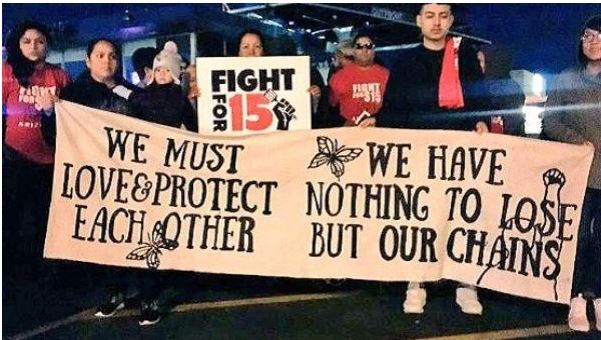
Just as Watney could not ultimately save himself without the help of his friends and fellow astronauts, we cannot hope to save our democracy, our rights and freedoms unless we band together. Rally with others to protest the illegal overturning of our democratic norms, the destruction of our institutions, the threats to our social safety nets, the wrecking of our economy (which no matter what Fox Noise says, was one of the strongest ever under Joe Biden).
In New York City, from Times Square to Trump Tower, massive protests have taken place to demand the release of Mahmoud Khalil, the Columbia University student activist I mentioned earlier who is being held without charge at a Louisiana ICE detention center.
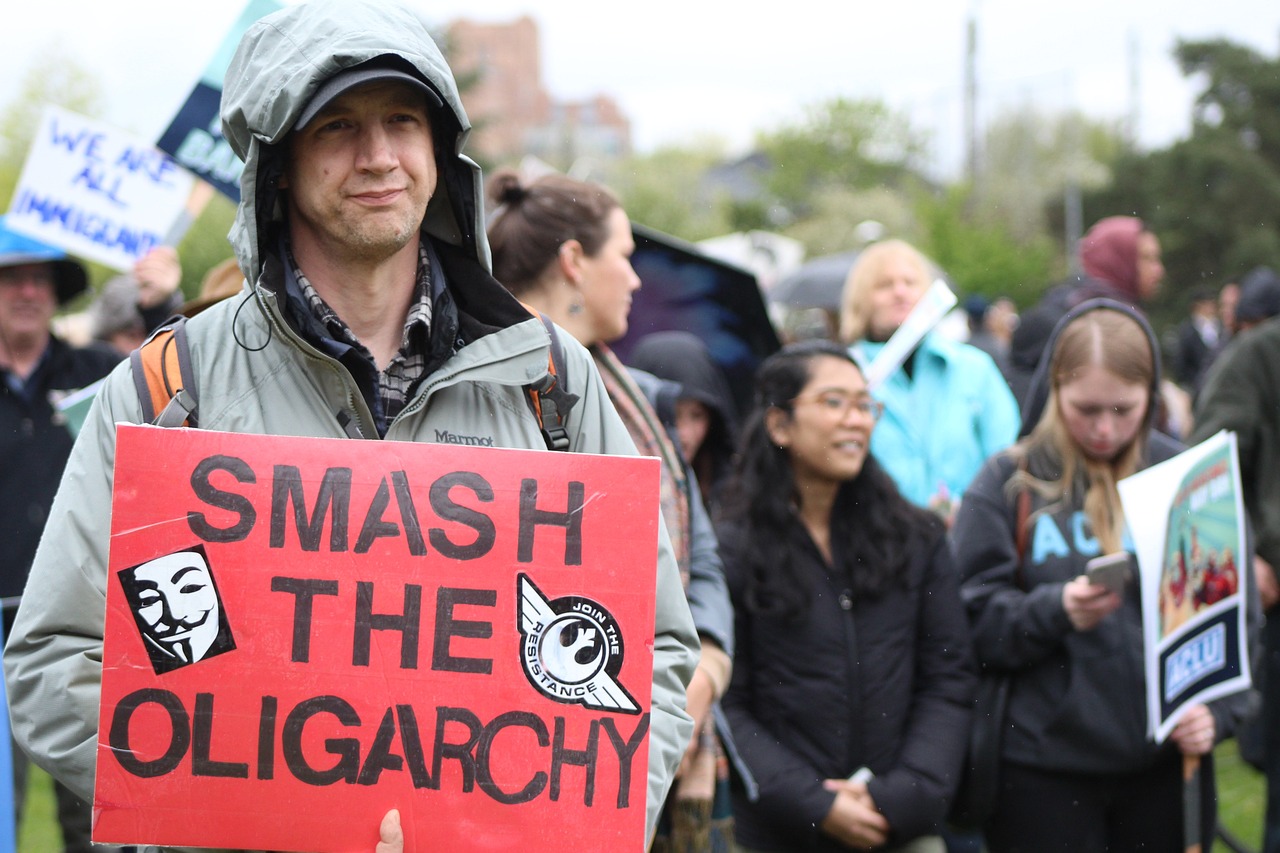
Bernie Sanders and Alexandria Ocasio-Cortez’s Fighting Oligarchy tour is drawing huge crowds everywhere—more than 34,000 in Denver this past month. One of the oligarchs they’re fighting is Elon Musk, and they’re not alone in taking this fight to the people. On March 29, Action Network (AN) hosted a Global Day of Action to stop Elon Musk. “Musk is destroying our democracy, and he’s using the fortune he built at Tesla to do it, ” AN posted on their site. “We are taking action at Tesla to stop Musk’s illegal coup.” Protests against the unelected centibillionaire took place in hundreds of Tesla locations across the U.S. and beyond: Canada, much of northwest Europe, and Australia all hosted rallies!
Unsplash: IG@clay.banks
As Trump begins his dismantling of the Department of Education, laying off half the staff at the department’s federal office, students, parents and teachers across the nation have taken to the streets to protest the beginning of the end of America’s public school system. The National Education Association, along with the American Federation of Teachers and various civil rights groups, have filed a lawsuit demanding staff be reinstated, asserting that the massive cuts have put student civil rights in jeopardy.
The above are but a few of the threats that have brought millions to their feet and into the street. The severe cuts to Social Security, Medicaid and Medicare, Health and Human Services, Federal Emergency Management (FEMA), the Environmental Protection Agency and many other American institutions that have long served the public interest are also being met with unrelenting backlash.
Not only is it empowering to make your voice heard, but if enough of us refuse to sit quietly while our democracy and its institutions are destroyed for the profit of a handful of billionaires, we just might win!
One Foot in Front of the Other
After many months of hair-raising disasters and having to find new solutions to problems he thought he’d conquered, Watney safely returns to Earth, where he becomes a NASA survival instructor for astronaut candidates. “You solve one problem,” he tells them, “then you solve the next, and if you solve enough of them, you get to come home.” Stay focused, keep fighting, don’t give up: That’s the message The Martian has for us.
As I was mentally outlining this post one evening while watching the news, I scribbled these words on a napkin: There is a future where everyone knows the answers to the questions we’re asking today. We can’t see into that distant moment from where we stand. Like Matt Damon’s astronaut, we can only put one foot in front of the other, strive to solve the most pressing problem of the moment, seek help from others (and offer assistance where we can), and hope it will be enough.
Eight months after I got my BA in Literature, and two months after I returned to the Midwest from Arizona—having discovered: 1) I do NOT like dry heat, and 2) I NEED green trees, green grass, seasons—I began a Masters in Literature. I was fortunate to be given a graduate teaching assistantship, structuring and leading a writing class for fourteen delightful freshmen. A gig that also covered a significant portion of my tuition and paid the rent for a room in a large boxy house a block from campus. A place I shared with fourteen other young women and men—some students, some working odd jobs until they figured out next steps. The usual college town scene.
Two of my housemates—Kevin and Connor—were into cooking, and as the house had a vast kitchen in the lower level, complete with a lengthy trestle table, they began cooking dinners several nights a week. Anyone from the house could partake of the meal if they pitched in a dollar. That’s right, one dollar to help cover the cost of groceries. And, if you didn’t have that dollar, you could still eat. All you had to do was go to the market two streets over and bring home the ingredients, as I did twice during the summer of ’78 before I got a part-time gig at a Joann Fabrics store—no stipends for grad students during the summer session.
Lest this generosity and communal bonhomie appear specific to my housemates, I can assure you it wasn’t. The late ‘70s were a time of community. Hungry? I’ve got a can of soup we can share. No place to crash? I’ve got a sleeping bag and an extra pillow. You can stay at my place. Need a doctor? The free medical clinic was tucked among the bookstores, music venues, and mini marts that define a college town. Everyone went there, and it was the consensus among former and current students that the care we received there was superior to the university’s health services. I used the clinic twice and received prompt, courteous, top-quality care both times.
The Backlash Begins
I remember thinking that ours would be the generation that would end hunger and homelessness, provide quality healthcare to everyone. After all, the decade before had seen the passing of The Civil Rights Act of 1964 and The Voting Rights Act of 1965. The Social Security Amendments of 1965 gave us both Medicare and Medicaid. Yes, we were building a new world, one that would make good on the promises of a true democracy, an America governed by the people and for the people as Abraham Lincoln said at Gettysburg. At its heart would lie that most basic of human truths: We are all depending on one another.
Sadly, the following decades were to prove me wrong, as Reagan’s “Morning in America” began the long eclipse of all that had flourished in the ‘60s and ‘70s, as we watched our best hopes smothered beneath a rollback of rights and cutbacks to domestic programs. All in service to hedge funds, private equity groups, and the billionaires who run them. (Sound familiar?)
I was reminded of this last fall when a bout of sciatica made walking painful and stairs almost unnavigable just days before we were to travel to Rome. I arrived at my local hospital’s emergency room, hobbling, my whole left hip/leg in agony. In the two hours I was there, the only person I saw was the one who showed up five minutes after I arrived to take my credit card info for my ER co-pay. She returned ninety minutes later to give me a shot “for the pain.” The pain remained. This is the kind of “service” I received and I have health insurance.
As I sat…and sat in the ER that morning, I recalled a very different experience from my early post-student days. I had developed a fever, but being generally very healthy, I chalked it up to “just something” that would quickly pass. It didn’t and by the time a friend stopped by several days later, I was slightly delirious. She drove me to the emergency room of the local hospital where my temp registered 104 degrees. “Why did you wait so long?” The ER doctor admonished me. “You could have lost a kidney!” I started to cry. “I don’t have any money right now,” I sobbed, “I can’t pay.” They treated me and never charged for the visit.
Healthcare Now
According to the Office of Health Policy (under HHS), 11.5 percent of adults in the U.S. lacked health insurance in the first quarter of 2024. I love percentages, don’t you—the way they transform real suffering on the ground into a neat, faceless mathematical expression. So let me put that statement into human terms: A year ago, more than 27 million people lacked health insurance. Their only option? Community health centers, if they were lucky to live near one.
But such health centers rely to a huge extent on federal funding. The very funding that TheRUMP announced he was freezing on January 23. Grants, loans, financial assistance. Thousands of organizations were affected. Thousands of community programs. Head Start, cancer research, Meals on Wheels, mental health programs, housing assistance, natural disaster aid, public schools, and a whole slew of other public-service programs—funded by our tax dollars—including hospitals and healthcare centers. All funding to be paused for such orgs until it could be determined whether they might conflict with the president’s “agenda.”
“Dangerous, Illegal and Unconstitutional”
As the Associated Press put it (in the understatement of the year), “the order capped the most chaotic day for the U.S. government since Trump returned to office.” Reaction was swift. Less than 24 hours after the nationwide funding freeze was announced, U.S. District Judge Loren AliKhan, granted an administrative stay in a case brought by the National Council of Nonprofits. Trump could not freeze the funds until further review, she ordered.
A second U.S. district judge, John McConnell, Jr., at the request of 23 Democratic state attorneys general, echoed AliKhan’s ruling, issuing a temporary block on the funding freeze, saying it appeared to violate the law. “The Executive cites no legal authority allowing it to do so; indeed, no federal law would authorize the Executive’s unilateral action here,” McConnell stated. New York Attorney General Letitia James agreed: “There is no question this policy is reckless, dangerous, illegal and unconstitutional.”
Despite these rulings, the funds and grants remained frozen, the Democratic state attorneys general reported in early February, calling on McConnell to enforce his earlier temporary restraining order. McConnell agreed and blocked the funding freeze, declaring it unconstitutional. “[It] has caused and continues to cause irreparable harm to a vast portion of this country,” he noted.
As of this writing, federal funding and grants appear to remain frozen.
Gimme Shelter: Poverty Becomes A Crime
Giving shelter—a cot, a sofa, a sleeping bag on the floor—to a friend who is out of work and can’t pay rent or a friend of a friend “between places”—that may still happen. I hope it still happens. In my senior year of college, we sheltered a friend of one of my roommates for a whole semester as she waited for a grant to come through. There were also public shelters back then. Places that offered a large room—fifty or so cots, bathrooms, often a soup kitchen staffed by volunteers. People need a roof over their head. They need a warm, dry place to sleep, a toilet, a shower. Because for chrissake, we are all human beings. And one human being does not leave another to freeze or starve.
Except now it seems we do. In 2024, over 770,000 people—that we know of—were homeless. That’s an 18% increase from 2023, itself a 12% increase from 2022, and the highest number since the Department of Housing and Urban Development (HUD) started counting in 2007. At the same time, the number of Community Housing and Homeless Shelters has dropped by 2.2.% in the past year. You don’t have to be a math whiz to know that a drop in the number of shelters during the single largest increase in the number of people without a home spells despair, illness, even death for hundreds of thousands.
So, if there are not enough shelters, where do these unfortunate people go? Where do they sleep? Good question. Until recently, it was the case that people without housing and no access to a shelter slept in tents in public spaces, laid out a pillow, maybe a blanket, on a park bench. If they were fortunate enough to still have wheels, they slept in their car. Some still might, but a purported wave of public antipathy toward the homeless brought a number of lawsuits last year demanding homelessness be made a crime.
I detailed this in my September post “The Madness of Money.” Suffice it to say that in June 2024, the Supreme Court ruled 6-3 that cities can ban the homeless from sleeping and “camping” in public spaces. (Wouldn’t want the good, upstanding folk to have to witness such “unpleasantness.”) This SCOTUS ruling, in a case brought by the city of Grants Pass, Oregon, overturned lower court decisions that found criminalizing homelessness to be “cruel and unusual” under the Eighth Amendment. After all, people must sleep. And if one has no options for lodging, what can one do?
The “kindly” officials of Grants Pass had an answer: Pay a $295 fine. And if they catch you sleeping rough again, you’ll be criminally prosecuted and spend a month in jail! Grants Pass claimed the previous rulings encouraged homelessness (as if this were something ‘desirable’ many people aspire to). As I pointed out in my post, people sleep rough because they don’t have $295. I strongly suspect if they had somewhere better to go, they would go there. And if a city, any city, has the money to imprison innocent people down on their luck, it could use those same funds to help them. Unfortunately, since the ruling, more than 100 cities have made it illegal to sleep outside. In California’s San Joaquin County, violators can be fined up to $1,000 and six months in jail. It will hardly surprise anyone that TheRUMP supports these bans.
What the World Needs Now
In the closing days of the Biden-Harris Administration, then-U.S. Surgeon General Dr. Vivek Murthy sat down with Time magazine’s senior health correspondent, Alice Park, to offer Americans “a parting prescription” as he put it, to address “the deeper pain, the unhappiness I was seeing for years across the country” based on his many conversations with Americans from all walks of life. Conversations that spanned his two terms of service, first under President Obama, then under Biden.
What Murthy discovered in those talks is that “for many people, [the] sense of community has eroded.” Millions of Americans are suffering from loneliness. Citing a recent survey, he expressed concern: “More than half of young adults …said they felt low or no sense of meaning and purpose in their lives.”
Murthy’s prescription? Rebuild what we have seemingly lost: Community. “Community is a place where we have relationships, help each other, and where we find purpose in each other,” he said. “Those three elements are the core pillars…” And those pillars, he stressed, are braced by love. Love fuels generosity, kindness, and courage. “When you put these together, then you have a place where people find a sense of belonging and meaning.”
A Caring Human Being
This past December, our car began making a horrendous clanking noise when starting up. I thought maybe the dealership had forgotten to top the anti-freeze when they replenished all the fluids last summer. After a week of this, Ed took the car to a local gas station where he filled up the tank, then asked the attendant to please check the fluids as we had concerns about the engine and wanted to make sure it was okay before driving to the airport the next day to pick up my son for the holidays. “What?!” the attendant snarled. “I’m not gonna send someone out in this weather (a sunny December day, low 30s) just to check your fluids!”
Ed then took the car to Ren’s, a neighborhood mechanic we trust. Ren checked all the fluid levels, found everything in order, and relieved our worries, assuring Ed it was simply a reaction to the low nighttime temps we’d been having for the past week. Sure enough, when the temps rose a bit, the car expressed its gratitude with perfect silence. And what did Ren charge for the time he spent going over the car? He charged NOTHING. He just did it because we had concerns. Because he didn’t want to send someone off to possibly experience a breakdown, or worse on a busy highway. Because he is a caring human being.
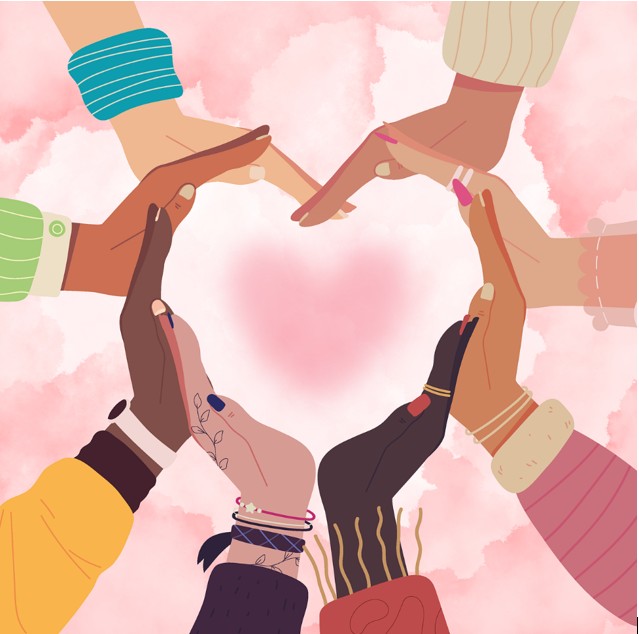
You don’t have to know someone to know what hunger is, what illness is, how frightening homelessness is. To offer a hand, to advocate for others, to stand up for justice for all. At the personal level, at the societal level, at the global level, we MUST take care of one another.
History never really says goodbye. History says, ‘See you later.’ (Eduardo Galeano)
[I’m escaping for some much-needed R&R this month, so I’m leaving you with a post that first appeared in 2018. As relevant as the issues it addresses felt at that time, they are even more critical now. We cannot afford to close our eyes and cover our ears. Ignorance isnotbliss. As Nelson Mandela said: “Education is the most powerful weapon which you can use to change the world.” See you on the flipside.]
My husband and I are having dinner at a local farm-sourced, regional-brewers kind of place when I notice the TV set over the bar is playing Whatever Happened to Baby Jane, that 1962 cult classic, mental/emotional slugfest between a manipulative Joan Crawford and a deranged Bette Davis. Both of them on the far side of their ingénue years.
When the server—a young woman in her mid-20s—comes to take our order, I ask if she knows the film. She scrutinizes the action on the TV screen and shakes her head. Never heard of it. I give it a strong recommendation. It may be camp, but it’s first-rate camp and it was nominated for five Academy Awards.
This exchange got me thinking about the increasing transience of culture and knowledge. How what’s happening in the ever-changing nanosecond fills and floods our attention to the exclusion of everything that came before.
The Seduction of Now
It’s very seductive to think of the past as something finished. Over. That it has no connection or relevance to who we are now or where we’re headed. That we can re-invent ourselves at will, without a backward glance, and no price to pay.
Our high-tech world, with its rapid flow of new, disposable “product” and seemingly endless streams of “content” not only encourages this attitude, but practically demands it. When something “brand new” happens every 15 minutes, our attention is sorely taxed just scrambling to keep up. Who has time to reflect? To make connections?
Though each of us has a personal life that begins with our birth and ends with our death, we’re also part of a much larger world with a long and complicated past that affects our little blip on the timeline.
Okay, no one is going to argue that Whatever Happened to Baby Jane is a force to deepen one’s understanding of the world. But an existence composed solely of what’s-happening-now leaves us with no compass to steer by, no yardstick for comparison on serious, larger-than-our-lifetime issues—say, global warming or the worldwide resurgence of nationalist movements. Without an understanding of what “went before,” we might not even realize it is a resurgence. That the current global trend toward nationalism has roots in the European fascist movements of the 1930s and the Jim Crow laws of the American South—the latter going back to the Civil War and that defender of slavery, John C. Calhoun. That nationalism itself is not without links to the European conquerors of Columbus’s “new world.” All of it a shorthand for the belief that some people are created more equal than others. That some people don’t even have the right to exist.
Without a sense of how today’s headlines fit in along the timeline of human history, we’re left vulnerable to all who would prey on that ignorance. And they are out there.
In a State of Disconnect: Clueless about History
A quick survey of polls targeting common misconceptions (and just plain ignorance) about history makes for fascinating—if frightening—reading.
A 2006 poll by the now defunct McCormick Tribune Freedom Museum found that one in five Americans could name all five Simpson cartoon family members, but only one in a thousand people could identify all five First Amendment freedoms.
A 2012 ACTA survey revealed that fewer than 20% of college graduates could correctly identify the effect of the Emancipation Proclamation.
A 2010 survey, cited by The Atlantic, reported more Americans knew that Michael Jackson composed “Beat It” than knew that the Bill of Rights is a body of amendments to the Constitution. And one in three did not know that the Bill of Rights guarantees the right to a trial by jury.
Fifty percent of Americans surveyed also suffer severe timeline confusion. They identified the American Revolution as happening after either the Civil War or the War of 1812. And more than a third had no clue at all in which century the American Revolution occurred. One can only hope continued sell-out performances of Hamilton will provide some hints.
In light of the video that went viral this summer—a man harassing a woman for wearing a shirt with the flag of Puerto Rico (“You should not be wearing that in the United States of America!” he shouted repeatedly.)—it’s worth noting that a 2017 poll revealed almost half of Americans don’t know that the people of Puerto Rico are United States citizens.
Perhaps the most shocking—and saddening—statistic I came across was cited on NPR’s All Things Considered: Forty percent of Americans cannot identify what Auschwitz was. In fact, fewer than half of Americans know that Hitler did not take control of Germany by force, but was democratically elected. We’ll return to this later.
Why Does This Matter? Why Should We Care?
Not knowing what came before, as I said, renders us prey to spin doctors, Russian hackers, unscrupulous politicians, and hucksters of every stripe.
It leaves us vulnerable to the lies of others, told for their own nefarious purposes.
“I watched when the World Trade Center came tumbling down,” said then-presidential candidate Trump at a 2015 Birmingham rally. “And I watched in Jersey City, New Jersey, where thousands and thousands of [Muslims] were cheering as that building was coming down. Thousands of people were cheering.”
Trump stirred up a lot of anti-immigrant feeling with these words, sowing the seeds of support for his notorious Muslim Ban, but politifact.com gave him a “Pants on Fire” rating for that speech. That’s code for one big fat whopper.
PolitiFact cites a September 17, 2001 Associated Press report that debunked “rumors of rooftop celebrations of the attack by Muslims” in Jersey City. And wildfire rumors of Muslim-Americans cheering the fall of the World Trade Center in Paterson, N.J., turned out to be a nasty lie spawned by chain e-mails and fanned by shock jock Howard Stern.
The historical truth? Muslim residents of Paterson mounted a banner in that city saying “The Muslim Community Does Not Support Terrorism.”
We fall for solutions that have failed us before.
Trump sold his tax cuts for the rich by promising American workers that, with more money in their boss’s pocket, they would benefit from increased wages and bonuses. It was gonna be “beeeeautiful.”
If there’s one thing we should be wise to by this point, it’s the bald-faced lie of trickle-down economics—that when you let the rich keep all their money, out of gratitude they will pass pots of it along to the peons who made them rich in the first place. William Jennings Bryan, a three-time Democratic presidential candidate, exposed the nonsense of trickle-down more than a hundred years ago in his Cross of Gold speech:
There are two ideas of government. There are those who believe that if you just legislate to make the well-to-do prosperous, that their prosperity will leak through to those below. The Democratic idea has been that if you legislate to make the masses prosperous their prosperity will find its way up and through every class that rests upon it.
The term “trickle-down economics” was coined by American humorist and commentator Will Rogers to ridicule President Hoover’s dismal stimulus efforts to cure a Great Depression many economists feel he played a large hand in creating. Hoover, a cheerleader for “rugged individualism,” believed that only the voluntary action of “socially responsible capitalist leaders” (know any?), not government intervention, would restore economic order.
Trickle-down economics failed in the close of the 19th century. It failed in the Great Depression. It failed in the massive tax cuts to the rich known as “Reaganomics” that started an almost 30-year slide into the financial crash of 2008. And it is failing under Trump. A 2018 analysis of Fortune 500 companies reveals that fewer than five percent of workers will get a one-time bonus or wage increase from the Trump tax cuts. If they still have a job. AT&T and General Motors both cut 1,500 jobs. Kimberly-Clark dumped 5,000 workers. It seems that most companies poured virtually all of their tax-break money into stock buybacks, making the richest folks even richer.
Trickle-down economics does one thing and one thing only: It robs from the poor and middle classes, and gives to the rich.
Blinds us from seeing how attacks on others are attacks on all of us.
Recently, I read a piece (sorry, I didn’t copy the link) where psychologists discussed how people tend to mentally catalog only those things they perceive as affecting them directly. For example, if you’re not a union member—a teacher, a nurse, an auto worker—you might think that current efforts to cripple or destroy unions have little to do with you. “Right to work” laws, attacks on overtime pay. But you’d be wrong.
History shows that the advantages labor unions have fought for and won (starting with the right to unionize) have generally benefitted all American workers. Before there were unions, many people worked six, even seven days a week for an average workweek of 61 hours. It was the unions, waging massive (and sometimes bloody) strikes in the late 19th/early 20th centuries that brought us the 8-hour day and the weekend. A half-century of struggle culminated in the passage of the Fair Labor Standards Act of 1938.
When unions are strong, the middle class tends to flourish. When they are weakened, as happened under Trump [2016-2020], income inequality increases for all workers and the purchasing power of the middle and poor classes shrinks. A lot. Benefits disappear, too.
Speaking of benefits, it was the rise of unions in the 1930s and 1940s that we have to thank for employer-sponsored health insurance. When unions used their numerical clout to negotiate health care for their members, many other employers scrambled to stay competitive by offering the same. By 1950, a majority of employers offered some type of health insurance to their workers. With the current two-pronged effort of the GOP to weaken unions and sabotage the ACA, the future of employer-sponsored healthcare is something to keep on your radar.
In its first national convention (1881), the American Federation of Labor started the ball rolling to end child labor. State after state responded to this call until the 1938 Fair Labor Standards Act abolished child labor nationwide. [UPDATE: Since this post first appeared, more than 60 bills to weaken child labor protections have been proposed in 29 states and enacted in thirteen.]
Allows those in power to cheat us of our rights.
If you don’t know the Bill of Rights guarantees you a trial by jury in serious civil cases as well as criminal cases—and inhibits the court from overturning a jury’s finding in the former—you might be bulldozed by your adversary into waiving your right to a jury trial in exchange for one heard (and ruled on) solely by a judge. This is increasingly a power tactic of corporations who feel juries tend to be sympathetic to individuals claiming damage or loss rather than to the big companies alleged to have screwed them.
It’s easy to take from people what they don’t know is theirs. Remember those 999 people out of 1,000 who could not name the five freedoms guaranteed in the First Amendment? They are at risk for believing the current propaganda that a press who criticizes the president is un-American. They may fear to speak out because some politician with an agenda says protesting government actions is “illegal.”
Well, here they are, the five freedoms guaranteed to all Americans under the First Amendment to the Constitution (at the very top of the Bill of Rights):
Congress shall make no law respecting an establishment of religion, or prohibiting the free exercise thereof; or abridging the freedom of speech, or of the press, or the right of the people peaceably to assemble, and to petition the Government for a redress of grievances.
We are allowed to holler with all our might against those who would violate or destroy our democracy. And we should.
We fail to recognize the signposts of eminent danger when they’re right before us.
Recently, a guest on MSNBC’s All In with Chris Hayes said of the current fight against widespread attacks on voting rights, “The Civil Rights Movement continues. It is eternal.”
Ditto the fight against fascism. Fascism did not end with the surrender of the Nazis any more than white supremacy died with Abraham Lincoln’s signature on the Emancipation Proclamation or the passage of the 13th Amendment.
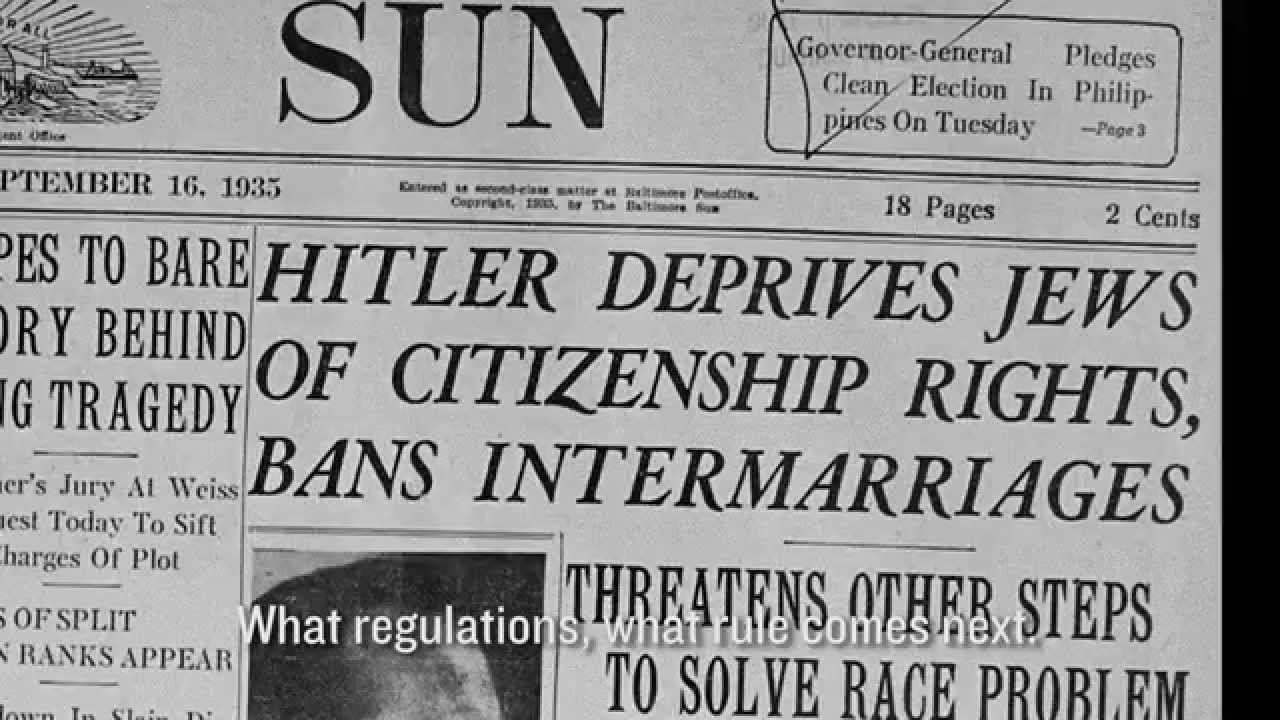
I mentioned up-top a poll that found fewer than half of Americans know that Hitler did not take control of Germany by force, but was democratically elected. As Emory University history professor, Deborah Lipstadt, explains: “The Nazis didn’t come into office on January 30, 1933, and decide on a genocide the next day. They slowly broke down a democracy. They destroyed it.”
She goes on to cite the “steady drumbeat of attacks” that began under Hitler. “First on the press, then on the courts, then on institutions, [the] slow takeover of institutions.”
Sound familiar?
Connecting the Dots
To have a solid grasp of what came before is to have a richer understanding of what we’re seeing now. A guide to sift truth from lies. A way to answer the always-pertinent question: From whose viewpoint is this coming and what do they stand to gain by pushing this particular agenda? Instead of bouncing from tweet to tweet, history gives us a telescopic lens to pinpoint the connections. And it cannot be said enough: Everything is connected.
The films and books, the music and paintings and theatre of the past have messages for us, too. Not perhaps the kitschy romp of Whatever Happened to Baby Jane? But there is much worth our attention in the dusty archives of film, the overflowing shelves of the library, in Shakespeare’s plays and John Donne’s poetry.
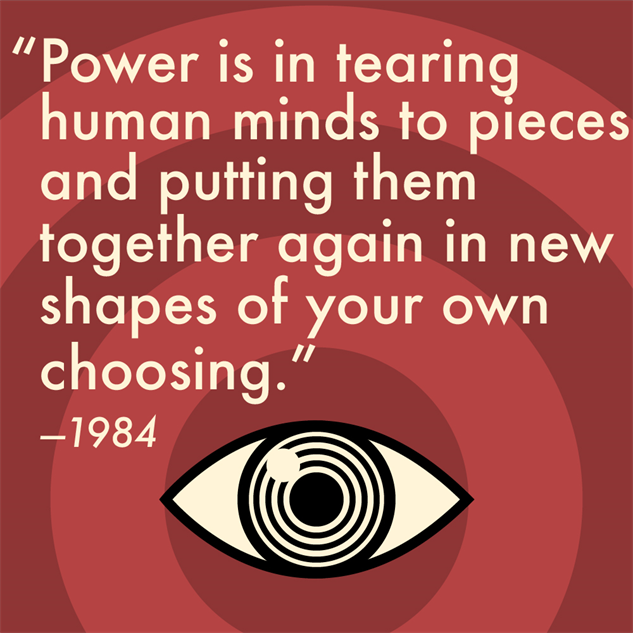
One book that Americans are rediscovering is a little dystopian novel, 1984.
Written 68 years ago by English author George Orwell, it’s been flying off the shelves, as they say, topping the best-seller list at Amazon in January 2017—after Kellyanne Conway coined the term “alternative facts” to justify Trump’s complete fabrication about the size of his inaugural crowd.
I will close with a paragraph from an article[LINK] written by Adam Gopnik for The New Yorker in 2017, “Orwell’s 1984 and Trump’s America”:
“And so, rereading Orwell, one is reminded of what Orwell got right about this kind of brute authoritarianism—and that was essentially that it rests on lies told so often, and so repeatedly, that fighting the lie becomes not simply more dangerous but more exhausting than repeating it. Orwell saw, to his credit, that the act of falsifying reality is only secondarily a way of changing perceptions. It is, above all, a way of asserting power.”
To know what came before is a great gift. It is also a warning.
In response to my December blog Keep Walking, long-time reader and fellow blogger Neil replied: Excellent essay. We should fight the good fight with our heads held high. And, simultaneously, we should enjoy life as much as possible too. It was as if he’d read my outline for this month’s post.
For many reasons, 2024 was a challenging year, both personally and politically. I’m generally a positive, happy, upbeat person, but in 2024, too many mornings began with shower musings that were dark and fretful. No way to start a day. Or live a life. So I’ve been making a list on “Keep Notes” (marvelous feature of smartphones!) of what I want to zero in on this coming year—activities that give me joy, that maintain physical health, that in some way make the world a better, safer place for all of us. I don’t want to leave happiness to chance—when I “have time.” In my experience, we never have time. We must make time. Give the activities that bring us the highest satisfaction top priority.
Couch Potatoes No More!
First of all, if we want to enjoy life and have energy for the good fight, we’ve got to get up out of our chairs, get away from the funk, and start moving forward. It’s amazing how energized you can feel by simply taking a brisk stroll around your hood. Got cooking duty tonight? Put on some vinyl, a CD, or Spotify and bop to the beat as you sauté, roast, or grill. I find dancing around my kitchen makes any chore lighter and happier. Feeling “sporty?” Shoot some hoops at your local playground, rollerblade through the park, or bike the backroads of your town. This last is one of my favorites—the tranquility of riding through cornfields under blue skies, the breeze sifting my hair. Heaven! Wintry where you are right now? Many communities offer salsa and swing dance classes. If you already have a partner, great, but don’t hang back because you’re solo. Lots of people take these classes and instructors make sure everyone is paired. So, groove to the music and dance the night away! Or grab a friend and go bowling. Ed and I go with my kids each year during the holidays. We all suck and we all have a great time.
Won’t You Be My Neighbor?
Speaking of friends, one giant step to a better, happier world is connecting with other people. And the best place to begin is right where you live. According to a 2018 Pew Research Center survey, only 26% of Americans said they know most of their neighbors.
So, get to know your neighbors if you don’t already. Throw an informal party on your lawn. You provide the drinks and the space, your neighbors bring their own deck chairs and a snack or dish to share. This is how I’ve met most of the folks in my hood. We now get together seven or eight times a year and keep in frequent touch between celebrations.
Knowing your neighbors can be a great source of strength, joy, and mutual assistance. Over the years, not only have we partied together, we have fed each other’s pets, watered plants and collected the mail of neighbors on vacation. We’ve prepared meals for the families of several neighbors after they underwent major surgery. As I take my daily walk, it’s a rare day I don’t see one or more of my neighbors out raking or gardening or reading on their porch and pause to enjoy a brief chat. Community—it’s a good feeling.
If Not Now, When?
We’ve all got ‘em—projects we’d like to undertake, new skills we’d love to acquire whether for our own pleasure or to make a career move, possibly into an entirely different field. But we’ve put off trying/starting/doing because we’re not sure how it will pan out, or the thing we want to do seems so vast, how will we ever carve out the time between the laundry and the cooking and the yardwork, all those daily repetitive tasks that eat up the clock?
If the things that would bring more joy to your life keep getting shifted to next week, next month, next year, I suggest taking a cue from that timeless Nike slogan and Just do it! Dive in. Take a leap. If something didn’t work out before, try again or try differently.
As a writer, I can tell you writing is the fun part. It’s getting the finished works out there that demands so much time, so much research, new skills. I submitted my first novel in what would prove to be the dying days of the traditional publishing industry, when there were houses galore and you sent your manuscript over the transom to be read by a real editor who brought his or her favorites to a company meeting and campaigned for the author. Long story short, those many publishers have been absorbed in the U.S. by the “Big Five.” To get a publisher now, you must first get an agent. To get an agent, you must develop a query letter, a synopsis of your book, an outline. And even if you are in the 1%-2% who land an agent, that’s no guarantee your book will find a home.
Alternatives include indy houses which may or may not charge you part of the cost of publishing, and you will definitely be handling all the marketing (lots of time); self-publishing where you will front all the costs including cover art and spend most of your valuable writing time finding avenues—a blog, for instance—to get your name out there. Or you can try to build a huge readership for your blog and market your book(s) to them, as Andy Weir did so successfully in 2011 with his book The Martian. Crown Publishing Group took notice of this and published the novel in 2014. Within weeks, a movie deal was signed. The film was nominated for seven Academy Awards in 2016.
For too long, I’ve been going in circles, so I’m making 2025 the year I map Plans A, B, and C—including the skills/actions I need to acquire/take for each—and just start DOING. Because, seriously, there’s nothing to lose.
What would you like to change, learn, do?
Get Out of Dodge Now and Again
A Grand Tour via a luxury liner is not required to rejuvenate the spirit. Instead, you can explore the art galleries and museums of a city within driving/train/bus distance. Attend a concert of whatever music turns you on be it Mozart, Taylor Swift, or contemporary jazz sensation, Masego. I’m a Rock & Roll girl, but an evening on the lawn at Tanglewood, listening to Mozart, Beethoven, Tchaikovsky, played by the virtuoso violinists and pianists of our time—the starry night overhead, picnic hamper and a bottle of wine at hand—is moving, healing, a deep and profound joy. Ed and I also love to drive up to Brattleboro, Vermont or Portsmouth, New Hampshire and make a day of browsing bookshops for new and used reads. And don’t overlook the restorative power of the great outdoors. One of my favorite places to wander is the Quabbin Reservoir, a one-hour drive from my house. I could roam this 25,000-acre preserve forever, under a sky so vast, it provides much-needed perspective about the universe and our humble place in it.
The People United Will Never Be Defeated
Echoing blogger-friend Neil’s words uptop—We should fight the good fight with our heads held high—I believe one of the most important actions we can undertake in this new year is to join our like-minded fellow beings and work together for the survival of our democracy and the planet. As then-Senator Obama stressed in his 2008 presidential campaign speech: “Change will not come if we wait for some other person, or some other time. We are the ones we’ve been waiting for. We are the change that we seek.”
If you’re in a sizeable city, you may already know of or belong to a local organization fighting for our freedoms and our environment. But if you live outside a metropolitan area or you’re not sure which org or orgs you’d like to dedicate some time and energy to, just click on https://www.democracy2025.org/ and scroll down to where you see This is the united frontline in the fight for our democracy. There you’ll find a rolling tape of more than 280 organizations who have joined together to preventour democracy/planet from being trashed and stolen by the greedy billionaires and their fascist buddies. Choose one and get involved—letter writing, phone-banking, registering voters, marching.
As someone who grew up in the Civil Rights era and came of age protesting the Viet Nam War, I can attest to the truth that fighting alongside others for what you hold dear is one of the most satisfying, uplifting experiences you will ever have.
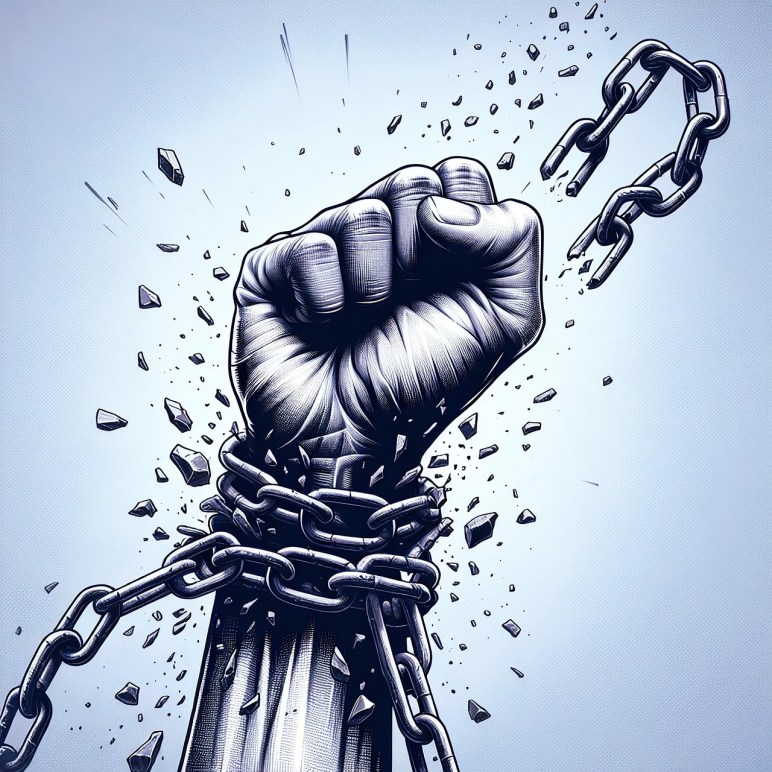
The bottom line: No one is coming to save us. We must save ourselves. And together, WE CAN.
Get a Life!
As I said, I’m a writer. Shaping plots, creating characters, taking them through whatever transformational journey is theirs to travel—that’s what I love doing. Fighting for our country, our world—that gives me hope and strength. So what if the patches on the walls (recent repairs to “plaster fatigue” in an 1895 house) that need priming and painting go bare a week, a month, a season longer. Does it really matter? If I’m devoting my energies to that which makes me happiest—writing, and that which gives me hope—banding together with others to save our freedoms, then in my book, that’s a life well-lived. I mean, in the final moments, who reflects on their life and regrets that the hallway suffered unpainted patches for several months? At the end of the road, it’s not the chores delayed or left undone we regret, but the myriad hours spent on things that didn’t really matter. The time lost to not doing what we loved most. What made us feel alive. So, here’s to truly living in 2025!


































 amyhenrybooks