
The title of this month’s post comes from Thomas Jefferson’s Canons of Conduct in Life—ten rules for living he cultivated over his decades on the planet, sharing them with family and friends. I’ve had a copy hanging by my desk for years.

In these ten rules, Jefferson, the leading author of the Declaration of Independence and America’s third president, demonstrates a remarkable grasp of human foibles and offers us guidelines for living more happily, less stressfully, and more harmoniously with others. Alot of ageless wisdom packed in ten short sentences.
No doubt about it, we live in difficult times and none of us needs to make life more stressful than it already is. So, as we start the new year, I’ve been pondering what gets in our way of “taking things by the smooth handle” (Rule #9). After all, why would any of us wish to compound our anxiety? But several very human tendencies often make us do just that. Trust me, I know these tendencies all too well.
The Idée Fixe
The Cambridge English Dictionary defines idée fixe as a “belief that someone refuses to change their mind about, even though it may be wrong” or in this instance, impractical. Just because we’ve always done something in a certain way does not mean we must continue to do so if circumstances prove it to be driving us bonkers.

Case in point: Every year, going back to the dawn of time—well, my time anyway—I have hung each and every one of my ornaments on the annual Christmas tree. As Ed and I purchase a new ornament each year, and have been gifted with new ornaments along the way, and have the collection of my childhood ornaments going back to my first Christmas—well, it adds up to an effing LOT of ornaments. Still, not one of them has ever been left in the box and there are now nine good-sized boxes. No matter, every December I crawl around the tree and under the tree and reach way atop, placing these decorations, then changing them and changing some more until every ornament has a spot. And not just any spot, but the perfect spot.
Until this year.
Two days after Thanksgiving, we drove out to our favorite Christmas tree farm on a sunny mountainside just fifteen minutes down the road. As tree farms always are, this one is in a state of transition. The type of tree we usually buy had been pretty much picked over and the new ones needed another year to reach maturity. So, we bought a different pine, one nearly identical in appearance. A big, fat tree, sure to easily accommodate all our ornaments. Except it didn’t.
The branches, while plentiful, frequently bent under the weight of all but the lightest decorations. The medium and heavy ones proved challenging, as in extremely so. My youngest, home for the holidays, and I hung ornaments. And hung ornaments. Or tried to. The boxes were still half full.
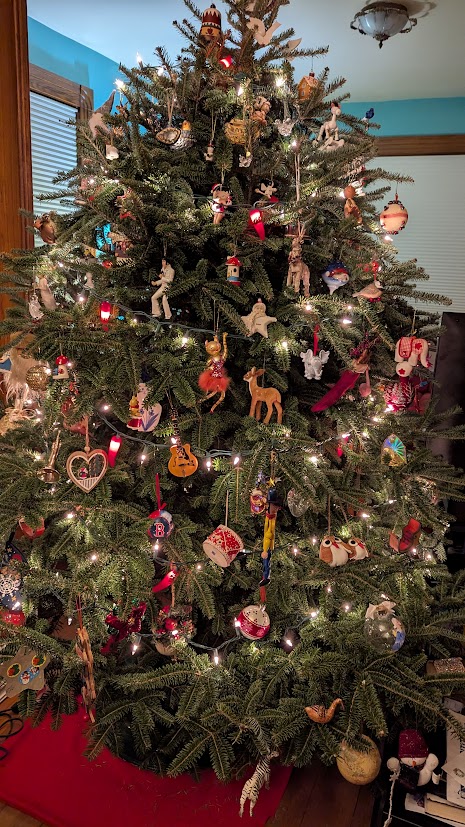
The kids went home, but I continued my quest to find a spot for each and every ornament, switching one out for another, searching for the right branch. There had to be one. “You don’t have to hang them all,” Ed said gently. I nodded, smiled, and went right on trying. Three more days passed. Desperate, I sifted the remaining 57 ornaments for my “must-haves”. Found places for four of them, but at the cost of removing two others. Eventually, I had to concede. My idée fixe would have to be “unfixed.” There simply was NO…MORE…SPACE on the tree. No more branches that would take anything heavier than a butterfly. I boxed up the 45 ornaments still lying on the dining room table and carried them up to the attic, admitting defeat.
And guess what? I survived. The tree looked fine. Christmas still came. How much time and maddening effort might I have saved if I’d just accepted the truth on Day 1: They weren’t all gonna fit? The smooth handle. Just because one has always done something is not a good enough reason to keep doing it when circumstances change.
The Straitjacket of Perfectionism
Closely related to the idée fixe—dizygotic twins in fact—is perfectionism, “the refusal to accept any standard short of perfection” (thank you, Oxford Languages Dictionary).
As a writer, I fully appreciate the folly of perfectionism. You can’t revise what you haven’t written is my mantra. A less-than, sometimes far-from-perfect first draft? Totally to be expected. “Polishing” one’s writing is part of the trade. But not everything in life has to be polished, and rarely is there anything that merits the anguish perfectionism exacts upon its adherents. Striving to be perfect at everything will wear you out and drive you nuts. Trust me, I know. If I had a dollar (or even a dime—do they make those anymore?) for every routine task I’ve agonized over, I’d be able to buy a couple of left-leaning, Constitution-upholding justices for the Supreme Court to counteract the current far-right fascist judges Leonard Leo and his merry band of Federalist Society billionaires bought. But, alas, I just have the angst I too often spend on projects like this year’s “bake-a-thon.”

For the past 44 years, I’ve baked, packaged, and sent tins of holiday cookies and candy to far-flung friends. It’s generally been an upbeat, lighthearted project. For three days in December, I bop to Christmas tunes while baking 20 dozen cookies and two batches of fudge. For 43 of those years, everything went swimmingly—cookies came out great, the fudge was melt-in-your-mouth fabulous. I thought of it as a fun time. A time when I blocked out everything else and baked! And then the 2025 holidays arrived…
Squeezed between a late-in-the-calendar Thanksgiving and Christmas, with a dental appointment to boot on Day 3, I knew I would have to work from dawn to dusk to make my (self-imposed) deadline.

Day 1 started off well enough. I prepared my ginger and sugar cookie doughs and put them in the fridge to chill. Then I made a pan of fudge. I was a tad concerned about how I was going to get six dozen sugar cookies frosted and roll out the 48 candy cane cookies by hand—both big time-consumers—in addition to prepping the dough for and baking five dozen shortbread cookies while whipping up a second batch of fudge, all before my appointment on Day 3. But, I decided to just plow ahead and see what happened. So, I popped a pan of ginger cookies into the oven, put “Rockin’ Around the Christmas Tree” on the CD player, and took five to dance around the kitchen.
When I checked on the gingers ten minutes later, I was shocked to find that they had all bled into each other. No longer the lovely circular cookies from the perfectly-rolled balls of dough I’d prepared, but lopsided squares and rectangles with maybe one rounded edge! How could this happen? I had prepared them exactly as I had for decades, the same number of cookies per baking pan as always!
I was definitely not taking things by the smooth handle.

I can now see how silly my distress was. Despite their appearance, they tasted great. And I got my four dozen candy canes rolled just before the dentist. I even made my deadline for packing the tins and boxing up the goodies for the post office…by working until midnight when, exhausted, I surveyed the lot and said: Screw it, they’re fine just the way they are. THAT’s the attitude I should have taken from the start. And honestly, if I’d extended my deadline one day longer than usual, would the world have exploded?
Part of taking things by the smooth handle is being able to distinguish what truly matters from what doesn’t. I’ll give you a hint here: Most things are not worthy of the angst perfectionists spend on them.
The What-ifs…

I don’t need to tell you we live in trying times. As in, extremely trying times. Which gives rise to perhaps the most stressful—and utterly useless—attempts to prepare for disasters we fear may be impending. What if this goes wrong? What if that goes wrong? Not a smooth handle in the bunch as far as we can see.
Trying to get out in front of possible catastrophes before they materialize is impossible and exhausting. We must save our strength for that which is happening. Threats to immigrants, for example, are real. They require resistance and a firm response from us in the now. But trying to foresee every possible bump in the road ahead and prepare for it just zaps our energy—exactly what Jefferson meant when he warns us in Rule #8: How much pain the evils have cost us that have never happened.
Case in point. My son flew in to spend Thanksgiving with us this past November. A long flight, requiring a change of planes halfway. Everything has to run on schedule to make it all work. Though the day he arrived was pleasant, I started looking well in advance at the weather forecast for his return home. Early December can harbor some nasty “surprises” in the Northeast. It wasn’t looking great 8-10 days out. Of course, there was nothing I could actually do. Nothing was at all certain. So I crossed my fingers and silently fretted. And checked the forecast daily. And fretted some more because it still wasn’t looking good. Major snowstorm beginning in the early morning.

The day of departure came. By 7:30 a.m., the morning train to the airport had been canceled. So had the Greyhound bus my son had booked as a back-up. I hurriedly dressed and, with visions of the car careening wildly off the highway or into the path of an eighteen-wheeler, I drove him the hour’s journey to the airport, trying to appear lighthearted while mentally rehearsing all my options should the road become impassable. There weren’t many. Basically, pull off the road at the nearest exit…and do what? Spend the day and maybe the night there? Where?
Just as I dropped my son off, the first flakes began. Lucky so far, but with each mile back, the snowfall picked up substantially. Eight miles from home, conditions were not good. Snow choked the road and the pavement was icy slick. Traffic was down to one lane and moving at a crawl. No one was driving over 20 miles an hour. I prepared myself for the hairpin exit turn and hoped everyone else was as familiar with that sharp curve as I was. Fortunately, the whole long line went into brake-pump mode. Gentle. Gentle. At last, I was off the highway.
The upshot? My son made his flight and the connecting flight. Obviously, I made it home. But how much less stressful it would have been to take things as they came. To not have fretted for days in advance. To have truly relaxed in the first part of the journey before the snow began falling. To have reminded myself on the return that each mile was bringing me closer to home. That I could, if necessary, exit the highway and then make a plan from there. Not everything needed to be settled in advance. I could have, should have taken the developing blizzard by the smooth handle.

As I write this, my son’s home for Christmas. I have a medical appointment scheduled for the same day he leaves. I need the train to the airport to be running that day. I need the weather to be clear. But what if it isn’t? What if we have a repeat of his journey home after Thanksgiving and I miss my appointment? Mindful of Jefferson’s sage words, I searched for the “smooth handle.” It was this: Somehow, whatever happens, I’ll cope.
Jefferson nailed it. You get no extra points for driving yourself mad. Life is finite. Spend it on that which really matters. That which brings you joy.
 amyhenrybooks