
Our memories are made up of the sights, the sounds, the smells, the emotional feel of a moment in time. And, of course, the presence—or absence—of people around us. A sunny day at a beach with a group of friends is a very different experience than a solo moonlit stroll along a deserted stretch of shoreline.

One of my most powerful—and enduring—memories takes me back to an evening more than fifty years ago. A sleepout on the shore of Lake Michigan on a warm July night at Girl Scout camp. Two counselors and thirty-some girls collecting wood and building a fire, roasting marshmallows and singing songs to the strumming of one of the counselor’s guitar, our faces rimmed in firelight, until we crawled into our sleeping bags, where I lay mesmerized by the hundreds of stars overhead, so many, many more than one can see in a city or even a small town, eventually drifting off to the rhythmic slap of the waves and the counselor’s song about a girl becoming a woman, a line from it—it’s given with pride, it’s given with joy—forever with me, etched in the memory of a summer’s evening, its hours among the most peaceful I’ve ever spent on the planet.
I was fully present in the moment.
Ain’t Nothin’ Like the Real Thing
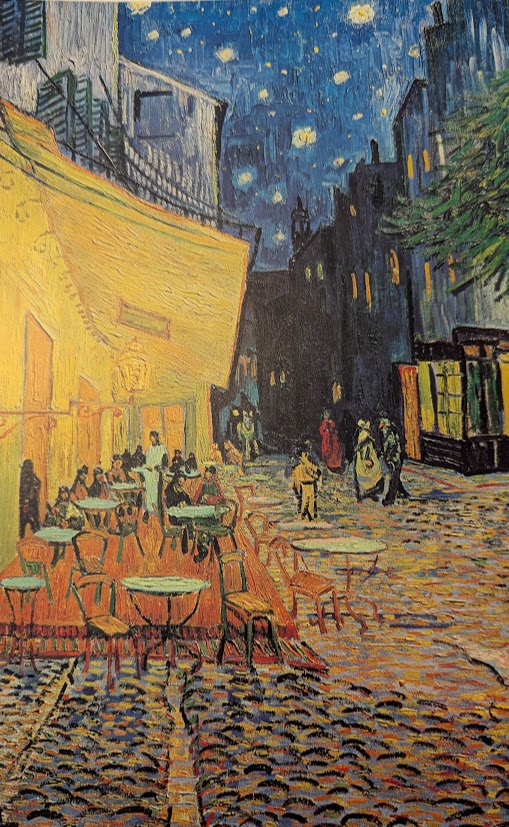
Fully present in the moment. Being where you are. When did we lose that? The question first arose for me at The National Gallery in the year after The Plague. The “natural” flow of art galleries up until then tended to be two or three people pausing before a painting, reading the posted info card about the painter/the subject/whether it was on loan or part of the gallery’s permanent collection, then taking some time to LOOK at the actual work. To consider the painting’s perspective and the artist’s technique—the colors, textures, shapes—the emotional impact of the whole. If the connection was powerful and the number of people waiting to view the painting not too pressing, one might linger a little longer, relish the brilliant golden light inviting us to take a seat beneath the twinkling stars in Van Gogh’s Café Terrace at Night.
Our last several visits to The National Gallery and other art venues at home and abroad revealed a disturbing trend. Art appreciation has become photo accumulation. Everyone rushing through, snapping pics with their cellphone of each painting and its accompanying card before dashing on to do the same with all the other paintings. They view the painting through their camera lens but never raise their eyes to the actual work. Two-to-three seconds per painting. No pausing to marvel at the rich depth of Van Gogh’s wheatfields or the heat generated by the intense reds and oranges of Degas’ Combing the Hair (La Coiffure). No moment given to the grief and the injustice, the brutality and heartbreak of Delaroche’s The Execution of Lady Jane Gray where the innocent, blind-folded 17-year-old queen of just nine days gropes the air to find the chopping block where she will be beheaded, guided by the Lieutenant of the Tower with much tenderness and sorrow, while her maids swoon, weeping, in the background scant minutes before this travesty is carried out. The best of art is meant to make us FEEL.

There are over 2,300 paintings in The National Gallery. It is not possible to view them all in one visit, or even several visits, just as it’s not possible to listen to all the symphonies of Beethoven, Mozart, Brahms, and Tchaikovsky in one evening. And to sample a few bars of each, flitting from one to the next, or more aptly in this case, to record a few bars of each on a cellphone, would be to miss them all. Their brilliance, their heartbreak and joy, their deathless beauty and power to move us, generation after generation.
And I can 99.99% guarantee you, those zillion quickie snaps of artworks and the snippets of symphonies—they will never be viewed or listened to again. Life moves on. Be where you are.
Not Now, I’m Busy

Imagine a lovely summer’s day, sunny, a light breeze blowing. Eight friends—young women in their twenties—gathered around a table outdoors in the courtyard of a local bakery, drinking coffee and munching on delicious muffins and cookies. You’d expect the conversation to be flying fast and furious, punctuated by plenty of laughter.
But it wasn’t. Instead, everyone was busily engaged with their cellphones. Texting, texting, texting. In the half-hour Ed and I sat at the next table, none of these women spoke a word to the others. Or acknowledged each other’s presence in any way. I recalled all the afternoon and evening outings with my college friends—the chatter, the laughter, the feel-good camaraderie of those precious hours shared with the dozen or so women who made my college years fabulous and unforgettable.

And it’s not only the young—those who have grown up with a cellphone in hand, as if it were a surgically-welded enhancement—that ignore the real people around them. Couples in their 40s, 50s, 60s out for a drink or dinner at a nice restaurant spend the evening on their phones! Are they indifferent to one another? Bored by each other? Ed and I, having earned our living in the years since we first met by writing and editing—in other words, working from home—spend virtually all our days together, but we have never run out of conversation. There’s always something new—new in the world, new in our individual projects, a fresh idea, an amusing anecdote—to share, to talk over, to laugh about.

But, to my mind, the saddest example of cellphone addiction is to be found on playgrounds and in parks, in coffee shops and cafes, wherever parents take their young children to play or enjoy a snack. I’m not talking toddlers on cellphones. I’m talking parents! Parents scrolling and texting while their toddler begs, “Look at me, Mommy/Daddy!” Or crumples straw wrappers and doodles on napkins in silence.
I witness this sad phenomenon regularly in the café where I go to write several mornings a week. There’s a preschool center next door, so parents often pick up their kid and come to the coffee shop for a snack. They could be asking the child about their morning—what did they do? What games did they play? Did they learn any new songs or paint a picture? Did the teacher read them a story? But they almost never do. And by the time the child’s five, the parent and kid are both on phones.

As a mom who relished walking with my kids, sharing meals at home or in restaurants with them, who cuddled up with them to read stories, who delighted in taking them to the local university’s horse barn with a bag of carrots to make the “horsies happy”, who got down on the floor and played with them daily—as a parent, I cannot imagine missing all that joy, that love, for what? Effing endless text sessions? And as a former first-grade teacher, I know how deadly it is for a child’s social, emotional, and intellectual development to be deprived of that early parent-child interaction.
Our phones have become a shield, a way of avoiding each other. For our own sake and theirs, we must be with those we purport to love—our children, our partner, our friends. Human connection, face to face—if there’s anything that can save us, that can save this world, that’s it.
I Can’t Hear You—And I Don’t Want To
I live in a beautiful town that banks along a river. Hills and mountains rise majestically in the distance. On a clear summer’s day, one of my favorite bike rides crosses a disused rail bridge that carries me over the river, through rolling farm fields and woodland, the breeze lifting my hair, cooling my face on even the hottest days. It’s a feast for the senses. If one is paying attention. But it seems we have added yet another layer to those high-tech distractors that shut out the world around us: Earbuds.
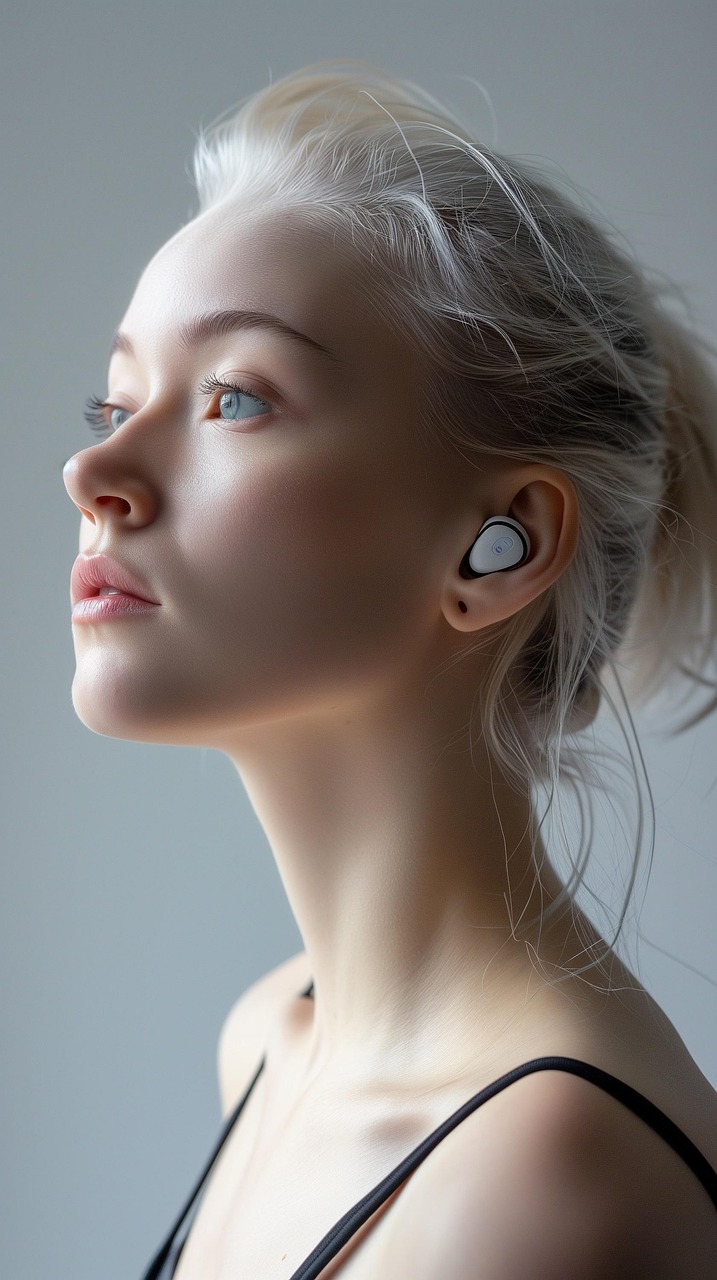
In the past year, the number of people sporting those little white ear-stoppers has increased substantially. Well over half the people I see on the bike path are wearing buds, cycling in a world of their own. Some are jabbering on the phone, but many are silent, listening to Spotify perhaps or tuning into the latest podcast. Completely tuned out, they could be anywhere. No need to bike the scenic backroads or enjoy a drink at a café with friends or family. No need to stroll the streets of New York or hike the mountains of Vermont. The people I’ve encountered with earbuds seem to want this disconnect. Passing them on the bike path or downtown, they stare straight through everyone with never a smile or even a nod to acknowledge the existence of others. Their silence speaks loudly: Leave me alone!
But in public spaces—the bike path, crowded city streets, busy intersections—there is no alone. Tuning out the world could prove fatal, not just for those who sport earbuds, but for the innocent others their “deaf to the world” puts at risk. When passing people on the bike path, cyclists are supposed to call out “On your left!” so other cyclists and walkers know to stick close to the right side. But the earbud cyclists don’t hear the warning. They may drift left at the crucial moment and badly injure, even kill someone, including themselves.
The Only Moment We Ever Have

I’m always looking for hope in the world and during a recent bike ride, I was happy to observe several moms who were cycling with their young children, talking them through the ride in a warm, loving way. Teaching them how to travel the bike path safely and responding when the child pointed out various things that caught their attention—a flat rock placed as a settee along the path that someone had decorated with colorful painted cats. Parent and child were engaged with each other and the larger world. They were fully present in the moment.
And what is life but a succession of moments? Blink and the moment is gone. Go through the days with earbuds embedded, staring at a screen, and your life…is gone. The only moment we ever have is this one. Don’t miss it!
 amyhenrybooks