
One of my great loves is the theatre, so when Ed and I visit London, I spend an entire weekend several months before, sifting through the city’s 241 theatres for “what’s on”: dramas, comedies, musicals and, always, “The Bard”—my beloved Shakespeare. Generally, this means a trip to the Globe Theatre (to which I donated £5 toward its reconstruction nearly fifty years ago when I was a poor student and £5 was a lot). This May, however, I was delighted to find not one but two of Will’s works on stage: Romeo & Juliet at the Globe and Richard II at the Bridge Theatre.
What’s All the Excitement About?

The Bridge Theatre always puts on great shows, but this production was on my absolutely-not-to-be-missed list for two reasons: 1) it was the only Shakespeare play I had never seen and 2) it had achieved a kind of notoriety in its day among Queen Elizabeth and her court for the scene where Henry Bolingbroke deposes King Richard II and has him imprisoned for life after Richard does a lot of bad stuff, including stealing Bolingbroke’s inheritance and banishing him from England. Bolingbroke then seizes the throne as King Henry IV.
The political intrigues and issues of the day are too numerous to go into here. Suffice it to say that there were many who would have been happy to see Elizabeth deposed, or worse. The queen, herself, was recorded as saying, “I am Richard II, know ye not that?” The scene containing Richard II’s forced abdication was banned by the Master of the Revels—a royal official who acted as a censor in Elizabeth’s reign—and stricken from all printed copies.
If all this 16th century intrigue seems like so much long-ago mumbo-jumbo, let me put it in contemporary terms: A movie written now that showed Elon Musk deposing Trump and seizing the Oval Office—how long do you think it would run? How many heads would roll?
I ordered the tix straight away.
The Clock Starts Ticking
6:15 The Evening Begins in High Anticipation

I like to get to the theatre comfortably early, say 7:00 pm for a 7:30 curtain. Stroll up to the bar, order a drink, and relax in a setting often decorated with photos from past theatre “biggies”—Noel Coward, Terence Rattigan, Harold Pinter. I calculated it would take us about 35 minutes to get from our flat to the Bridge Theatre—a simple three stops away on the Tube (London’s subway) with one transfer—and added 10 minutes for good measure. A 6:15 departure for a 7:00 arrival. No sweat. I could practically taste my gin-and-tonic!
What I hadn’t figured into the mix was the chaos we encountered at the Holborn tube station. A platform jam-packed with hundreds of people. Not just 100 or 200 people but more like 500 to 600. The entire Central line was in an uproar, running only a fraction of the usual trains. And the station was reporting major delays everywhere.
Okay, I know the London tube map pretty much like the back of my hand. Plan change: We would take the station’s other line, the Piccadilly, down two stops to Leicester Square, then transfer to the Northern line from there down to Waterloo and walk the south bank of the Thames to the theatre on the far side of London Bridge. It looked very doable—if we hustled.
6:45 As The Crow Flies NOT!
Getting off at Waterloo station, my plan was to walk along the Thames to The Globe Theatre—an unmissable half-way mark—then continue along to the Bridge Theatre, also fronting on the river. Roughly, a tad more than a mile as the crow flies according to my London AtoZ map. Should take us about 20 minutes. Twenty-five max. A quickie pre-theatre quaff still seemed possible.

Only the crow didn’t fly, not straight anyway. Leaving Waterloo station, I was shocked at all the construction work we encountered and its attendant paraphernalia—bulldozers, cranes, stacks of materials and a host of temporary structures to shelter the smaller machinery and tools—which in turn, had given rise to half a dozen food stands to feed the glut of workers. All this stuff obscured our view, making it impossible to see a clear way to the riverbank. It’s not easy to lose something as large as the Thames River but it took more than a few minutes to get our orientation straight. Okay, forget the pre-theatre drink.
We started off, squeezing through gaps wherever possible to follow the Thames. After three or four detours, and now in the waning light, it was difficult to be certain just exactly where we were. I paused every hundred yards or so to look at the “You Are Here” maps displayed on lamp posts. No mention of the Bridge Theatre on any of them. My American cellphone was useless. It doesn’t have internet overseas unless I’m in a shop or café with wifi. But I’m an optimist. Surely the Bridge Theatre would show up after we passed the Globe.
7:00 Where Oh Where Has My Theatre Gone?
Okay, we got to the Globe after forging our way through the crush of Friday night revelers on the riverbank beneath the Millennium Bridge—constructed in 2000 to celebrate, you guessed it, the Millenium!—and continued on through several shopping arcades until I spotted another “You Are Here” poster. Miracle of miracles, it featured the Bridge Theatre! Now all I had to do was find Tooley Street where the London Bridge tube station stood—the station we would have gotten off at ages ago if the mess with the Central Line had never happened. But it did happen, so now we had to wend our way through the streets until we found Tooley.
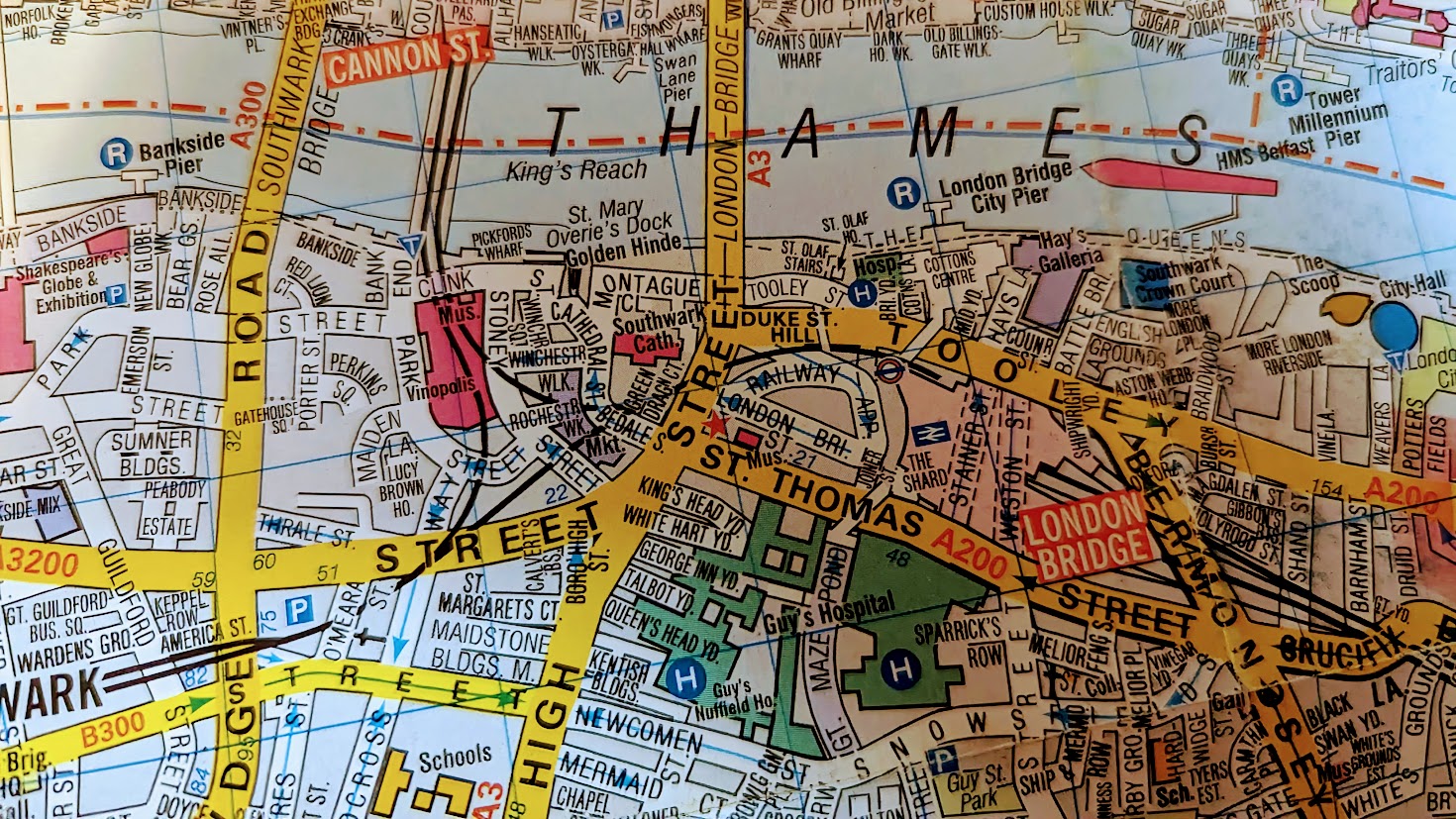
But oh, what a wending way was there, to paraphrase (quite liberally) the Ghost of Hamlet’s father. Again, as the crow flies, it was less than half a mile. Again, the crow failed us. Created through the centuries—the first roads were actually laid down by the Romans almost 2,000 years ago—London streets have a tendency to twists and turns and whimsical name changes mid-road. After we returned to the States, I got the Google map directions for the jaunt from the Globe to the Bridge Theatre. They included eight left turns (one denoted as “sharp”), four right turns, and twelve street or place names with a lot of “continue onto” directives where a street bent or changed names. The last time we had gone to the Bridge Theatre was May 2022 to see Ralph Fiennes in “Straight Line Crazy.” I would have given anything for a straight line that evening, but alas…
7:15 Almost There But Not There

As we drew closer to London Bridge, I continued checking my AtoZ in the near dark—where the hell was Tooley Street? After a few more twists and turns, we came to a wider road with shops and offices on both sides—a throughfare of sorts. I paused at every corner to check the buildings for the street name, something that is usually posted wherever two roads intersect. Five blocks along, I still had not encountered such a sign. During World War II, the Brits had removed the street-name signs in London to confuse the Germans should they invade—well, as a tactic, I can vouch for its success.
Ed, walking ten paces behind, informed me it was 7:20. Ten minutes to curtain.

At last, I saw a man dressed in some sort of city-employee type garb standing in a doorway. I asked him if this was Tooley Street. Yes, he said. We cranked up the pace. Several hundred yards on was the sign I’d been looking for—Potters Fields! A small side street, more like a walkway, Potters Fields led us through a large green space where we trailed several dozen people heading down to… the Bridge Theatre! O happy day! I hustled as I’ve seldom hustled—and I’m a fast walker under even the most relaxed circumstances. But, alas, we arrived—I kid you not—one minute after curtain, and so had to wait in a room adjacent to the auditorium, where we watched the play on a large screen until we could be seated after the first act. About 15 minutes in all.
If we had swum the mile down the Thames instead of walking, we could have covered the distance in 35 minutes, according to Google, but one does not wish to arrive at the theatre soaked to the bone.
All’s Well That Ends Well
Yes, Will Shakespeare had a line—or a play—for pretty much every human situation, and he often used his writing to address the perilous times he lived in. The harassment and murder of Catholics, the torture and imprisonment of those who aided them, the machinations of the queen’s scheming—and greedy—privy council, the quickie trials that mostly favored the prosecution, and the Bubonic Plague.
We in America face a daunting number of our own challenges at present, those of us who champion democracy and the Constitution, who believe all peoples, whatever their skin color, ethnicity, sexual orientation or gender identity deserve respect, healthcare, housing, food, clean water to drink, clean air to breathe, and the freedom to speak their minds. In a nation of such immense wealth—albeit much of it hoarded by the greedy few—anything less is an abomination.
But if we persist. And persist. Keep putting one foot in front of the other, demand something better from our elected leaders—and elect different, better leaders—we just might make it.
Ed and I agreed that Richard II was worth the hassles and frustration. As great as Shakespeare is, though, how much more precious and worth the effort is our democracy?
 amyhenrybooks